Artículo
Long-Term Forecasting of Strong Earthquakes in North America, South America, Japan, Southern China and Northern India With Machine Learning
Velasco Herrera, Victor Manuel; Rossello, Eduardo Antonio ; Orgeira, Maria Julia
; Arioni, Lucas; Soon, Willie; Velasco, Graciela; Rosique de la Cruz, Laura; Zúñiga, Emmanuel; Vera, Carlos
; Orgeira, Maria Julia
; Arioni, Lucas; Soon, Willie; Velasco, Graciela; Rosique de la Cruz, Laura; Zúñiga, Emmanuel; Vera, Carlos
; Orgeira, Maria Julia
; Arioni, Lucas; Soon, Willie; Velasco, Graciela; Rosique de la Cruz, Laura; Zúñiga, Emmanuel; Vera, Carlos
Fecha de publicación:
22/06/2022
Editorial:
Frontiers Media
Revista:
Frontiers in Earth Science
ISSN:
2296-6463
Idioma:
Inglés
Tipo de recurso:
Artículo publicado
Clasificación temática:
Resumen
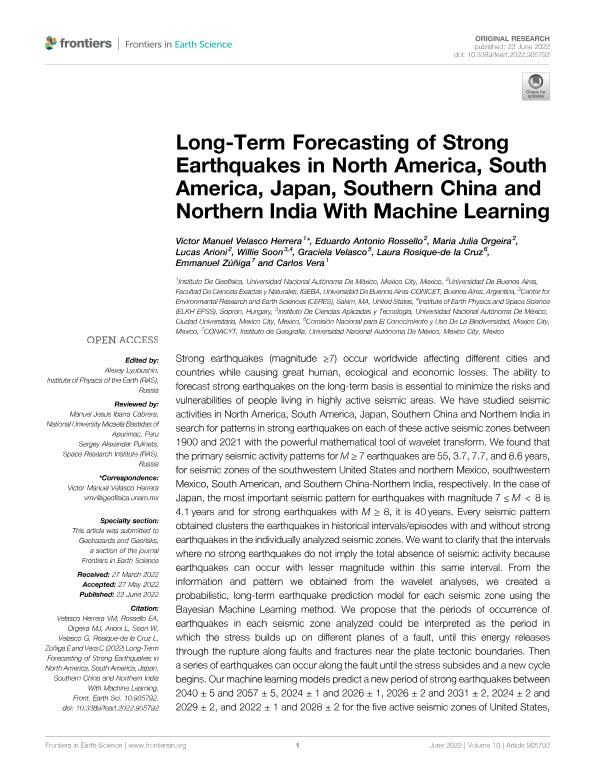
Strong earthquakes (magnitude ≥7) occur worldwide affecting different cities and countries while causing great human, ecological and economic losses. The ability to forecast strong earthquakes on the long-term basis is essential to minimize the risks and vulnerabilities of people living in highly active seismic areas. We have studied seismic activities in North America, South America, Japan, Southern China and Northern India in search for patterns in strong earthquakes on each of these active seismic zones between 1900 and 2021 with the powerful mathematical tool of wavelet transform. We found that the primary seismic activity patterns for M ≥ 7 earthquakes are 55, 3.7, 7.7, and 8.6 years, for seismic zones of the southwestern United States and northern Mexico, southwestern Mexico, South American, and Southern China-Northern India, respectively. In the case of Japan, the most important seismic pattern for earthquakes with magnitude 7 ≤ M (Formula presented.) 8 is 4.1 years and for strong earthquakes with M ≥ 8, it is 40 years. Every seismic pattern obtained clusters the earthquakes in historical intervals/episodes with and without strong earthquakes in the individually analyzed seismic zones. We want to clarify that the intervals where no strong earthquakes do not imply the total absence of seismic activity because earthquakes can occur with lesser magnitude within this same interval. From the information and pattern we obtained from the wavelet analyses, we created a probabilistic, long-term earthquake prediction model for each seismic zone using the Bayesian Machine Learning method. We propose that the periods of occurrence of earthquakes in each seismic zone analyzed could be interpreted as the period in which the stress builds up on different planes of a fault, until this energy releases through the rupture along faults and fractures near the plate tectonic boundaries. Then a series of earthquakes can occur along the fault until the stress subsides and a new cycle begins. Our machine learning models predict a new period of strong earthquakes between 2040 ± 5 and 2057 ± 5, 2024 ± 1 and 2026 ± 1, 2026 ± 2 and 2031 ± 2, 2024 ± 2 and 2029 ± 2, and 2022 ± 1 and 2028 ± 2 for the five active seismic zones of United States, Mexico, South America, Japan, and Southern China and Northern India, respectively. In additon, our methodology can be applied in areas where moderate earthquakes occur, as for the case of the Parkfield section of the San Andreas fault (California, United States). Our methodology explains why a moderate earthquake could never occur in 1988 ± 5 as proposed and why the long-awaited Parkfield earthquake event occurred in 2004. Furthermore, our model predicts that possible seismic events may occur between 2019 and 2031, with a high probability of earthquake events at Parkfield around 2025 ± 2 years.
Archivos asociados

Tamaño:
8.568Mb
Formato:
PDF
Licencia
 Excepto donde se diga explícitamente, este item se publica bajo la siguiente descripción:
Creative Commons Attribution-NonCommercial-ShareAlike 2.5 Unported (CC BY-NC-SA 2.5)
Excepto donde se diga explícitamente, este item se publica bajo la siguiente descripción:
Creative Commons Attribution-NonCommercial-ShareAlike 2.5 Unported (CC BY-NC-SA 2.5)
Identificadores
Colecciones
Articulos(IGEBA)
Articulos de INSTITUTO DE GEOCIENCIAS BASICAS, APLICADAS Y AMBIENTALES DE BS. AS
Articulos de INSTITUTO DE GEOCIENCIAS BASICAS, APLICADAS Y AMBIENTALES DE BS. AS
Citación
Velasco Herrera, Victor Manuel; Rossello, Eduardo Antonio; Orgeira, Maria Julia; Arioni, Lucas; Soon, Willie; et al.; Long-Term Forecasting of Strong Earthquakes in North America, South America, Japan, Southern China and Northern India With Machine Learning; Frontiers Media; Frontiers in Earth Science; 10; 22-6-2022; 1-25
Compartir


Altmétricas