Artículo
Sister chromatid exchanges and chromosomal aberrations in Chinese Hamster Ovary (CHO-K1) cells treated with insecticide pirimicarb

Fecha de publicación:
02/2010
Editorial:
Elsevier Science
Revista:
Journal of Hazardous Materials
ISSN:
0304-3894
Idioma:
Inglés
Tipo de recurso:
Artículo publicado
Clasificación temática:
Resumen
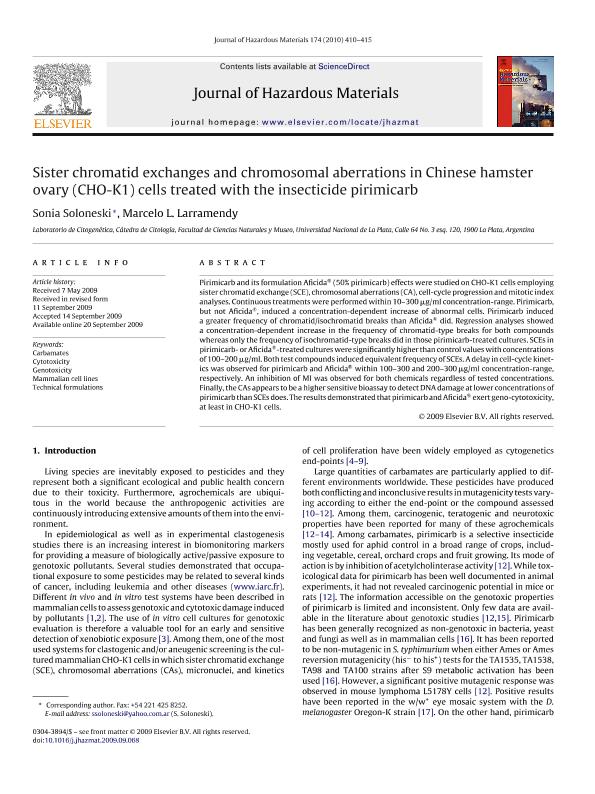
Pirimicarb and its formulation Aficida® (50% pirimicarb) effects were studied on CHO-K1 cells employing sister chromatid exchange (SCE), chromosomal aberrations (CA), cell-cycle progression and mitotic index analyses. Continuous treatments were performed within 10-300 μg/ml concentration-range. Pirimicarb, but not Aficida®, induced a concentration-dependent increase of abnormal cells. Pirimicarb induced a greater frequency of chromatid/isochromatid breaks than Aficida® did. Regression analyses showed a concentration-dependent increase in the frequency of chromatid-type breaks for both compounds whereas only the frequency of isochromatid-type breaks did in those pirimicarb-treated cultures. SCEs in pirimicarb- or Aficida®-treated cultures were significantly higher than control values with concentrations of 100-200 μg/ml. Both test compounds induced equivalent frequency of SCEs. A delay in cell-cycle kinetics was observed for pirimicarb and Aficida® within 100-300 and 200-300 μg/ml concentration-range, respectively. An inhibition of MI was observed for both chemicals regardless of tested concentrations. Finally, the CAs appears to be a higher sensitive bioassay to detect DNA damage at lower concentrations of pirimicarb than SCEs does. The results demonstrated that pirimicarb and Aficida® exert geno-cytotoxicity, at least in CHO-K1 cells.
Archivos asociados

Tamaño:
221.8Kb
Formato:
PDF
Licencia
 Excepto donde se diga explícitamente, este item se publica bajo la siguiente descripción:
Creative Commons Attribution-NonCommercial-ShareAlike 2.5 Unported (CC BY-NC-SA 2.5)
Excepto donde se diga explícitamente, este item se publica bajo la siguiente descripción:
Creative Commons Attribution-NonCommercial-ShareAlike 2.5 Unported (CC BY-NC-SA 2.5)
Identificadores
Colecciones
Articulos(CCT - LA PLATA)
Articulos de CTRO.CIENTIFICO TECNOL.CONICET - LA PLATA
Articulos de CTRO.CIENTIFICO TECNOL.CONICET - LA PLATA
Citación
Soloneski, Sonia Maria Elsa; Larramendy, Marcelo Luis; Sister chromatid exchanges and chromosomal aberrations in Chinese Hamster Ovary (CHO-K1) cells treated with insecticide pirimicarb; Elsevier Science; Journal of Hazardous Materials; 174; 1-3; 2-2010; 410-415
Compartir


Altmétricas