Artículo
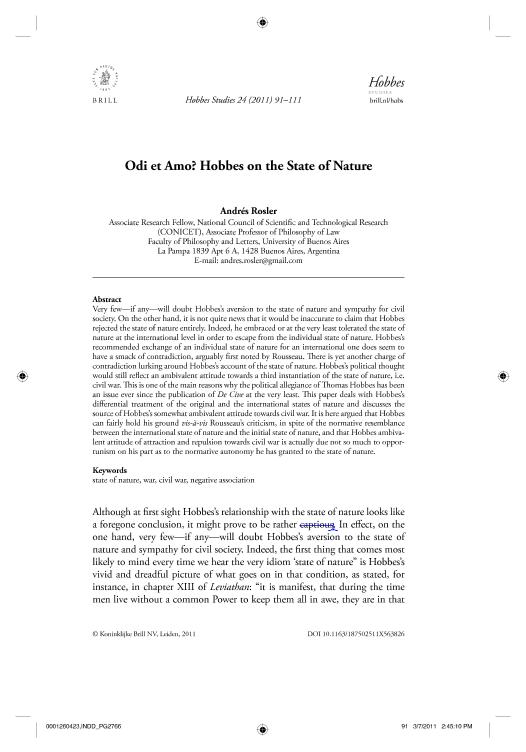
Odi et Amo? Hobbes on the state of nature

Fecha de publicación:
06/2011
Editorial:
Brill Academic Publishers
Revista:
Hobbes Studies
ISSN:
0921-5891
e-ISSN:
1875-0257
Idioma:
Inglés
Tipo de recurso:
Artículo publicado
Clasificación temática:
Resumen
Very few-if any-will doubt Hobbes's aversion to the state of nature and sympathy for civil society. On the other hand, it is not quite news that it would be inaccurate to claim that Hobbes rejected the state of nature entirely. Indeed, he embraced or at the very least tolerated the state of nature at the international level in order to escape from the individual state of nature. Hobbes's recommended exchange of an individual state of nature for an international one does seem to have a smack of contradiction, arguably first noted by Rousseau. There is yet another charge of contradiction lurking around Hobbes's account of the state of nature. Hobbes's political thought would still reflect an ambivalent attitude towards a third instantiation of the state of nature, i.e. civil war. This is one of the main reasons why the political allegiance of Thomas Hobbes has been an issue ever since the publication of De Cive at the very least. This paper deals with Hobbes's differential treatment of the original and the international states of nature and discusses the source of Hobbes's somewhat ambivalent attitude towards civil war. It is here argued that Hobbes can fairly hold his ground vis-à-vis Rousseau's criticism, in spite of the normative resemblance between the international state of nature and the initial state of nature, and that Hobbes ambivalent attitude of attraction and repulsion towards civil war is actually due not so much to opportunism on his part as to the normative autonomy he has granted to the state of nature.
Palabras clave:
CIVIL WAR
,
NEGATIVE ASSOCIATION
,
STATE OF NATURE
,
WAR
Archivos asociados

Tamaño:
557.6Kb
Formato:
PDF
Licencia
 Excepto donde se diga explícitamente, este item se publica bajo la siguiente descripción:
Creative Commons Attribution-NonCommercial-ShareAlike 2.5 Unported (CC BY-NC-SA 2.5)
Excepto donde se diga explícitamente, este item se publica bajo la siguiente descripción:
Creative Commons Attribution-NonCommercial-ShareAlike 2.5 Unported (CC BY-NC-SA 2.5)
Identificadores
Colecciones
Articulos(SEDE CENTRAL)
Articulos de SEDE CENTRAL
Articulos de SEDE CENTRAL
Citación
Rosler, Andres Bernardo; Odi et Amo? Hobbes on the state of nature; Brill Academic Publishers; Hobbes Studies; 24; 1; 6-2011; 91-111
Compartir


Altmétricas