Artículo
MR1-restricted MAIT cells display ligand discrimination and pathogen selectivity through distinct T cell receptor usage
Gold, Marielle C.; McLaren, James E.; Reistetter, Joseph A.; Smyk Pearson, Sue; Ladell, Kristin; Swarbrick, Gwendolyn M.; Yu, Yik Y. L.; Hansen, Ted H.; Lund, Ole; Nielsen, Morten ; Gerritsen, Bram; Kesmir, Can; Miles, John J.; Lewinsohn, Deborah A.; Price, David A.; Lewinsohn, David M.
; Gerritsen, Bram; Kesmir, Can; Miles, John J.; Lewinsohn, Deborah A.; Price, David A.; Lewinsohn, David M.
Fecha de publicación:
07/2014
Editorial:
Rockefeller Univ Press
Revista:
Journal Of Experimental Medicine
ISSN:
0022-1007
Idioma:
Inglés
Tipo de recurso:
Artículo publicado
Clasificación temática:
Resumen
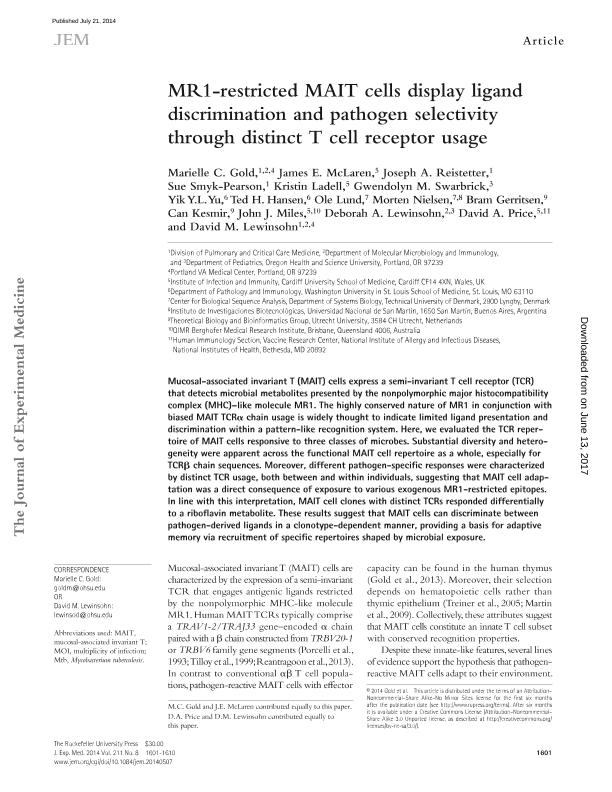
Mucosal-associated invariant T (MAIT) cells express a semi-invariant T cell receptor (TCR) that detects microbial metabolites presented by the nonpolymorphic major histocompatibility complex (MHC)–like molecule MR1. The highly conserved nature of MR1 in conjunction with biased MAIT TCRα chain usage is widely thought to indicate limited ligand presentation and discrimination within a pattern-like recognition system. Here, we evaluated the TCR repertoire of MAIT cells responsive to three classes of microbes. Substantial diversity and heterogeneity were apparent across the functional MAIT cell repertoire as a whole, especially for TCRβ chain sequences. Moreover, different pathogen-specific responses were characterized by distinct TCR usage, both between and within individuals, suggesting that MAIT cell adaptation was a direct consequence of exposure to various exogenous MR1-restricted epitopes. In line with this interpretation, MAIT cell clones with distinct TCRs responded differentially to a riboflavin metabolite. These results suggest that MAIT cells can discriminate between pathogen-derived ligands in a clonotype-dependent manner, providing a basis for adaptive memory via recruitment of specific repertoires shaped by microbial exposure.
Palabras clave:
Mait
,
T Cell
,
T Cell Receptor
Archivos asociados

Tamaño:
6.800Mb
Formato:
PDF
Licencia
 Excepto donde se diga explícitamente, este item se publica bajo la siguiente descripción:
Creative Commons Attribution-NonCommercial-ShareAlike 2.5 Unported (CC BY-NC-SA 2.5)
Excepto donde se diga explícitamente, este item se publica bajo la siguiente descripción:
Creative Commons Attribution-NonCommercial-ShareAlike 2.5 Unported (CC BY-NC-SA 2.5)
Identificadores
Colecciones
Articulos(IQUIFIB)
Articulos de INST.DE QUIMICA Y FISICO-QUIMICA BIOLOGICAS "PROF. ALEJANDRO C. PALADINI"
Articulos de INST.DE QUIMICA Y FISICO-QUIMICA BIOLOGICAS "PROF. ALEJANDRO C. PALADINI"
Citación
Gold, Marielle C.; McLaren, James E.; Reistetter, Joseph A.; Smyk Pearson, Sue; Ladell, Kristin; et al.; MR1-restricted MAIT cells display ligand discrimination and pathogen selectivity through distinct T cell receptor usage; Rockefeller Univ Press; Journal Of Experimental Medicine; 211; 8; 7-2014; 1601-1610
Compartir


Altmétricas