Artículo
NetTepi: an integrated method for the prediction of T-cell epitopes

Fecha de publicación:
08/2014
Editorial:
Springer Verlag Berlín
Revista:
Immunogenetics
ISSN:
0093-7711
e-ISSN:
1432-1211
Idioma:
Inglés
Tipo de recurso:
Artículo publicado
Clasificación temática:
Resumen
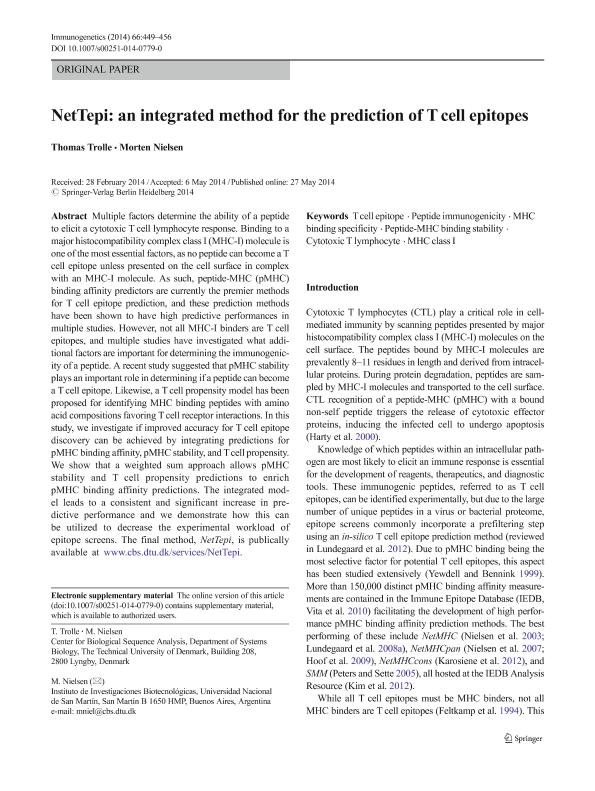
Multiple factors determine the ability of a peptide to elicit a cytotoxic T cell lymphocyte response. Binding to a major histocompatibility complex class I (MHC-I) molecule is one of the most essential factors, as no peptide can become a T cell epitope unless presented on the cell surface in complex with an MHC-I molecule. As such, peptide-MHC (pMHC) binding affinity predictors are currently the premier methods for T cell epitope prediction, and these prediction methods have been shown to have high predictive performances in multiple studies. However, not all MHC-I binders are T cell epitopes, and multiple studies have investigated what additional factors are important for determining the immunogenicity of a peptide. A recent study suggested that pMHC stability plays an important role in determining if a peptide can become a T cell epitope. Likewise, a T cell propensity model has been proposed for identifying MHC binding peptides with amino acid compositions favoring T cell receptor interactions. In this study, we investigate if improved accuracy for T cell epitope discovery can be achieved by integrating predictions for pMHC binding affinity, pMHC stability, and T cell propensity. We show that a weighted sum approach allows pMHC stability and T cell propensity predictions to enrich pMHC binding affinity predictions. The integrated model leads to a consistent and significant increase in predictive performance and we demonstrate how this can be utilized to decrease the experimental workload of epitope screens. The final method, NetTepi, is publically available at www.cbs.dtu.dk/services/NetTepi
Archivos asociados

Tamaño:
284.0Kb
Formato:
PDF
Licencia
 Excepto donde se diga explícitamente, este item se publica bajo la siguiente descripción:
Creative Commons Attribution-NonCommercial-ShareAlike 2.5 Unported (CC BY-NC-SA 2.5)
Excepto donde se diga explícitamente, este item se publica bajo la siguiente descripción:
Creative Commons Attribution-NonCommercial-ShareAlike 2.5 Unported (CC BY-NC-SA 2.5)
Identificadores
Colecciones
Articulos(IQUIFIB)
Articulos de INST.DE QUIMICA Y FISICO-QUIMICA BIOLOGICAS "PROF. ALEJANDRO C. PALADINI"
Articulos de INST.DE QUIMICA Y FISICO-QUIMICA BIOLOGICAS "PROF. ALEJANDRO C. PALADINI"
Citación
Trolle, Thomas; Nielsen, Morten; NetTepi: an integrated method for the prediction of T-cell epitopes; Springer Verlag Berlín; Immunogenetics; 66; 7; 8-2014; 449-456
Compartir


Altmétricas