Artículo
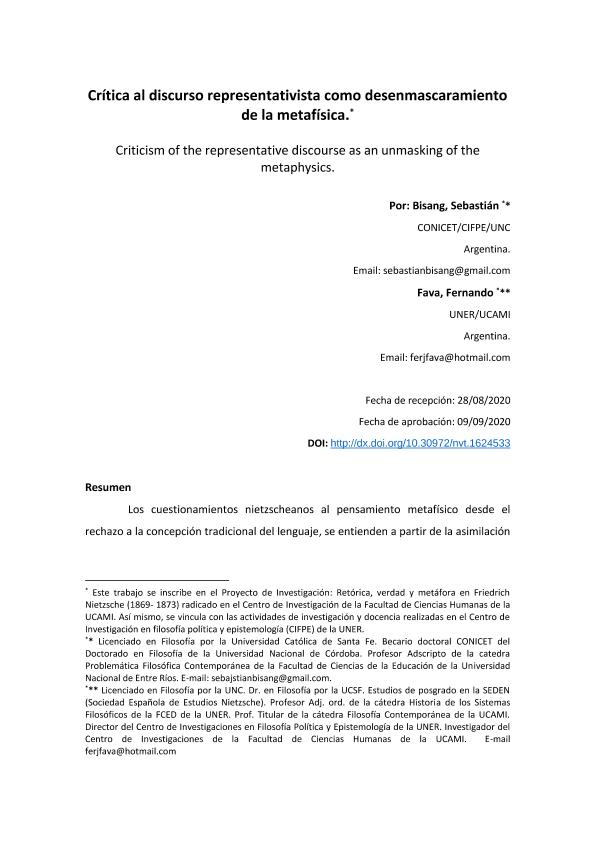
Los cuestionamientos nietzscheanos al pensamiento metafísico desde el rechazo a la concepción tradicional del lenguaje, se entienden a partir de la asimilación crítica que Nietzsche realiza de pensadores inscriptos en la órbita del neokantismo como podrían considerarse a Schopenhauer, Hartmann o Lange. Durante los años 1865-1872, de un modo muy intuitivo, con fórmulas heredadas de su admirado maestro Schopenhauer, y bajo el influjo del proyecto cultural wagneriano, Nietzsche va combinando su bagaje cultural con lecturas de pensadores de cuño crítico como Lange o Hartmann. Ensayando su propio pensamiento desde bocetos no exentos de tensiones y confrontaciones, como también de intuiciones geniales. Un universo de lecturas que poco tiempo después (1873) el joven catedrático de Basilea, reorientará desde los aspectos tropológicos del lenguaje, a partir de su recepción de Die Sprache als Kunst de G. Gerber. En el siguiente artículo, nos proponemos trazar una génesis de su crítica al “pensamiento metafísico” desde la reconstrucción de sus preocupaciones tempranas en torno al conocimiento. Focalizándonos en los Nachgelassene Fragmente de este período (1865-1875), intentaremos reconstruir la poliédrica recepción nietzscheana de la crítica epistemológica asumida por Lange, el valor de lo instintivo-inconsciente en la configuración de las representaciones sostenida por Hartmann y el carácter ilusorio del conocimiento propuesto por Schopenhauer. Un entramado de ideas que bien reflejan los póstumos de esta etapa y que, si tomamos como hilo genealógico-interpretativo sus preocupaciones lingüísticas, se revelarán como la verdadera geología del mapa conceptual explayado en Über Wahrheit und Lüge im aussermoralischen Sinne. Escrito en el que Nietzsche no sólo sintetiza, concretiza y clarifica este camino de búsqueda, sino que prefigura los parámetros, la cartografía, de su pensamiento maduro. The Nietzschean questions to metaphysical thought from the rejection of the traditional conception of language, are understood from the critical assimilation that Nietzsche makes of thinkers enrolled in the orbit of neo-Kantianism as Schopenhauer, Hartmann or Lange. During the years 1865-1872, in a very intuitive way, with formulas inherited from his admired teacher Schopenhauer, and under the influence of the Wagnerian cultural project, Nietzsche combines his cultural background with readings of critical thinkers such as Lange or Hartmann. Rehearsing his own thinking from sketches that are not without tension and confrontations, as well as great insights. A universe of readings that a short time later (1873) the young professor from Basel, reoriented from the tropological aspects of language, from his reception of Die Sprache als Kunst by G. Gerber. In the following article, we propose to trace a genesis of his critique of "metaphysical thought" from the reconstruction of his early concerns about knowledge. Focusing on the Nachgelassene Fragmente of this period (1865-1875), we will try to reconstruct the multifaceted Nietzschean reception of the epistemological critique assumed by Lange, the value of the instinctual-unconscious in the configuration of representations sustained by Hartmann and the illusory character of knowledge proposed by Schopenhauer. A network of ideas that well reflect the posthumous fragments of this stage and that, if we take their linguistic concerns as a genealogical-interpretative thread, will reveal themselves as the true geology of the conceptual map expanded in Über Wahrheit und Lüge im aussermoralischen Sinne. Work in which Nietzsche not only synthesizes, concretizes and clarifies this path of search, but prefigures the parameters, the cartography, of his mature thought.
Crítica al discurso representativista como desenmascaramiento de la metafísica
Título:
Criticism of the representative discourse as an unmasking of the metaphysics

Fecha de publicación:
11/2020
Editorial:
Universidad Nacional del Nordeste. Facultad de Humanidades. Instituto de Filosofía
Revista:
Nuevo Itinerario
ISSN:
1850-3578
Idioma:
Español
Tipo de recurso:
Artículo publicado
Clasificación temática:
Resumen
Palabras clave:
NIETZSCHE
,
VERDAD
,
CONOCIMIENTO
,
FISIOLOGÍA
Archivos asociados

Tamaño:
559.5Kb
Formato:
PDF
Licencia
 Excepto donde se diga explícitamente, este item se publica bajo la siguiente descripción:
Creative Commons Attribution-NonCommercial 2.5 Unported (CC BY-NC 2.5)
Excepto donde se diga explícitamente, este item se publica bajo la siguiente descripción:
Creative Commons Attribution-NonCommercial 2.5 Unported (CC BY-NC 2.5)
Identificadores
Colecciones
Articulos(SEDE CENTRAL)
Articulos de SEDE CENTRAL
Articulos de SEDE CENTRAL
Citación
Bisang, Sebastián Pablo; Fava, Fernando Juan; Crítica al discurso representativista como desenmascaramiento de la metafísica; Universidad Nacional del Nordeste. Facultad de Humanidades. Instituto de Filosofía; Nuevo Itinerario; 16; 2; 11-2020; 27-51
Compartir


Altmétricas