Artículo
Band structure and electronic transport across Ta2O5/Nb:SrTiO3 interfaces
Miron, Dror; Cohen Azarzar, Dana; Segev, Noa; Baskin, Maria; Palumbo, Félix Roberto Mario ; Yalon, Eilam; Kornblum, Lior
; Yalon, Eilam; Kornblum, Lior
Fecha de publicación:
07/2020
Editorial:
American Institute of Physics
Revista:
Journal of Applied Physics
ISSN:
0021-8979
Idioma:
Inglés
Tipo de recurso:
Artículo publicado
Clasificación temática:
Resumen
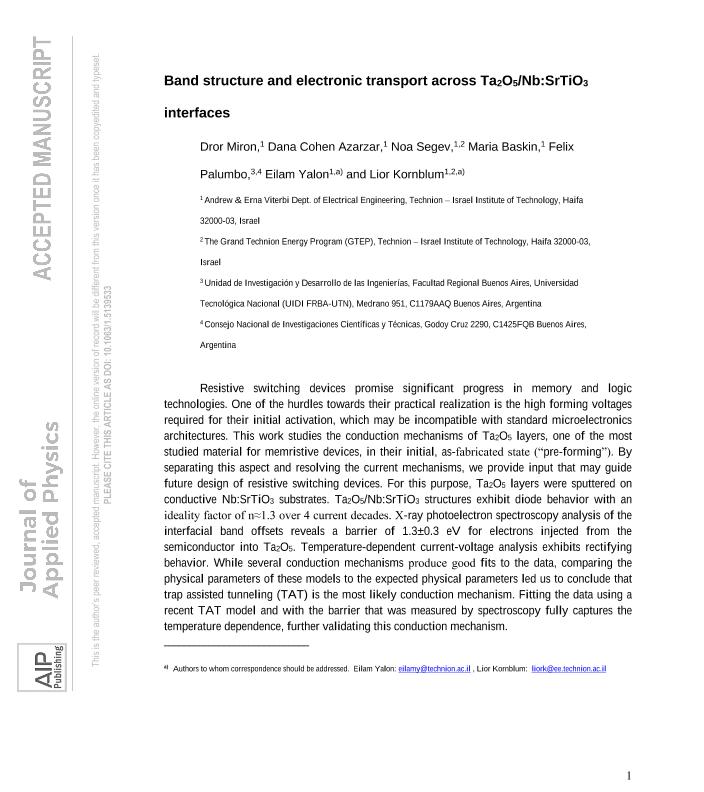
Resistive switching devices promise significant progress in memory and logic technologies. One of the hurdles toward their practical realization is the high forming voltages required for their initial activation, which may be incompatible with standard microelectronic architectures. This work studies the conduction mechanisms of Ta2O5 layers, one of the most studied materials for memristive devices, in their initial, as-fabricated state (“pre-forming”). By separating this aspect and resolving the current mechanisms, we provide the input that may guide future design of resistive switching devices. For this purpose, Ta2O5 layers were sputtered on conductive Nb:SrTiO3 substrates. Ta2O5/Nb:SrTiO3 structures exhibit diode behavior with an ideality factor of n ≈ 1.3 over four current decades. X-ray photoelectron spectroscopy analysis of the interfacial band offsets reveals a barrier of 1.3 ± 0.3 eV for electrons injected from the semiconductor into Ta2O5. Temperature-dependent current–voltage analysis exhibits rectifying behavior. While several conduction mechanisms produce good fits to the data, comparing the physical parameters of these models to the expected physical parameters led us to conclude that trap-assisted tunneling (TAT) is the most likely conduction mechanism. Fitting the data using a recent TAT model and with the barrier that was measured by spectroscopy fully captures the temperature dependence, further validating this conduction mechanism.
Palabras clave:
STO
,
BAND STRUCTURE
,
STO INTERFACES
Archivos asociados

Tamaño:
1.291Mb
Formato:
PDF
Licencia
 Excepto donde se diga explícitamente, este item se publica bajo la siguiente descripción:
Creative Commons Attribution-NonCommercial-ShareAlike 2.5 Unported (CC BY-NC-SA 2.5)
Excepto donde se diga explícitamente, este item se publica bajo la siguiente descripción:
Creative Commons Attribution-NonCommercial-ShareAlike 2.5 Unported (CC BY-NC-SA 2.5)
Identificadores
Colecciones
Articulos(SEDE CENTRAL)
Articulos de SEDE CENTRAL
Articulos de SEDE CENTRAL
Citación
Miron, Dror; Cohen Azarzar, Dana; Segev, Noa; Baskin, Maria; Palumbo, Félix Roberto Mario; et al.; Band structure and electronic transport across Ta2O5/Nb:SrTiO3 interfaces; American Institute of Physics; Journal of Applied Physics; 128; 4; 7-2020; 1-16
Compartir


Altmétricas