Artículo
Multi-gene metabolic engineering of tomato plants results in increased fruit yield up to 23%
Vallarino, José G.; Kubiszewski Jakubiak, Szymon; Ruf, Stephanie; Rößner, Margit; Timm, Stefan; Bauwe, Hermann; Carrari, Fernando Oscar ; Rentsch, Doris; Bock, Ralph; Sweetlove, Lee J.; Fernie, Alisdair R.
; Rentsch, Doris; Bock, Ralph; Sweetlove, Lee J.; Fernie, Alisdair R.
Fecha de publicación:
12/2020
Editorial:
Nature Research
Revista:
Scientific Reports
ISSN:
2045-2322
Idioma:
Inglés
Tipo de recurso:
Artículo publicado
Clasificación temática:
Resumen
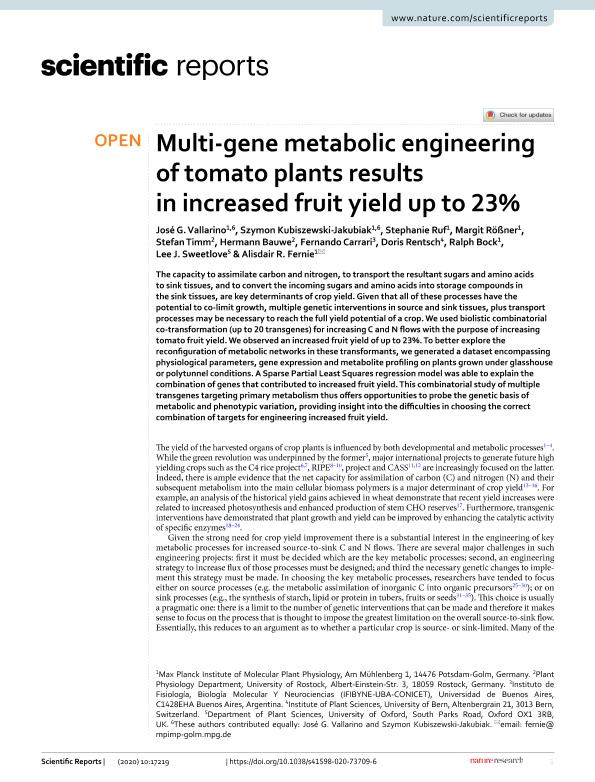
The capacity to assimilate carbon and nitrogen, to transport the resultant sugars and amino acids to sink tissues, and to convert the incoming sugars and amino acids into storage compounds in the sink tissues, are key determinants of crop yield. Given that all of these processes have the potential to co-limit growth, multiple genetic interventions in source and sink tissues, plus transport processes may be necessary to reach the full yield potential of a crop. We used biolistic combinatorial co-transformation (up to 20 transgenes) for increasing C and N flows with the purpose of increasing tomato fruit yield. We observed an increased fruit yield of up to 23%. To better explore the reconfiguration of metabolic networks in these transformants, we generated a dataset encompassing physiological parameters, gene expression and metabolite profiling on plants grown under glasshouse or polytunnel conditions. A Sparse Partial Least Squares regression model was able to explain the combination of genes that contributed to increased fruit yield. This combinatorial study of multiple transgenes targeting primary metabolism thus offers opportunities to probe the genetic basis of metabolic and phenotypic variation, providing insight into the difficulties in choosing the correct combination of targets for engineering increased fruit yield.
Palabras clave:
Multi‑gene
,
Metabolic engineering
,
Tomato plants
Archivos asociados

Tamaño:
5.926Mb
Formato:
PDF
Licencia
 Excepto donde se diga explícitamente, este item se publica bajo la siguiente descripción:
Creative Commons Attribution 2.5 Unported (CC BY 2.5)
Excepto donde se diga explícitamente, este item se publica bajo la siguiente descripción:
Creative Commons Attribution 2.5 Unported (CC BY 2.5)
Identificadores
Colecciones
Articulos(IFIBYNE)
Articulos de INST.DE FISIOL., BIOL.MOLECULAR Y NEUROCIENCIAS
Articulos de INST.DE FISIOL., BIOL.MOLECULAR Y NEUROCIENCIAS
Citación
Vallarino, José G.; Kubiszewski Jakubiak, Szymon; Ruf, Stephanie; Rößner, Margit; Timm, Stefan; et al.; Multi-gene metabolic engineering of tomato plants results in increased fruit yield up to 23%; Nature Research; Scientific Reports; 10; 1; 12-2020; 1-18
Compartir


Altmétricas