Artículo
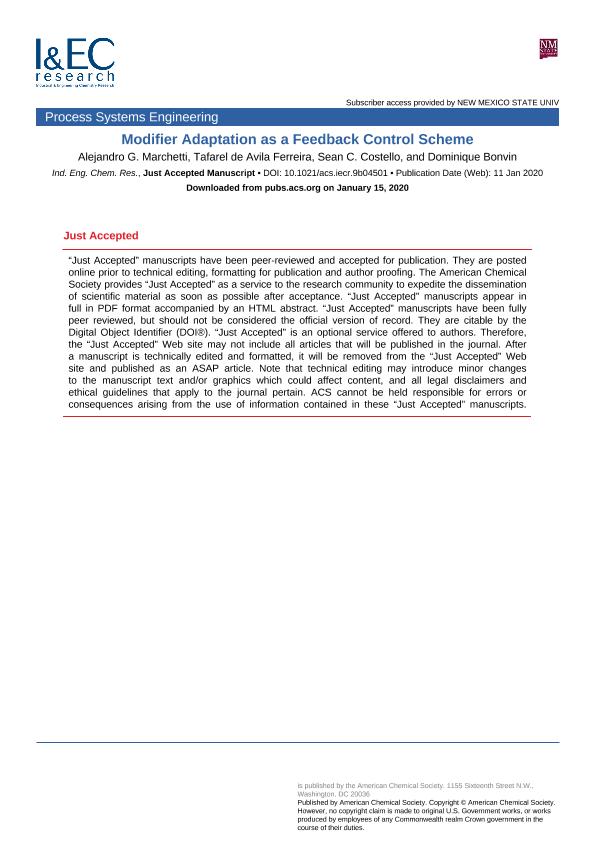
Modifier Adaptation as a Feedback Control Scheme

Fecha de publicación:
02/2020
Editorial:
American Chemical Society
Revista:
Industrial & Engineering Chemical Research
ISSN:
0888-5885
Idioma:
Inglés
Tipo de recurso:
Artículo publicado
Clasificación temática:
Resumen
As a real-time optimization technique, modifier adaptation (MA) has gained much significance in recent years. This is mainly due to the fact that MA can deal explicitly with structural plant-model mismatch and unknown disturbances. MA is an iterative technique that is ideally suited to real-life applications. Its two main features are the way measurements are used to correct the model and the role played by the model in actually computing the next inputs. This paper analyzes these two features and shows that, although MA computes the next inputs via numerical optimization, it can be viewed as a feedback control scheme, that is, optimization implements tracking of the plant Karush-Kuhn-Tucker (KKT) conditions. As a result, the role of the model is downplayed to the point that model accuracy is not an important issue. The key issues are gradient estimation and model adequacy, the latter requiring that the model possesses the correct curvature of the cost function at the plant optimum. The main role of optimization is to identify the proper set of controlled variables (the active constraints and reduced gradients) as these might change with the operating point and disturbances. Thanks to this reduced requirement on model accuracy, MA is ideally suited to drive real-life processes to optimality. This is illustrated through two experimental systems with very different optimization features, namely, a commercial fuel-cell system and an experimental kite setup for harnessing wind energy.
Archivos asociados

Tamaño:
1.943Mb
Formato:
PDF
Licencia
 Excepto donde se diga explícitamente, este item se publica bajo la siguiente descripción:
Atribución-NoComercial-SinDerivadas 2.5 Argentina (CC BY-NC-ND 2.5 AR)
Excepto donde se diga explícitamente, este item se publica bajo la siguiente descripción:
Atribución-NoComercial-SinDerivadas 2.5 Argentina (CC BY-NC-ND 2.5 AR)
Identificadores
Colecciones
Articulos(CIFASIS)
Articulos de CENTRO INT.FRANCO ARG.D/CS D/L/INF.Y SISTEM.
Articulos de CENTRO INT.FRANCO ARG.D/CS D/L/INF.Y SISTEM.
Citación
Marchetti, Alejandro Gabriel; de Avila Ferreira, T.; Costello, Sergio Gustavo; Bonvin, Dominique; Modifier Adaptation as a Feedback Control Scheme; American Chemical Society; Industrial & Engineering Chemical Research; 59; 6; 2-2020; 2261-2274
Compartir


Altmétricas