Artículo
Representation of spatial sequences using nested rules in human prefrontal cortex
Wang, Liping; Amalric, Marie; Fang, Wen; Jiang, Xinjian; Pallier, Christophe; Figueira, Santiago ; Sigman, Mariano
; Dehaene, Stanislas
; Sigman, Mariano
; Dehaene, Stanislas
; Sigman, Mariano
; Dehaene, Stanislas
Fecha de publicación:
02/2019
Editorial:
Academic Press Inc Elsevier Science
Revista:
Journal Neuroimag
ISSN:
1053-8119
Idioma:
Inglés
Tipo de recurso:
Artículo publicado
Clasificación temática:
Resumen
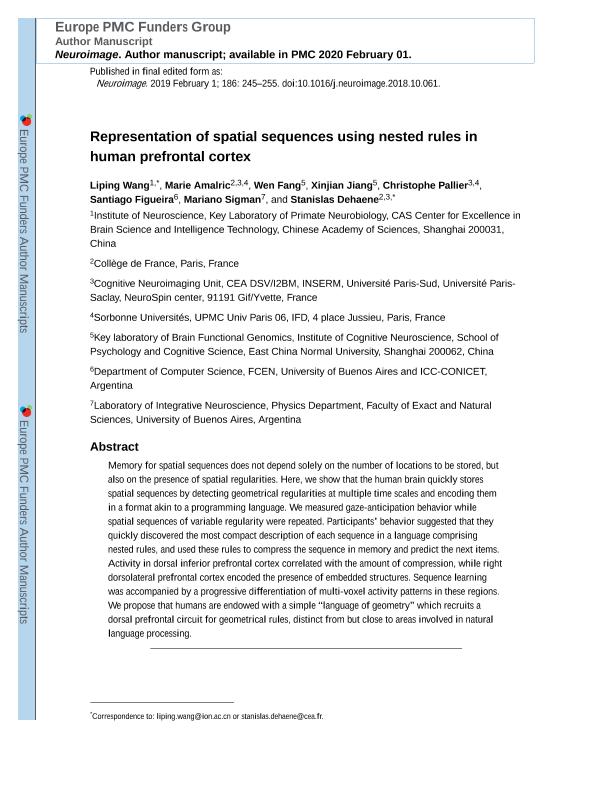
Memory for spatial sequences does not depend solely on the number of locations to be stored, but also on the presence of spatial regularities. Here, we show that the human brain quickly stores spatial sequences by detecting geometrical regularities at multiple time scales and encoding them in a format akin to a programming language. We measured gaze-anticipation behavior while spatial sequences of variable regularity were repeated. Participants’ behavior suggested that they quickly discovered the most compact description of each sequence in a language comprising nested rules, and used these rules to compress the sequence in memory and predict the next items. Activity in dorsal inferior prefrontal cortex correlated with the amount of compression, while right dorsolateral prefrontal cortex encoded the presence of embedded structures. Sequence learning was accompanied by a progressive differentiation of multi-voxel activity patterns in these regions. We propose that humans are endowed with a simple “language of geometry” which recruits a dorsal prefrontal circuit for geometrical rules, distinct from but close to areas involved in natural language processing
Palabras clave:
spatial sequences
,
human prefrontal cortex
Archivos asociados

Tamaño:
1.970Mb
Formato:
PDF
Licencia
 Excepto donde se diga explícitamente, este item se publica bajo la siguiente descripción:
Atribución-NoComercial-SinDerivadas 2.5 Argentina (CC BY-NC-ND 2.5 AR)
Excepto donde se diga explícitamente, este item se publica bajo la siguiente descripción:
Atribución-NoComercial-SinDerivadas 2.5 Argentina (CC BY-NC-ND 2.5 AR)
Identificadores
Colecciones
Articulos(ICC)
Articulos de INSTITUTO DE INVESTIGACION EN CIENCIAS DE LA COMPUTACION
Articulos de INSTITUTO DE INVESTIGACION EN CIENCIAS DE LA COMPUTACION
Articulos(SEDE CENTRAL)
Articulos de SEDE CENTRAL
Articulos de SEDE CENTRAL
Citación
Wang, Liping; Amalric, Marie; Fang, Wen; Jiang, Xinjian; Pallier, Christophe; et al.; Representation of spatial sequences using nested rules in human prefrontal cortex; Academic Press Inc Elsevier Science; Journal Neuroimag; 186; 2-2019; 245-255
Compartir


Altmétricas