Artículo
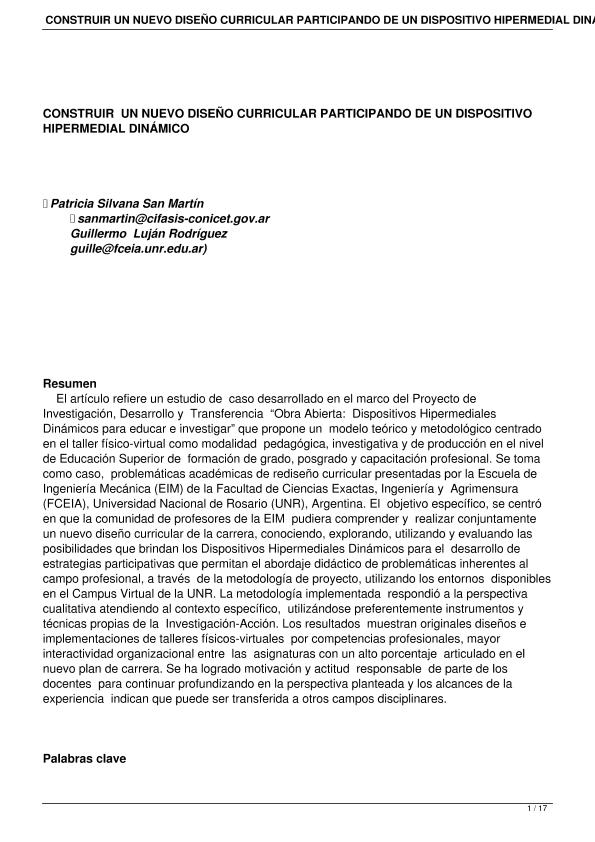
El artículo refiere un estudio de caso desarrollado en el marco del Proyecto de Investigación, Desarrollo y Transferencia “Obra Abierta: Dispositivos Hipermediales Dinámicos para educar e investigar” que propone un modelo teórico y metodológico centrado en el taller físico-virtual como modalidad pedagógica, investigativa y de producción en el nivel de Educación Superior de formación de grado, posgrado y capacitación profesional. Se toma como caso, problemáticas académicas de rediseño curricular presentadas por la Escuela de Ingeniería Mecánica (EIM) de la Facultad de Ciencias Exactas, Ingeniería y Agrimensura (FCEIA), Universidad Nacional de Rosario (UNR), Argentina. El objetivo específico, se centró en que la comunidad de profesores de la EIM pudiera comprender y realizar conjuntamente un nuevo diseño curricular de la carrera, conociendo, explorando, utilizando y evaluando las posibilidades que brindan los Dispositivos Hipermediales Dinámicos para el desarrollo de estrategias participativas que permitan el abordaje didáctico de problemáticas inherentes al campo profesional, a través de la metodología de proyecto, utilizando los entornos disponibles en el Campus Virtual de la UNR. La metodología implementada respondió a la perspectiva cualitativa atendiendo al contexto específico, utilizándose preferentemente instrumentos y técnicas propias de la Investigación-Acción. Los resultados muestran originales diseños e implementaciones de talleres físicos-virtuales por competencias profesionales, mayor interactividad organizacional entre las asignaturas con un alto porcentaje articulado en el nuevo plan de carrera. Se ha logrado motivación y actitud responsable de parte de los docentes para continuar profundizando en la perspectiva planteada y los alcances de la experiencia indican que puede ser transferida a otros campos disciplinares. This article refers to a case study developed within the Project of Research, Development, and Transfer “Obra Abierta: Dynamic Hypermedia Devices for education and research”. This projects proposes a theoretical and methodological model centered on virtual and real life workshops as pedagogical, research and knowledge construction model for the education and training of undergraduates, graduates, and professionals. The case is based on the academic issues of the design process of the new curriculum for the School of Mechanical Engineering of the College of Exact Sciences, Engineering and Surveying of the National University of Rosario, Argentina (Escuela de Ingeniería Mecánica - EIM - Facultad de Ciencias Exactas, Ingeniería y Agrimensura - FCEIA - de la Universidad Nacional de Rosario - UNR). The specific objective was that teachers from the EIM could comprehend and develop the syllabus design of their courses for the new curriculum exploring, using and evaluating the possibilities of the Dynamic Hypermedia Devices from the project, while developing participative strategies and considering the development of the students’ professional skills, by using the tools available on the Virtual Campus of the UNR. The implemented methodology was developed with a quality perspective in mind, and taking into account the case context. The results show several original designs and implementations of virtual and real life workgroups based on skills, and a greater degree of organizational interaction between the different courses, which articulate better with the new curriculum. It was also achieved a high level of motivation and a responsible attitude from the teachers, that would allow to continue the process. The results obtained also suggest that the experience could be transferred to other fields of study.
Construir un nuevo diseño curricular participando de un dispositivo hipermedial dinámico

Fecha de publicación:
09/2009
Editorial:
Instituto Latinoamericano de Investigación Educativa
Revista:
Cognición
ISSN:
1850-1974
Idioma:
Español
Tipo de recurso:
Artículo publicado
Clasificación temática:
Resumen
Archivos asociados

Tamaño:
402.4Kb
Formato:
PDF
Licencia
 Excepto donde se diga explícitamente, este item se publica bajo la siguiente descripción:
Creative Commons Attribution-NonCommercial-ShareAlike 2.5 Unported (CC BY-NC-SA 2.5)
Excepto donde se diga explícitamente, este item se publica bajo la siguiente descripción:
Creative Commons Attribution-NonCommercial-ShareAlike 2.5 Unported (CC BY-NC-SA 2.5)
Identificadores
Colecciones
Articulos(CIFASIS)
Articulos de CENTRO INT.FRANCO ARG.D/CS D/L/INF.Y SISTEM.
Articulos de CENTRO INT.FRANCO ARG.D/CS D/L/INF.Y SISTEM.
Citación
San Martin, Patricia Silvana; Rodríguez, Guillermo Luján; Construir un nuevo diseño curricular participando de un dispositivo hipermedial dinámico; Instituto Latinoamericano de Investigación Educativa; Cognición; 22; 9-2009; 1-8
Compartir

