Artículo
Inhibition of Notch signaling attenuates pituitary adenoma growth in Nude mice
Zubeldia Brenner, Lautaro ; de Winne, Catalina
; Perrone, Sofía
; Rodríguez Seguí, Santiago Andrés
; Willems, Christophe; Ornstein, Ana Maria
; Lacau Mengido, Isabel; Vankelecom, Hugo; Cristina, Carolina; Becu, Damasia
; de Winne, Catalina
; Perrone, Sofía
; Rodríguez Seguí, Santiago Andrés
; Willems, Christophe; Ornstein, Ana Maria
; Lacau Mengido, Isabel; Vankelecom, Hugo; Cristina, Carolina; Becu, Damasia
; de Winne, Catalina
; Perrone, Sofía
; Rodríguez Seguí, Santiago Andrés
; Willems, Christophe; Ornstein, Ana Maria
; Lacau Mengido, Isabel; Vankelecom, Hugo; Cristina, Carolina; Becu, Damasia
Fecha de publicación:
08/2018
Editorial:
BioScientifica
Revista:
Endocrine - Related Cancer
ISSN:
1351-0088
Idioma:
Inglés
Tipo de recurso:
Artículo publicado
Clasificación temática:
Resumen
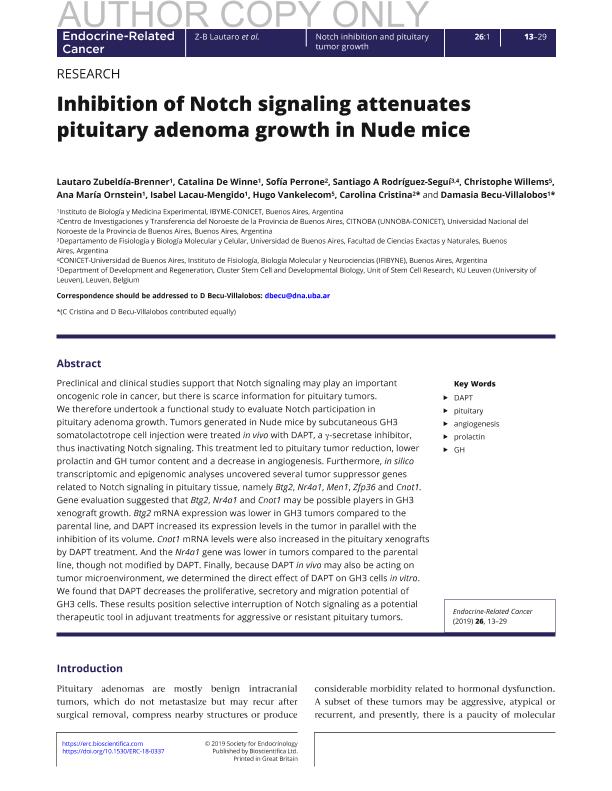
Preclinical and clinical studies support that Notch signaling may play an important oncogenic role in cancer, but there is scarce information for pituitary tumors. We therefore undertook a functional study to evaluate Notch participation in pituitary adenoma growth. Tumors generated in nude mice by subcutaneous GH3 somatolactotrope cell injection were treated in vivo with DAPT, a γ-secretase inhibitor, thus inactivating Notch signaling. This treatment led to pituitary tumor reduction, lower prolactin and GH tumor content, and a decrease in angiogenesis. Furthermore, in silico transcriptomic and epigenomic analyses uncovered several tumor suppressor genes related to Notch signaling in pituitary tissue, namely Btg2, Nr4a1, Men1, Zfp36, and Cnot1. Gene evaluation suggested that Btg2, Nr4a1 and Cnot1 may be possible players in GH3 xenograft growth. Btg2 mRNA expression was lower in GH3 tumors compared to the parental line, and DAPT increased its expression levels in the tumor in parallel with the inhibition of its volume. Cnot1 mRNA levels were also increased in the pituitary xenografts by DAPT treatment. And the Nr4a1 gene was lower in tumors compared to the parental line, though not modified by DAPT. Finally, because DAPT in vivo may be also acting on tumor microenvironment, we determined the direct effect of DAPT on GH3 cells in vitro. We found that DAPT decreases the proliferative, secretory and migration potential of GH3 cells. These results position selective interruption of Notch signaling as a potential therapeutic tool in adjuvant treatments for aggressive or resistant pituitary tumors.
Palabras clave:
DAPT
,
PITUITARY
,
ANGIOGENESIS
,
PROLACTIN
,
GH
Archivos asociados

Tamaño:
1.996Mb
Formato:
PDF
Licencia
 Excepto donde se diga explícitamente, este item se publica bajo la siguiente descripción:
Creative Commons Attribution-NonCommercial-ShareAlike 2.5 Unported (CC BY-NC-SA 2.5)
Excepto donde se diga explícitamente, este item se publica bajo la siguiente descripción:
Creative Commons Attribution-NonCommercial-ShareAlike 2.5 Unported (CC BY-NC-SA 2.5)
Identificadores
Colecciones
Articulos(IBYME)
Articulos de INST.DE BIOLOGIA Y MEDICINA EXPERIMENTAL (I)
Articulos de INST.DE BIOLOGIA Y MEDICINA EXPERIMENTAL (I)
Articulos(IFIBYNE)
Articulos de INST.DE FISIOL., BIOL.MOLECULAR Y NEUROCIENCIAS
Articulos de INST.DE FISIOL., BIOL.MOLECULAR Y NEUROCIENCIAS
Articulos(SEDE CENTRAL)
Articulos de SEDE CENTRAL
Articulos de SEDE CENTRAL
Citación
Zubeldia Brenner, Lautaro; de Winne, Catalina; Perrone, Sofía; Rodríguez Seguí, Santiago Andrés; Willems, Christophe; et al.; Inhibition of Notch signaling attenuates pituitary adenoma growth in Nude mice; BioScientifica; Endocrine - Related Cancer; 26; 1; 8-2018; 13-29
Compartir


Altmétricas