Artículo
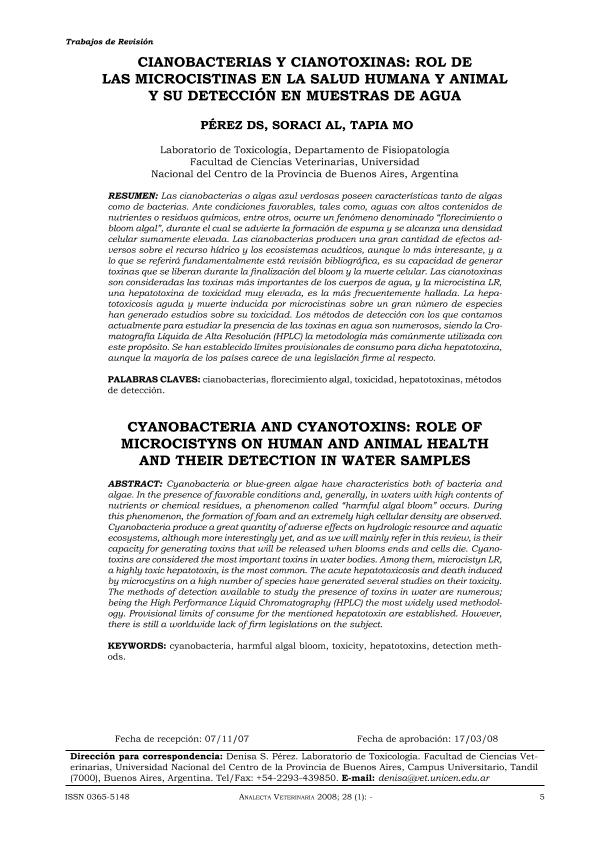
Las cianobacterias o algas azul verdosas poseen características tanto de algas como de bacterias. Ante condiciones favorables, tales como, aguas con altos contenidos de nutrientes o residuos químicos, entre otros, ocurre un fenómeno denominado “florecimiento o bloom algal”, durante el cual se advierte la formación de espuma y se alcanza una densidad celular sumamente elevada. Las cianobacterias producen una gran cantidad de efectos adversos sobre el recurso hídrico y los ecosistemas acuáticos, aunque lo más interesante, y a lo que se referirá fundamentalmente está revisión bibliográfica, es su capacidad de generar toxinas que se liberan durante la finalización del bloom y la muerte celular. Las cianotoxinas son consideradas las toxinas más importantes de los cuerpos de agua, y la microcistina LR, una hepatotoxina de toxicidad muy elevada, es la más frecuentemente hallada. La hepatotoxicosis aguda y muerte inducida por microcistinas sobre un gran número de especies han generado estudios sobre su toxicidad. Los métodos de detección con los que contamos actualmente para estudiar la presencia de las toxinas en agua son numerosos, siendo la Cromatografía Líquida de Alta Resolución (HPLC) la metodología más comúnmente utilizada con este propósito. Se han establecido límites provisionales de consumo para dicha hepatotoxina, aunque la mayoría de los países carece de una legislación firme al respecto. Cyanobacteria or blue-green algae have characteristics both of bacteria and algae. In the presence of favorable conditions and, generally, in waters with high contents of nutrients or chemical residues, a phenomenon called “harmful algal bloom” occurs. During this phenomenon, the formation of foam and an extremely high cellular density are observed. Cyanobacteria produce a great quantity of adverse effects on hydrologic resource and aquatic ecosystems, although more interestingly yet, and as we will mainly refer in this review, is their capacity for generating toxins that will be released when blooms ends and cells die. Cyanotoxins are considered the most important toxins in water bodies. Among them, microcistyn LR, a highly toxic hepatotoxin, is the most common. The acute hepatotoxicosis and death induced by microcystins on a high number of species have generated several studies on their toxicity. The methods of detection available to study the presence of toxins in water are numerous; being the High Performance Liquid Chromatography (HPLC) the most widely used methodology. Provisional limits of consume for the mentioned hepatotoxin are established. However, there is still a worldwide lack of firm legislations on the subject.
Cianobacterias y cianotoxinas: rol de las microcistinas en la salud humana y animal y su detección en muestras de agua
Título:
Cyanobacteria and cyanotoxins: role of microcistyns on human and animal health and their detection in water samples

Fecha de publicación:
12/2008
Editorial:
Universidad Nacional de La Plata. Facultad de Ciencias Veterinarias
Revista:
Analecta Veterinaria
e-ISSN:
1514-2590
Idioma:
Español
Tipo de recurso:
Artículo publicado
Clasificación temática:
Resumen
Palabras clave:
CIANOBACTERIAS
,
CIANOTOXINAS
,
MICROCISTINA
,
SALUD ANIMAL Y PÚBLICA
Archivos asociados

Tamaño:
437.9Kb
Formato:
PDF
Licencia
 Excepto donde se diga explícitamente, este item se publica bajo la siguiente descripción:
Creative Commons Attribution-NonCommercial-ShareAlike 2.5 Unported (CC BY-NC-SA 2.5)
Excepto donde se diga explícitamente, este item se publica bajo la siguiente descripción:
Creative Commons Attribution-NonCommercial-ShareAlike 2.5 Unported (CC BY-NC-SA 2.5)
Identificadores
Colecciones
Articulos(CIVETAN)
Articulos de CENTRO DE INVESTIGACION VETERINARIA DE TANDIL
Articulos de CENTRO DE INVESTIGACION VETERINARIA DE TANDIL
Citación
Pérez, Denisa Soledad; Soraci, Alejandro Luis; Tapia, Maria Ofelia; Cianobacterias y cianotoxinas: rol de las microcistinas en la salud humana y animal y su detección en muestras de agua; Universidad Nacional de La Plata. Facultad de Ciencias Veterinarias; Analecta Veterinaria; 28; 1; 12-2008; 5-13
Compartir

