Artículo
Reactive oxygen species in bovine oocyte maturation in vitro

Fecha de publicación:
12/2009
Editorial:
Csiro Publishing
Revista:
Reproduction Fertility and Development
ISSN:
1031-3613
Idioma:
Inglés
Tipo de recurso:
Artículo publicado
Clasificación temática:
Resumen
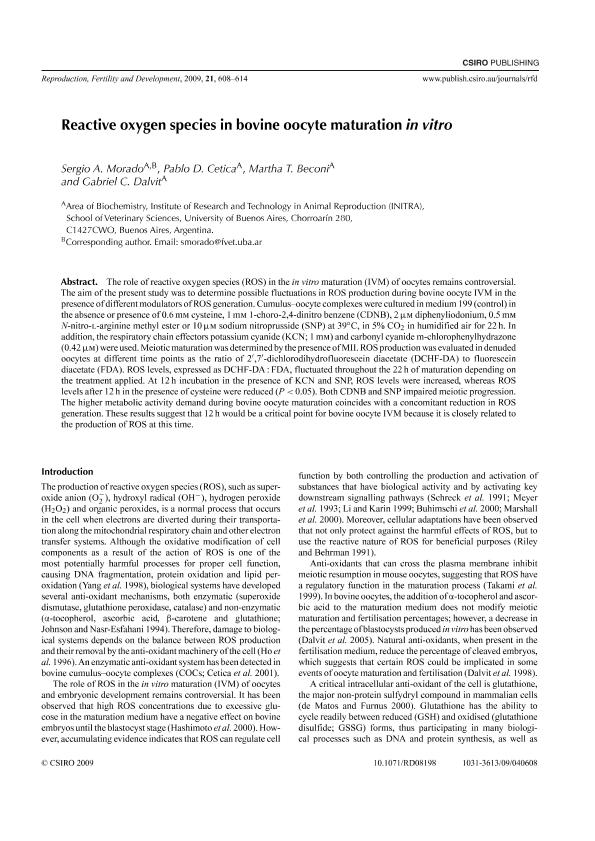
The role of reactive oxygen species (ROS) in the in vitro maturation (IVM) of oocytes remains controversial. The aim of the present study was to determine possible fluctuations in ROS production during bovine oocyte IVM in the presence of different modulators of ROS generation. Cumulus-oocyte complexes were cultured in medium 199 (control) in the absence or presence of 0.6 mm cysteine, 1mm 1-choro-2,4-dinitro benzene (CDNB), 2μm diphenyliodonium, 0.5 mm N-nitro-l-arginine methyl ester or 10 μm sodium nitroprusside (SNP) at 39°C, in 5% CO2 in humidified air for 22 h. In addition, the respiratory chain effectors potassium cyanide (KCN; 1 mm) and carbonyl cyanide m-chlorophenylhydrazone (0.42 μm) were used. Meiotic maturation was determined by the presence of MII. ROS production was evaluated in denuded oocytes at different time points as the ratio of 2′,7′- dichlorodihydrofluorescein diacetate (DCHF-DA) to fluorescein diacetate (FDA). ROS levels, expressed as DCHF-DA : FDA, fluctuated throughout the 22 h of maturation depending on the treatment applied. At 12 h incubation in the presence of KCN and SNP, ROS levels were increased, whereas ROS levels after 12 h in the presence of cysteine were reduced (P < 0.05). Both CDNB and SNP impaired meiotic progression. The higher metabolic activity demand during bovine oocyte maturation coincides with a concomitant reduction in ROS generation. These results suggest that 12 h would be a critical point for bovine oocyte IVM because it is closely related to the production of ROS at this time.
Palabras clave:
Oocyte
,
In vitro maturation
,
Reactive oxygen species
,
Bovine
Archivos asociados

Tamaño:
283.7Kb
Formato:
PDF
Licencia
 Excepto donde se diga explícitamente, este item se publica bajo la siguiente descripción:
Creative Commons Attribution-NonCommercial-ShareAlike 2.5 Unported (CC BY-NC-SA 2.5)
Excepto donde se diga explícitamente, este item se publica bajo la siguiente descripción:
Creative Commons Attribution-NonCommercial-ShareAlike 2.5 Unported (CC BY-NC-SA 2.5)
Identificadores
Colecciones
Articulos(OCA PQUE. CENTENARIO)
Articulos de OFICINA DE COORDINACION ADMINISTRATIVA PQUE. CENTENARIO
Articulos de OFICINA DE COORDINACION ADMINISTRATIVA PQUE. CENTENARIO
Citación
Morado, Sergio Adrián; Cetica, Pablo Daniel; Beconi, Martha Teresa; Dalvit, Gabriel Carlos; Reactive oxygen species in bovine oocyte maturation in vitro; Csiro Publishing; Reproduction Fertility and Development; 21; 4; 12-2009; 608-614
Compartir


Altmétricas