Artículo
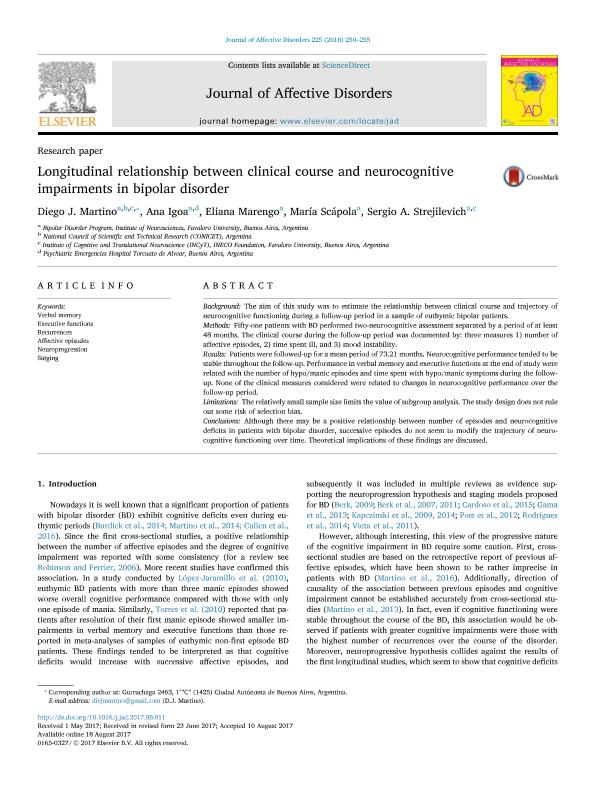
Longitudinal relationship between clinical course and neurocognitive impairments in bipolar disorder

Fecha de publicación:
01/2018
Editorial:
Elsevier Science
Revista:
Journal of Affective Disorders
ISSN:
0165-0327
Idioma:
Inglés
Tipo de recurso:
Artículo publicado
Clasificación temática:
Resumen
Background The aim of this study was to estimate the relationship between clinical course and trajectory of neurocognitive functioning during a follow-up period in a sample of euthymic bipolar patients. Methods Fifty-one patients with BD performed two-neurocognitive assessment separated by a period of at least 48 months. The clinical course during the follow-up period was documented by: three measures 1) number of affective episodes, 2) time spent ill, and 3) mood instability. Results Patients were followed-up for a mean period of 73.21 months. Neurocognitive performance tended to be stable throughout the follow-up. Performance in verbal memory and executive functions at the end of study were related with the number of hypo/manic episodes and time spent with hypo/manic symptoms during the follow-up. None of the clinical measures considered were related to changes in neurocognitive performance over the follow-up period. Limitations The relatively small sample size limits the value of subgroup analysis. The study design does not rule out some risk of selection bias. Conclusions Although there may be a positive relationship between number of episodes and neurocognitive deficits in patients with bipolar disorder, successive episodes do not seem to modify the trajectory of neurocognitive functioning over time. Theoretical implications of these findings are discussed.
Archivos asociados

Tamaño:
430.9Kb
Formato:
PDF
Licencia
 Excepto donde se diga explícitamente, este item se publica bajo la siguiente descripción:
Atribución-NoComercial-SinDerivadas 2.5 Argentina (CC BY-NC-ND 2.5 AR)
Excepto donde se diga explícitamente, este item se publica bajo la siguiente descripción:
Atribución-NoComercial-SinDerivadas 2.5 Argentina (CC BY-NC-ND 2.5 AR)
Identificadores
Colecciones
Articulos(INCYT)
Articulos de INSTITUTO DE NEUROCIENCIAS COGNITIVAS Y TRASLACIONAL
Articulos de INSTITUTO DE NEUROCIENCIAS COGNITIVAS Y TRASLACIONAL
Citación
Martino, Diego Javier; Igoa, Ana; Marengo, Eliana; Scápola, María; Strejilevich, Sergio; Longitudinal relationship between clinical course and neurocognitive impairments in bipolar disorder; Elsevier Science; Journal of Affective Disorders; 225; 1-2018; 250-255
Compartir


Altmétricas