Artículo
Differential Modulation of MAP Kinases by Zinc Deficiency in IMR-32 Cells: Role of H2O2.
Zago, María Paola ; Mackenzie, Gerardo G.; Adamo, Ana María
; Keen, Carl L.; Oteiza, Patricia Isabel
; Mackenzie, Gerardo G.; Adamo, Ana María
; Keen, Carl L.; Oteiza, Patricia Isabel
; Mackenzie, Gerardo G.; Adamo, Ana María
; Keen, Carl L.; Oteiza, Patricia Isabel
Fecha de publicación:
11/2005
Editorial:
Mary Ann Liebert
Revista:
Antioxidants & Redox Signaling
ISSN:
1523-0864
Idioma:
Inglés
Tipo de recurso:
Artículo publicado
Clasificación temática:
Resumen
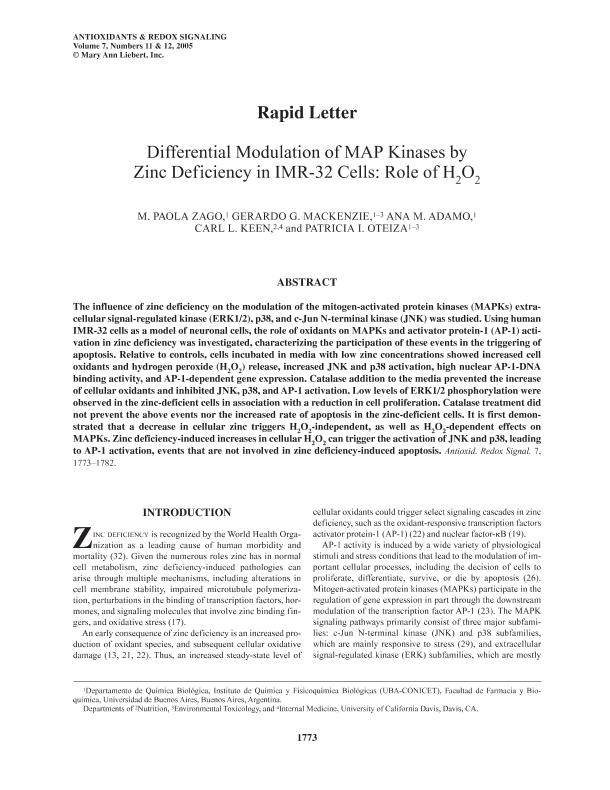
The influence of zinc deficiency on the modulation of the mitogen-activated protein kinases (MAPKs) extracellular signal-regulated kinase (ERK1/2), p38, and c-Jun N-terminal kinase (JNK) was studied. Using human IMR-32 cells as a model of neuronal cells, the role of oxidants on MAPKs and activator protein-1 (AP-1) activation in zinc deficiency was investigated, characterizing the participation of these events in the triggering of apoptosis. Relative to controls, cells incubated in media with low zinc concentrations showed increased cell oxidants and hydrogen peroxide (H2O2) release, increased JNK and p38 activation, high nuclear AP-1-DNA binding activity, and AP-1-dependent gene expression. Catalase addition to the media prevented the increase of cellular oxidants and inhibited JNK, p38, and AP-1 activation. Low levels of ERK1/2 phosphorylation were observed in the zinc-deficient cells in association with a reduction in cell proliferation. Catalase treatment did not prevent the above events nor the increased rate of apoptosis in the zinc-deficient cells. It is first demonstrated that a decrease in cellular zinc triggers H2O2-independent, as well as H2O 2-dependent effects on MAPKs. Zinc deficiency-induced increases in cellular H2O2 can trigger the activation of JNK and p38, leading to AP-1 activation, events that are not involved in zinc deficiency-induced apoptosis.
Archivos asociados

Tamaño:
194.2Kb
Formato:
PDF
Licencia
 Excepto donde se diga explícitamente, este item se publica bajo la siguiente descripción:
Creative Commons Attribution-NonCommercial-ShareAlike 2.5 Unported (CC BY-NC-SA 2.5)
Excepto donde se diga explícitamente, este item se publica bajo la siguiente descripción:
Creative Commons Attribution-NonCommercial-ShareAlike 2.5 Unported (CC BY-NC-SA 2.5)
Identificadores
Colecciones
Articulos(CCT - SALTA-JUJUY)
Articulos de CTRO.CIENTIFICO TECNOL.CONICET - SALTA-JUJUY
Articulos de CTRO.CIENTIFICO TECNOL.CONICET - SALTA-JUJUY
Citación
Zago, María Paola; Mackenzie, Gerardo G.; Adamo, Ana María; Keen, Carl L.; Oteiza, Patricia Isabel; Differential Modulation of MAP Kinases by Zinc Deficiency in IMR-32 Cells: Role of H2O2.; Mary Ann Liebert; Antioxidants & Redox Signaling; 7; 11-12; 11-2005; 1773-1782
Compartir


Altmétricas