Mostrar el registro sencillo del ítem
dc.contributor.author
Bentancor, A.
dc.contributor.author
Rumi, M.
dc.contributor.author
Carbonari, C.
dc.contributor.author
Gerhard, Elizabeth
dc.contributor.author
Larzabal, Mariano
dc.contributor.author
Vilte, Daniel A.
dc.contributor.author
Pistone Creydt, Virginia
dc.contributor.author
Chinen, Isabel
dc.contributor.author
Ibarra, Cristina Adriana
dc.contributor.author
Cataldi, Angel Adrian
dc.contributor.author
Mercado, Elsa C.
dc.date.available
2016-12-20T19:58:42Z
dc.date.issued
2012-05
dc.identifier.citation
Bentancor, A.; Rumi, M.; Carbonari, C.; Gerhard, Elizabeth; Larzabal, Mariano; et al.; Profile of Shiga toxin-producing Escherichia coli strains isolated from dogs and cats and genetic relationships with isolates from cattle, meat and humans.; Elsevier Science; Veterinary Microbiology; 156; 3-4; 5-2012; 336-342
dc.identifier.issn
0378-1135
dc.identifier.uri
http://hdl.handle.net/11336/9849
dc.description.abstract
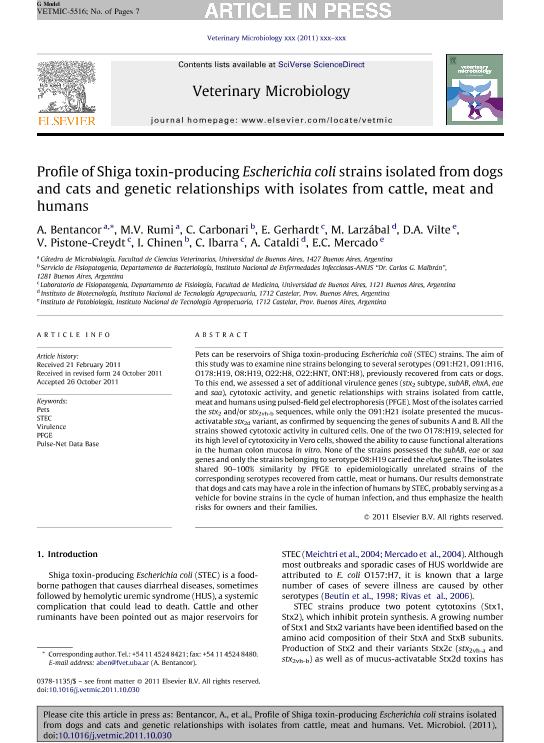
Pets can be reservoirs of Shiga toxin-producing Escherichia coli (STEC) strains. The aim of this study was to examine nine strains belonging to several serotypes (O91:H21, O91:H16, O178:H19, O8:H19, O22:H8, O22:HNT, ONT:H8), previously recovered from cats or dogs. To this end, we assessed a set of additional virulence genes (stx(2) subtype, subAB, ehxA, eae and saa), cytotoxic activity, and genetic relationships with strains isolated from cattle, meat and humans using pulsed-field gel electrophoresis (PFGE). Most of the isolates carried the stx(2) and/or stx(2vh-b) sequences, while only the O91:H21 isolate presented the mucus-activatable stx(2d) variant, as confirmed by sequencing the genes of subunits A and B. All the strains showed cytotoxic activity in cultured cells. One of the two O178:H19, selected for its high level of cytotoxicity in Vero cells, showed the ability to cause functional alterations in the human colon mucosa in vitro. None of the strains possessed the subAB, eae or saa genes and only the strains belonging to serotype O8:H19 carried the ehxA gene. The isolates shared 90-100% similarity by PFGE to epidemiologically unrelated strains of the corresponding serotypes recovered from cattle, meat or humans. Our results demonstrate that dogs and cats may have a role in the infection of humans by STEC, probably serving as a vehicle for bovine strains in the cycle of human infection, and thus emphasize the health risks for owners and their families.
dc.format
application/pdf
dc.language.iso
eng
dc.publisher
Elsevier Science
dc.rights
info:eu-repo/semantics/openAccess
dc.rights.uri
https://creativecommons.org/licenses/by-nc-nd/2.5/ar/
dc.subject
Pets
dc.subject
Stec
dc.subject
Virulence
dc.subject
Pfge
dc.subject.classification
Enfermedades Infecciosas
dc.subject.classification
Ciencias de la Salud
dc.subject.classification
CIENCIAS MÉDICAS Y DE LA SALUD
dc.subject.classification
Ciencias Veterinarias
dc.subject.classification
Ciencias Veterinarias
dc.subject.classification
CIENCIAS AGRÍCOLAS
dc.title
Profile of Shiga toxin-producing Escherichia coli strains isolated from dogs and cats and genetic relationships with isolates from cattle, meat and humans.
dc.type
info:eu-repo/semantics/article
dc.type
info:ar-repo/semantics/artículo
dc.type
info:eu-repo/semantics/publishedVersion
dc.date.updated
2016-11-22T21:21:22Z
dc.identifier.eissn
1873-2542
dc.journal.volume
156
dc.journal.number
3-4
dc.journal.pagination
336-342
dc.journal.pais
Países Bajos
dc.journal.ciudad
Amsterdam
dc.description.fil
Fil: Bentancor, A.. Universidad de Buenos Aires. Facultad de Ciencias Veterinarias; Argentina
dc.description.fil
Fil: Rumi, M.. Universidad de Buenos Aires. Facultad de Ciencias Veterinarias; Argentina
dc.description.fil
Fil: Carbonari, C.. Dirección Nacional de Instituto de Investigación. Administración Nacional de Laboratorio e Instituto de Salud; Argentina
dc.description.fil
Fil: Gerhard, Elizabeth. Universidad de Buenos Aires. Facultad de Medicina; Argentina
dc.description.fil
Fil: Larzabal, Mariano. Instituto Nacional de Tecnología Agropecuaria; Argentina. Consejo Nacional de Investigaciones Científicas y Técnicas; Argentina
dc.description.fil
Fil: Vilte, Daniel A.. Instituto Nacional de Tecnología Agropecuaria; Argentina
dc.description.fil
Fil: Pistone Creydt, Virginia. Universidad de Buenos Aires. Facultad de Medicina; Argentina. Consejo Nacional de Investigaciones Científicas y Técnicas. Instituto de Biología y Medicina Experimental (i); Argentina
dc.description.fil
Fil: Chinen, Isabel. Dirección Nacional de Instituto de Investigación. Administración Nacional de Laboratorio e Instituto de Salud; Argentina
dc.description.fil
Fil: Ibarra, Cristina Adriana. Instituto Nacional de Tecnología Agropecuaria; Argentina. Consejo Nacional de Investigaciones Científicas y Técnicas. Instituto de Biología y Medicina Experimental (i); Argentina
dc.description.fil
Fil: Cataldi, Angel Adrian. Instituto Nacional de Tecnología Agropecuaria; Argentina. Consejo Nacional de Investigaciones Científicas y Técnicas; Argentina
dc.description.fil
Fil: Mercado, Elsa C.. Instituto Nacional de Tecnología Agropecuaria; Argentina
dc.journal.title
Veterinary Microbiology
dc.relation.alternativeid
info:eu-repo/semantics/altIdentifier/url/http://www.sciencedirect.com/science/article/pii/S0378113511005876
dc.relation.alternativeid
info:eu-repo/semantics/altIdentifier/doi/http://dx.doi.org/10.1016/j.vetmic.2011.10.030
Archivos asociados

Tamaño:
595.3Kb
Formato:
PDF