Artículo
FSH and bFGF stimulate the production of glutathione in cultured rat sertoli cells

Fecha de publicación:
06/2009
Editorial:
Wiley Blackwell Publishing, Inc
Revista:
International Journal Of Andrology
ISSN:
0105-6263
Idioma:
Inglés
Tipo de recurso:
Artículo publicado
Clasificación temática:
Resumen
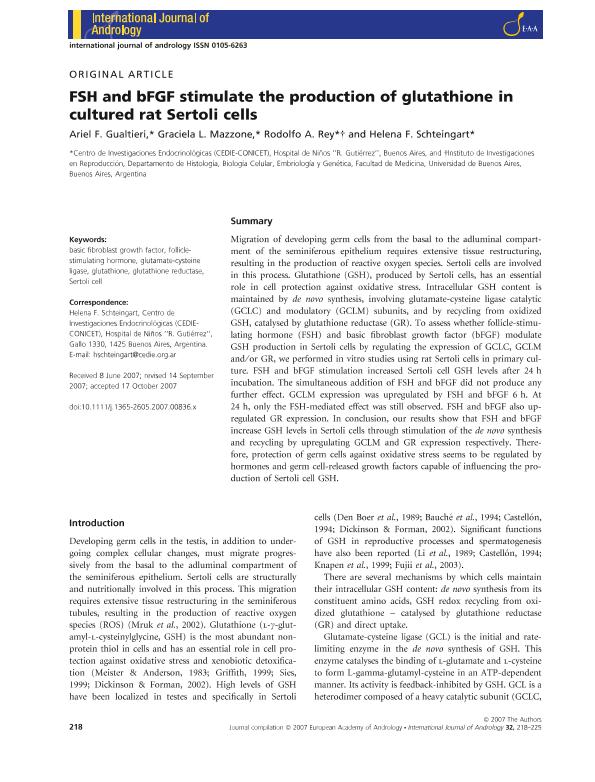
Migration of developing germ cells from the basal to the adluminal compartment of the seminiferous epithelium requires extensive tissue restructuring, resulting in the production of reactive oxygen species. Sertoli cells are involved in this process. Glutathione (GSH), produced by Sertoli cells, has an essential role in cell protection against oxidative stress. Intracellular GSH content is maintained by de novo synthesis, involving glutamate-cysteine ligase catalytic (GCLC) and modulatory (GCLM) subunits, and by recycling from oxidized GSH, catalysed by glutathione reductase (GR). To assess whether follicle-stimulating hormone (FSH) and basic fibroblast growth factor (bFGF) modulate GSH production in Sertoli cells by regulating the expression of GCLC, GCLM and/or GR, we performed in vitro studies using rat Sertoli cells in primary culture. FSH and bFGF stimulation increased Sertoli cell GSH levels after 24 h incubation. The simultaneous addition of FSH and bFGF did not produce any further effect. GCLM expression was upregulated by FSH and bFGF 6 h. At 24 h, only the FSH-mediated effect was still observed. FSH and bFGF also upregulated GR expression. In conclusion, our results show that FSH and bFGF increase GSH levels in Sertoli cells through stimulation of the de novo synthesis and recycling by upregulating GCLM and GR expression respectively. Therefore, protection of germ cells against oxidative stress seems to be regulated by hormones and germ cell-released growth factors capable of influencing the production of Sertoli cell GSH.
Archivos asociados

Tamaño:
207.9Kb
Formato:
PDF
Licencia
 Excepto donde se diga explícitamente, este item se publica bajo la siguiente descripción:
Creative Commons Attribution-NonCommercial-ShareAlike 2.5 Unported (CC BY-NC-SA 2.5)
Excepto donde se diga explícitamente, este item se publica bajo la siguiente descripción:
Creative Commons Attribution-NonCommercial-ShareAlike 2.5 Unported (CC BY-NC-SA 2.5)
Identificadores
Colecciones
Articulos(CEDIE)
Articulos de CENTRO DE INVESTIGACIONES ENDOCRINOLOGICAS "DR. CESAR BERGADA"
Articulos de CENTRO DE INVESTIGACIONES ENDOCRINOLOGICAS "DR. CESAR BERGADA"
Citación
Gualtieri, Ariel Félix; Mazzone, Graciela Luján; Rey, Rodolfo Alberto; Schteingart, Helena Fedora; FSH and bFGF stimulate the production of glutathione in cultured rat sertoli cells; Wiley Blackwell Publishing, Inc; International Journal Of Andrology; 32; 3; 6-2009; 218-225
Compartir


Altmétricas