Artículo
Patient-centered primary care and self-rated health in 6 Latin American and Caribbean countries: Analysis of a public opinion cross-sectional survey
Guanais, Frederico; Doubova, Svetlana V.; Leslie, Hannah H.; Perez Cuevas, Ricardo; Garcia Elorrio, Ezequiel ; Kruk, Margaret E.
; Kruk, Margaret E.
Fecha de publicación:
10/2018
Editorial:
Public Library of Science
Revista:
Plos Medicine
ISSN:
1549-1277
Idioma:
Inglés
Tipo de recurso:
Artículo publicado
Clasificación temática:
Resumen
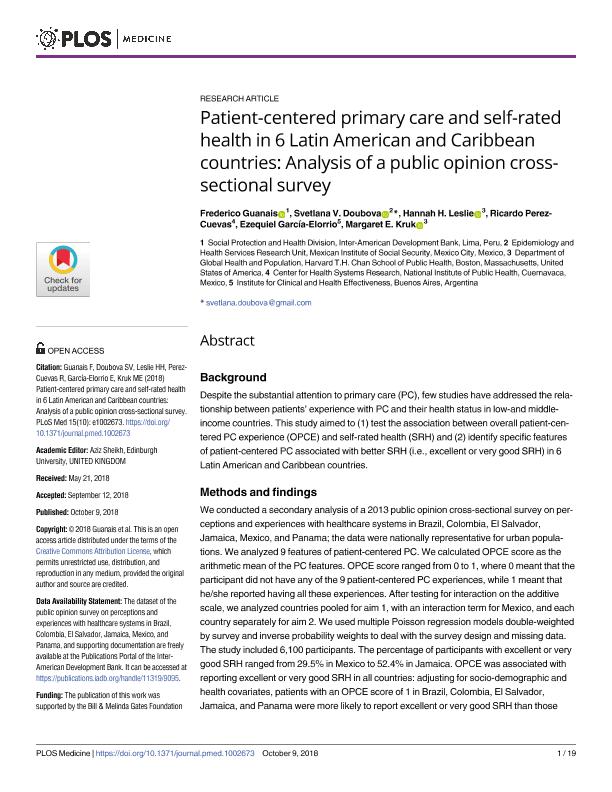
Background: Despite the substantial attention to primary care (PC), few studies have addressed the relationship between patients’ experience with PC and their health status in low-and middle-income countries. This study aimed to (1) test the association between overall patient-centered PC experience (OPCE) and self-rated health (SRH) and (2) identify specific features of patient-centered PC associated with better SRH (i.e., excellent or very good SRH) in 6 Latin American and Caribbean countries. Methods and findings: We conducted a secondary analysis of a 2013 public opinion cross-sectional survey on perceptions and experiences with healthcare systems in Brazil, Colombia, El Salvador, Jamaica, Mexico, and Panama; the data were nationally representative for urban populations. We analyzed 9 features of patient-centered PC. We calculated OPCE score as the arithmetic mean of the PC features. OPCE score ranged from 0 to 1, where 0 meant that the participant did not have any of the 9 patient-centered PC experiences, while 1 meant that he/she reported having all these experiences. After testing for interaction on the additive scale, we analyzed countries pooled for aim 1, with an interaction term for Mexico, and each country separately for aim 2. We used multiple Poisson regression models double-weighted by survey and inverse probability weights to deal with the survey design and missing data. The study included 6,100 participants. The percentage of participants with excellent or very good SRH ranged from 29.5% in Mexico to 52.4% in Jamaica. OPCE was associated with reporting excellent or very good SRH in all countries: adjusting for socio-demographic and health covariates, patients with an OPCE score of 1 in Brazil, Colombia, El Salvador, Jamaica, and Panama were more likely to report excellent or very good SRH than those with a score of 0 (adjusted prevalence ratio [aPR] 1.61, 95% CI 1.37–1.90, p < 0.001); in Mexico, this association was even stronger (aPR 4.27, 95% CI 2.34–7.81, p < 0.001). The specific features of patient-centered PC associated with better SRH differed by country. The perception that PC providers solve most health problems was associated with excellent or very good SRH in Colombia (aPR 1.38, 95% CI 1.01–1.91, p = 0.046) and Jamaica (aPR 1.21, 95% CI 1.02–1.43, p = 0.030). Having a provider who knows relevant medical history was positively associated with better SRH in Mexico (aPR 1.47, 95% CI 1.03–2.12, p = 0.036) but was negatively associated with better SRH in Brazil (aPR 0.71, 95% CI 0.56–0.89, p = 0.003). Finally, easy contact with PC facility (Mexico: aPR 1.35, 95% CI 1.04–1.74, p = 0.023), coordination of care (Mexico: aPR 1.53, 95% CI 1.19–1.98, p = 0.001), and opportunity to ask questions (Brazil: aPR 1.42, 95% CI 1.11–1.83, p = 0.006) were each associated with better SRH. The main study limitation consists in the analysis being of cross-sectional data, which does not allow making causal inferences or identifying the direction of the association between the variables. Conclusions: Overall, a higher OPCE score was associated with better SRH in these 6 Latin American and Caribbean countries; associations between specific characteristics of patient-centered PC and SRH differed by country. The findings underscore the importance of high-quality, patient-centered PC as a path to improved population health.
Palabras clave:
SELF-RATED HEALTH
,
CROSS-SECTIONAL
Archivos asociados

Tamaño:
1.116Mb
Formato:
PDF
Licencia
 Excepto donde se diga explícitamente, este item se publica bajo la siguiente descripción:
Creative Commons Attribution 2.5 Unported (CC BY 2.5)
Excepto donde se diga explícitamente, este item se publica bajo la siguiente descripción:
Creative Commons Attribution 2.5 Unported (CC BY 2.5)
Identificadores
Colecciones
Articulos(SEDE CENTRAL)
Articulos de SEDE CENTRAL
Articulos de SEDE CENTRAL
Citación
Guanais, Frederico; Doubova, Svetlana V.; Leslie, Hannah H.; Perez Cuevas, Ricardo; Garcia Elorrio, Ezequiel; et al.; Patient-centered primary care and self-rated health in 6 Latin American and Caribbean countries: Analysis of a public opinion cross-sectional survey; Public Library of Science; Plos Medicine; 15; 10; 10-2018; 1-19
Compartir


Altmétricas