Artículo
Prediction of double retrograde vaporization: Transitions in binary mixtures of near critical fluids with components of homologous series

Fecha de publicación:
12/2004
Editorial:
Elsevier Science
Revista:
Journal of Supercritical Fluids
ISSN:
0896-8446
Idioma:
Inglés
Tipo de recurso:
Artículo publicado
Clasificación temática:
Resumen
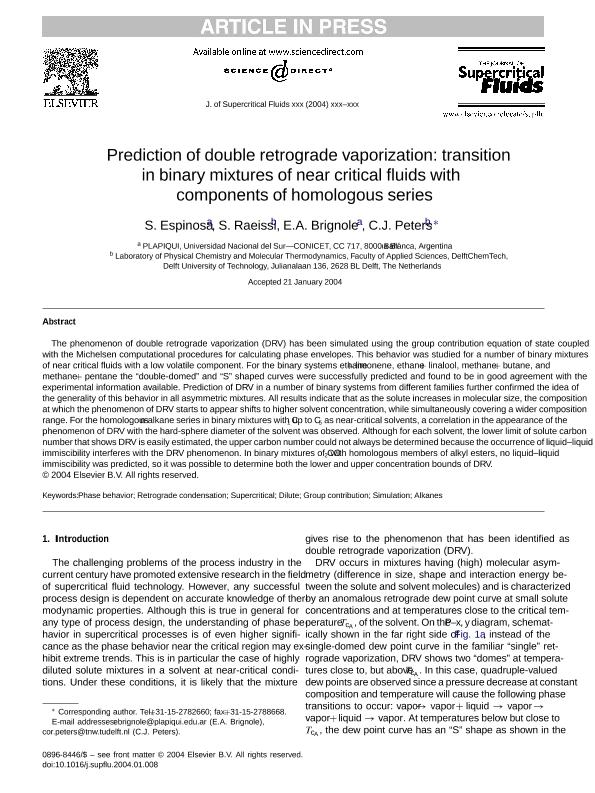
The phenomenon of double retrograde vaporization (DRV) has been simulated using the group contribution equation of state coupled with the Michelsen computational procedures for calculating phase envelopes. This behavior was studied for a number of binary mixtures of near critical fluids with a low volatile component. For the binary systems ethane+limonene, ethane+linalool, methane+butane, and methane+pentane the "double-domed" and "S" shaped curves were successfully predicted and found to be in good agreement with the experimental information available. Prediction of DRV in a number of binary systems from different families further confirmed the idea of the generality of this behavior in all asymmetric mixtures. All results indicate that as the solute increases in molecular size, the composition at which the phenomenon of DRV starts to appear shifts to higher solvent concentration, while simultaneously covering a wider composition range. For the homologous n-alkane series in binary mixtures with C1 up to C5 as near-critical solvents, a correlation in the appearance of the phenomenon of DRV with the hard-sphere diameter of the solvent was observed. Although for each solvent, the lower limit of solute carbon number that shows DRV is easily estimated, the upper carbon number could not always be determined because the occurrence of liquid-liquid immiscibility interferes with the DRV phenomenon. In binary mixtures of CO2 with homologous members of alkyl esters, no liquid-liquid immiscibility was predicted, so it was possible to determine both the lower and upper concentration bounds of DRV.
Archivos asociados

Tamaño:
359.2Kb
Formato:
PDF
Licencia
 Excepto donde se diga explícitamente, este item se publica bajo la siguiente descripción:
Creative Commons Attribution-NonCommercial-ShareAlike 2.5 Unported (CC BY-NC-SA 2.5)
Excepto donde se diga explícitamente, este item se publica bajo la siguiente descripción:
Creative Commons Attribution-NonCommercial-ShareAlike 2.5 Unported (CC BY-NC-SA 2.5)
Identificadores
Colecciones
Articulos(PLAPIQUI)
Articulos de PLANTA PILOTO DE INGENIERIA QUIMICA (I)
Articulos de PLANTA PILOTO DE INGENIERIA QUIMICA (I)
Citación
Espinosa, Susana; Raeissi, S.; Brignole, Esteban Alberto; Peters, Cornelis J.; Prediction of double retrograde vaporization: Transitions in binary mixtures of near critical fluids with components of homologous series; Elsevier Science; Journal of Supercritical Fluids; 32; 1-3; 12-2004; 63-71
Compartir


Altmétricas