Artículo
Developmental programming: Prenatal androgen excess disrupts ovarian steroid receptor balance

Fecha de publicación:
12/2009
Editorial:
BioScientifica
Revista:
Reproduction
ISSN:
1470-1626
Idioma:
Inglés
Tipo de recurso:
Artículo publicado
Clasificación temática:
Resumen
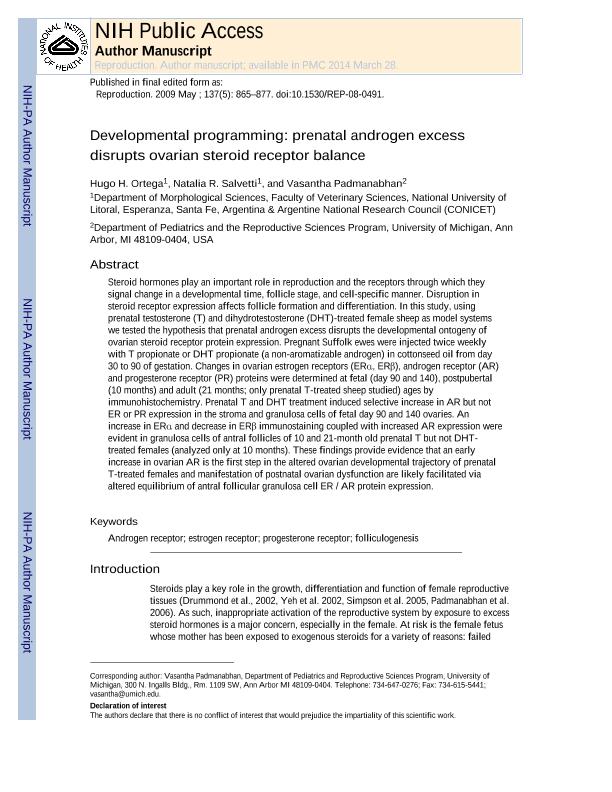
Steroid hormones play an important role in reproduction and the receptors through which they signal change in a developmental time, follicle stage, and cell-specific manner. Disruption in steroid receptor expression affects follicle formation and differentiation. In this study, using prenatal testosterone (T) and dihydrotestosterone (DHT)-treated female sheep as model systems, we tested the hypothesis that prenatal androgen excess disrupts the developmental ontogeny of ovarian steroid receptor protein expression. Pregnant Suffolk ewes were injected twice weekly with T propionate or DHT propionate (a non-aromatizable androgen) in cottonseed oil from days 30 to 90 of gestation. Changes in ovarian estrogen receptors (ER; ESR1, ESR2), androgen receptor (AR) and progesterone receptor (PGR) proteins were determined at fetal (days 90 and 140), postpubertal (10 months), and adult (21 months; only prenatal T-treated sheep studied) ages by immunohistochemistry. Prenatal T and DHT treatment induced selective increase in AR but not ER or PGR expression in the stroma and granulosa cells of fetal days 90 and 140 ovaries. An increase in ESR1 and decrease in ESR2 immunostaining coupled with increased AR expression were evident in granulosa cells of antral follicles of 10- and 21-month-old prenatal T but not DHT-treated females (analyzed only at 10 months). These findings provide evidence that an early increase in ovarian AR is the first step in the altered ovarian developmental trajectory of prenatal T-treated females, and manifestations of postnatal ovarian dysfunction are likely facilitated via altered equilibrium of antral follicular granulosa cell ER/AR protein expression.
Palabras clave:
OVARIAN FAILURE
,
ANDROGEN
,
OVINE
Archivos asociados

Tamaño:
1.590Mb
Formato:
PDF
Licencia
 Excepto donde se diga explícitamente, este item se publica bajo la siguiente descripción:
Creative Commons Attribution-NonCommercial-ShareAlike 2.5 Unported (CC BY-NC-SA 2.5)
Excepto donde se diga explícitamente, este item se publica bajo la siguiente descripción:
Creative Commons Attribution-NonCommercial-ShareAlike 2.5 Unported (CC BY-NC-SA 2.5)
Identificadores
Colecciones
Articulos(CCT - SANTA FE)
Articulos de CTRO.CIENTIFICO TECNOL.CONICET - SANTA FE
Articulos de CTRO.CIENTIFICO TECNOL.CONICET - SANTA FE
Citación
Ortega, Hugo Hector; Salvetti, Natalia Raquel; Padmanabhan, Vasantha; Developmental programming: Prenatal androgen excess disrupts ovarian steroid receptor balance; BioScientifica; Reproduction; 137; 5; 12-2009; 865-877
Compartir


Altmétricas