Artículo
Learning motion: Human vs. optimal Bayesian learner

Fecha de publicación:
02/2010
Editorial:
Pergamon-Elsevier Science Ltd
Revista:
Vision Research
ISSN:
0042-6989
Idioma:
Inglés
Tipo de recurso:
Artículo publicado
Clasificación temática:
Resumen
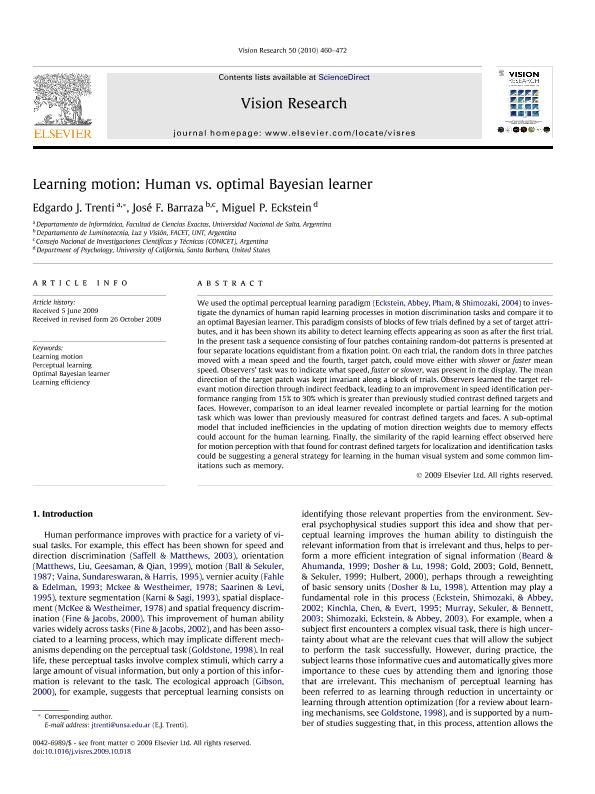
We used the optimal perceptual learning paradigm (Eckstein, Abbey, Pham, & Shimozaki, 2004) to investigate the dynamics of human rapid learning processes in motion discrimination tasks and compare it to an optimal Bayesian learner. This paradigm consists of blocks of few trials defined by a set of target attributes, and it has been shown its ability to detect learning effects appearing as soon as after the first trial. In the present task a sequence consisting of four patches containing random-dot patterns is presented at four separate locations equidistant from a fixation point. On each trial, the random dots in three patches moved with a mean speed and the fourth, target patch, could move either with slower or faster mean speed. Observers' task was to indicate what speed, faster or slower, was present in the display. The mean direction of the target patch was kept invariant along a block of trials. Observers learned the target relevant motion direction through indirect feedback, leading to an improvement in speed identification performance ranging from 15% to 30% which is greater than previously studied contrast defined targets and faces. However, comparison to an ideal learner revealed incomplete or partial learning for the motion task which was lower than previously measured for contrast defined targets and faces. A sub-optimal model that included inefficiencies in the updating of motion direction weights due to memory effects could account for the human learning. Finally, the similarity of the rapid learning effect observed here for motion perception with that found for contrast defined targets for localization and identification tasks could be suggesting a general strategy for learning in the human visual system and some common limitations such as memory.
Archivos asociados

Tamaño:
737.7Kb
Formato:
PDF
Licencia
 Excepto donde se diga explícitamente, este item se publica bajo la siguiente descripción:
Creative Commons Attribution-NonCommercial-ShareAlike 2.5 Unported (CC BY-NC-SA 2.5)
Excepto donde se diga explícitamente, este item se publica bajo la siguiente descripción:
Creative Commons Attribution-NonCommercial-ShareAlike 2.5 Unported (CC BY-NC-SA 2.5)
Identificadores
Colecciones
Articulos(ILAV)
Articulos de INST.DE INVESTIGACION EN LUZ, AMBIENTE Y VISION
Articulos de INST.DE INVESTIGACION EN LUZ, AMBIENTE Y VISION
Citación
Trenti, Edgardo Javier; Barraza, Jose Fernando; Eckstein, Miguel P.; Learning motion: Human vs. optimal Bayesian learner; Pergamon-Elsevier Science Ltd; Vision Research; 50; 4; 2-2010; 460-472
Compartir


Altmétricas