Artículo
Glucose metabolism regulates T cell activation, differentiation, and functions

Fecha de publicación:
01/2015
Editorial:
Frontiers Research Foundation
Revista:
Frontiers in Immunology
ISSN:
1664-3224
Idioma:
Inglés
Tipo de recurso:
Artículo publicado
Clasificación temática:
Resumen
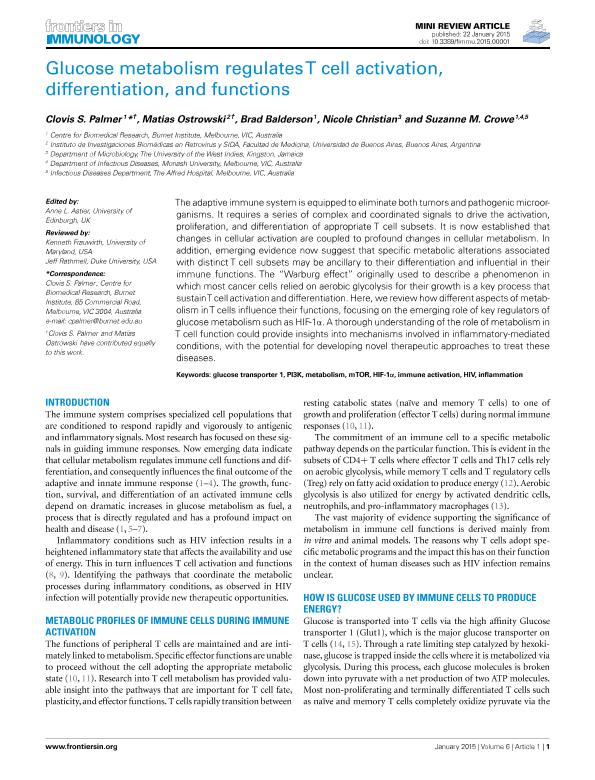
The adaptive immune system is equipped to eliminate both tumors and pathogenic microorganisms. It requires a series of complex and coordinated signals to drive the activation, proliferation, and differentiation of appropriate T cell subsets. It is now established that changes in cellular activation are coupled to profound changes in cellular metabolism. In addition, emerging evidence now suggest that specific metabolic alterations associated with distinct T cell subsets may be ancillary to their differentiation and influential in their immune functions. The "Warburg effect" originally used to describe a phenomenon in which most cancer cells relied on aerobic glycolysis for their growth is a key process that sustain T cell activation and differentiation. Here, we review how different aspects of metabolism in T cells influence their functions, focusing on the emerging role of key regulators of glucose metabolism such as HIF-1a. A thorough understanding of the role of metabolism in T cell function could provide insights into mechanisms involved in inflammatory-mediated conditions, with the potential for developing novel therapeutic approaches to treat these diseases.
Palabras clave:
GLUCOSE TRANSPORTER 1
,
HIF-1A
,
HIV
,
IMMUNE ACTIVATION
,
INFLAMMATION
,
METABOLISM
,
MTOR
,
PI3K
Archivos asociados

Tamaño:
638.2Kb
Formato:
PDF
Licencia
 Excepto donde se diga explícitamente, este item se publica bajo la siguiente descripción:
Creative Commons Attribution-NonCommercial-ShareAlike 2.5 Unported (CC BY-NC-SA 2.5)
Excepto donde se diga explícitamente, este item se publica bajo la siguiente descripción:
Creative Commons Attribution-NonCommercial-ShareAlike 2.5 Unported (CC BY-NC-SA 2.5)
Identificadores
Colecciones
Articulos(INBIRS)
Articulos de INSTITUTO DE INVESTIGACIONES BIOMEDICAS EN RETROVIRUS Y SIDA
Articulos de INSTITUTO DE INVESTIGACIONES BIOMEDICAS EN RETROVIRUS Y SIDA
Citación
Palmer, Clovis; Ostrowski, Matias; Balderson, Brad; Christian, Nicole; Crowe, Suzanne; Glucose metabolism regulates T cell activation, differentiation, and functions; Frontiers Research Foundation; Frontiers in Immunology; 6; JAN; 1-2015; 1-6
Compartir


Altmétricas