Artículo
Perturbation of whole-brain dynamics in silico reveals mechanistic differences between brain states
Deco, Gustavo; Cabral, Joana; Saenger, Victor M.; Boly, Melanie; Tagliazucchi, Enzo Rodolfo ; Laufs, Helmut; Someren, Eus Van; Jobst, Beatrice; Stevner, Angus; Kringelbach, Morten L.
; Laufs, Helmut; Someren, Eus Van; Jobst, Beatrice; Stevner, Angus; Kringelbach, Morten L.
Fecha de publicación:
04/2018
Editorial:
Academic Press
Revista:
Journal Neuroimag
ISSN:
1053-8119
Idioma:
Inglés
Tipo de recurso:
Artículo publicado
Clasificación temática:
Resumen
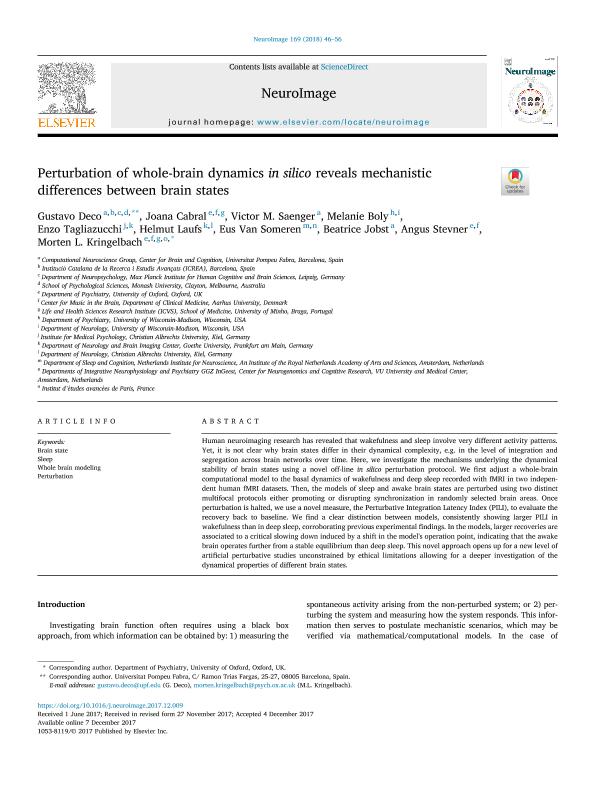
Human neuroimaging research has revealed that wakefulness and sleep involve very different activity patterns. Yet, it is not clear why brain states differ in their dynamical complexity, e.g. in the level of integration and segregation across brain networks over time. Here, we investigate the mechanisms underlying the dynamical stability of brain states using a novel off-line in silico perturbation protocol. We first adjust a whole-brain computational model to the basal dynamics of wakefulness and deep sleep recorded with fMRI in two independent human fMRI datasets. Then, the models of sleep and awake brain states are perturbed using two distinct multifocal protocols either promoting or disrupting synchronization in randomly selected brain areas. Once perturbation is halted, we use a novel measure, the Perturbative Integration Latency Index (PILI), to evaluate the recovery back to baseline. We find a clear distinction between models, consistently showing larger PILI in wakefulness than in deep sleep, corroborating previous experimental findings. In the models, larger recoveries are associated to a critical slowing down induced by a shift in the model's operation point, indicating that the awake brain operates further from a stable equilibrium than deep sleep. This novel approach opens up for a new level of artificial perturbative studies unconstrained by ethical limitations allowing for a deeper investigation of the dynamical properties of different brain states.
Palabras clave:
BRAIN STATE
,
PERTURBATION
,
SLEEP
,
WHOLE BRAIN MODELING
Archivos asociados

Tamaño:
2.178Mb
Formato:
PDF
Licencia
 Excepto donde se diga explícitamente, este item se publica bajo la siguiente descripción:
Atribución-NoComercial-SinDerivadas 2.5 Argentina (CC BY-NC-ND 2.5 AR)
Excepto donde se diga explícitamente, este item se publica bajo la siguiente descripción:
Atribución-NoComercial-SinDerivadas 2.5 Argentina (CC BY-NC-ND 2.5 AR)
Identificadores
Colecciones
Articulos(IFIBA)
Articulos de INST.DE FISICA DE BUENOS AIRES
Articulos de INST.DE FISICA DE BUENOS AIRES
Citación
Deco, Gustavo; Cabral, Joana; Saenger, Victor M.; Boly, Melanie; Tagliazucchi, Enzo Rodolfo; et al.; Perturbation of whole-brain dynamics in silico reveals mechanistic differences between brain states; Academic Press; Journal Neuroimag; 169; 4-2018; 46-56
Compartir


Altmétricas