Artículo
Glyphosate-based herbicide enhances the uterine sensitivity to estradiol in rats
Guerrero Schimpf, Marlise Luciana ; Milesi, Maria Mercedes
; Luque, Enrique Hugo
; Varayoud, Jorgelina Guadalupe
; Milesi, Maria Mercedes
; Luque, Enrique Hugo
; Varayoud, Jorgelina Guadalupe
; Milesi, Maria Mercedes
; Luque, Enrique Hugo
; Varayoud, Jorgelina Guadalupe
Fecha de publicación:
11/2018
Editorial:
BioScientifica
Revista:
Journal of Endocrinology
ISSN:
0022-0795
Idioma:
Inglés
Tipo de recurso:
Artículo publicado
Clasificación temática:
Resumen
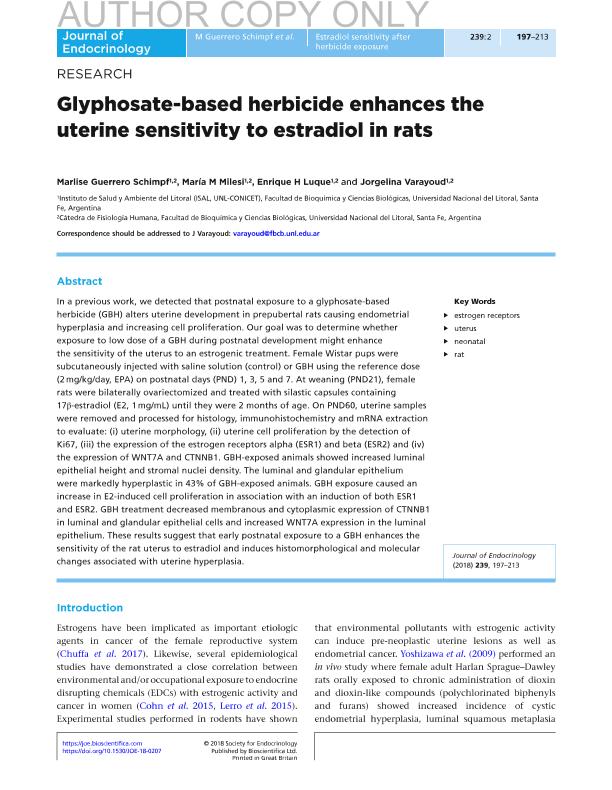
In a previous work, we detected that postnatal exposure to a glyphosate-based herbicide (GBH) alters uterine development in prepubertal rats causing endometrial hyperplasia and increasing cell proliferation. Our goal was to determine whether exposure to low dose of a GBH during postnatal development might enhance the sensitivity of the uterus to an estrogenic treatment. Female Wistar pups were subcutaneously injected with saline solution (control) or GBH using the reference dose (2 mg/kg/day, EPA) on postnatal days (PND) 1, 3, 5 and 7. At weaning (PND21), female rats were bilaterally ovariectomized and treated with silastic capsules containing 17β-estradiol (E2, 1 mg/mL) until they were 2 months of age. On PND60, uterine samples were removed and processed for histology, immunohistochemistry and mRNA extraction to evaluate: (i) uterine morphology, (ii) uterine cell proliferation by the detection of Ki67, (iii) the expression of the estrogen receptors alpha (ESR1) and beta (ESR2) and (iv) the expression of WNT7A and CTNNB1. GBH-exposed animals showed increased luminal epithelial height and stromal nuclei density. The luminal and glandular epithelium were markedly hyperplastic in 43% of GBH-exposed animals. GBH exposure caused an increase in E2-induced cell proliferation in association with an induction of both ESR1 and ESR2. GBH treatment decreased membranous and cytoplasmic expression of CTNNB1 in luminal and glandular epithelial cells and increased WNT7A expression in the luminal epithelium. These results suggest that early postnatal exposure to a GBH enhances the sensitivity of the rat uterus to estradiol and induces histomorphological and molecular changes associated with uterine hyperplasia.
Palabras clave:
ESTROGEN RECEPTORS
,
UTERUS
,
NEONATAL
,
RAT
Archivos asociados

Tamaño:
5.646Mb
Formato:
PDF
Licencia
 Excepto donde se diga explícitamente, este item se publica bajo la siguiente descripción:
Creative Commons Attribution-NonCommercial-ShareAlike 2.5 Unported (CC BY-NC-SA 2.5)
Excepto donde se diga explícitamente, este item se publica bajo la siguiente descripción:
Creative Commons Attribution-NonCommercial-ShareAlike 2.5 Unported (CC BY-NC-SA 2.5)
Identificadores
Colecciones
Articulos(ISAL)
Articulos de INSTITUTO DE SALUD Y AMBIENTE DEL LITORAL
Articulos de INSTITUTO DE SALUD Y AMBIENTE DEL LITORAL
Citación
Guerrero Schimpf, Marlise Luciana; Milesi, Maria Mercedes; Luque, Enrique Hugo; Varayoud, Jorgelina Guadalupe; Glyphosate-based herbicide enhances the uterine sensitivity to estradiol in rats; BioScientifica; Journal of Endocrinology; 239; 2; 11-2018; 197-213
Compartir


Altmétricas