Artículo
Population structure and reproductive biology of the stone crab Xantho poressa (Crustacea: Decapoda: Xanthidae) in the 'Corrales de Rota' (south-western Spain), a human-modified intertidal fishing area

Fecha de publicación:
03/2010
Editorial:
Cambridge University Press
Revista:
Journal of the Marine Biological Association of the United Kingdom
ISSN:
0025-3154
Idioma:
Inglés
Tipo de recurso:
Artículo publicado
Clasificación temática:
Resumen
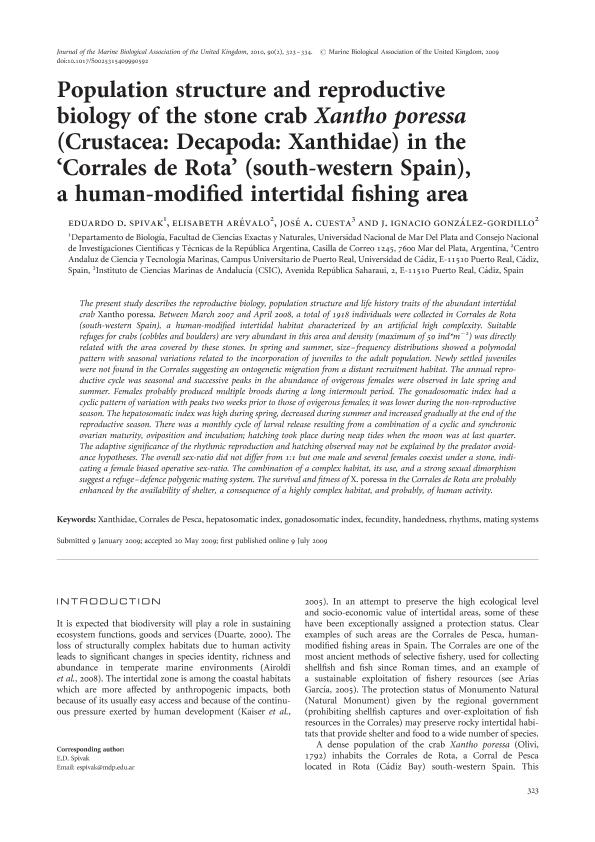
The present study describes the reproductive biology, population structure and life history traits of the abundant intertidal crab Xantho poressa. Between March 2007 and April 2008, a total of 1918 individuals were collected in Corrales de Rota (south-western Spain), a human-modified intertidal habitat characterized by an artificial high complexity. Suitable refuges for crabs (cobbles and boulders) are very abundant in this area and density (maximum of 50 ind*m−2) was directly related with the area covered by these stones. In spring and summer, size–frequency distributions showed a polymodal pattern with seasonal variations related to the incorporation of juveniles to the adult population. Newly settled juveniles were not found in the Corrales suggesting an ontogenetic migration from a distant recruitment habitat. The annual reproductive cycle was seasonal and successive peaks in the abundance of ovigerous females were observed in late spring and summer. Females probably produced multiple broods during a long intermoult period. The gonadosomatic index had a cyclic pattern of variation with peaks two weeks prior to those of ovigerous females; it was lower during the non-reproductive season. The hepatosomatic index was high during spring, decreased during summer and increased gradually at the end of the reproductive season. There was a monthly cycle of larval release resulting from a combination of a cyclic and synchronic ovarian maturity, oviposition and incubation; hatching took place during neap tides when the moon was at last quarter. The adaptive significance of the rhythmic reproduction and hatching observed may not be explained by the predator avoidance hypotheses. The overall sex-ratio did not differ from 1:1 but one male and several females coexist under a stone, indicating a female biased operative sex-ratio. The combination of a complex habitat, its use, and a strong sexual dimorphism suggest a refuge–defence polygenic mating system. The survival and fitness of X. poressa in the Corrales de Rota are probably enhanced by the availability of shelter, a consequence of a highly complex habitat, and probably, of human activity.
Archivos asociados

Tamaño:
458.1Kb
Formato:
PDF
Licencia
 Excepto donde se diga explícitamente, este item se publica bajo la siguiente descripción:
Creative Commons Attribution-NonCommercial-ShareAlike 2.5 Unported (CC BY-NC-SA 2.5)
Excepto donde se diga explícitamente, este item se publica bajo la siguiente descripción:
Creative Commons Attribution-NonCommercial-ShareAlike 2.5 Unported (CC BY-NC-SA 2.5)
Identificadores
Colecciones
Articulos(IIMYC)
Articulos de INSTITUTO DE INVESTIGACIONES MARINAS Y COSTERAS
Articulos de INSTITUTO DE INVESTIGACIONES MARINAS Y COSTERAS
Citación
Spivak, Eduardo Daniel; Arévalo, Elisabeth; Cuesta, José A.; González Gordillo, J. Ignacio; Population structure and reproductive biology of the stone crab Xantho poressa (Crustacea: Decapoda: Xanthidae) in the 'Corrales de Rota' (south-western Spain), a human-modified intertidal fishing area; Cambridge University Press; Journal of the Marine Biological Association of the United Kingdom; 90; 2; 3-2010; 323-334
Compartir


Altmétricas