Artículo
Moisture deficit and defoliation effects on white clover yield and demography

Fecha de publicación:
09/2010
Editorial:
Crop Science Society of America
Revista:
Crop Science
ISSN:
0011-183X
Idioma:
Inglés
Tipo de recurso:
Artículo publicado
Clasificación temática:
Resumen
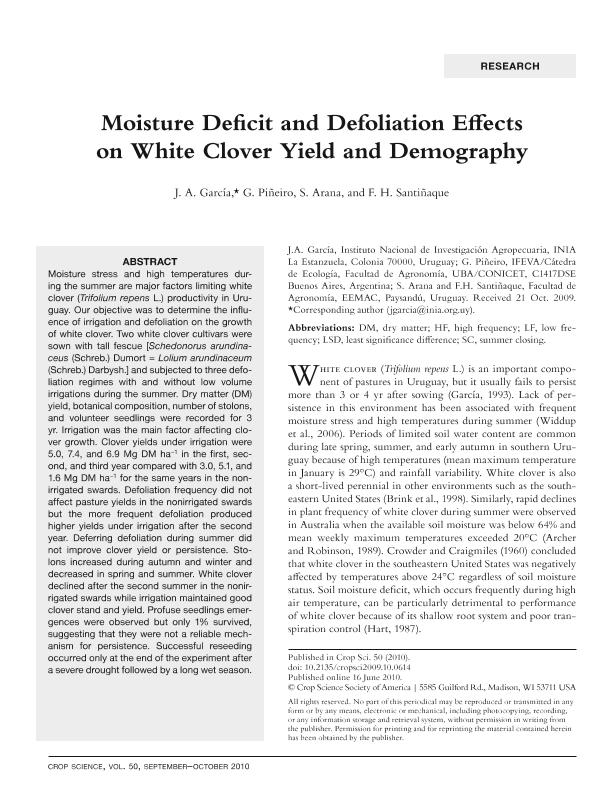
Moisture stress and high temperatures during the summer are major factors limiting white clover (Trifolium repens L.) productivity in Uruguay. Our objective was to determine the influence of irrigation and defoliation on the growth of white clover. Two white clover cultivars were sown with tall fescue [Schedonorus arundinaceus (Schreb.) Dumort = Lolium arundinaceum (Schreb.) Darbysh.] and subjected to three defoliation regimes with and without low volume irrigations during the summer. Dry matter (DM) yield, botanical composition, number of stolons, and volunteer seedlings were recorded for 3 yr. Irrigation was the main factor affecting clover growth. Clover yields under irrigation were 5.0, 7.4, and 6.9 Mg DM ha−1 in the first, second, and third year compared with 3.0, 5.1, and 1.6 Mg DM ha−1 for the same years in the nonirrigated swards. Defoliation frequency did not affect pasture yields in the nonirrigated swards but the more frequent defoliation produced higher yields under irrigation after the second year. Deferring defoliation during summer did not improve clover yield or persistence. Stolons increased during autumn and winter and decreased in spring and summer. White clover declined after the second summer in the nonirrigated swards while irrigation maintained good clover stand and yield. Profuse seedlings emergences were observed but only 1% survived, suggesting that they were not a reliable mechanism for persistence. Successful reseeding occurred only at the end of the experiment after a severe drought followed by a long wet season.
Palabras clave:
White Clover
,
Seedlings
,
Persistence
,
Pastures
Archivos asociados

Tamaño:
638.4Kb
Formato:
PDF
Licencia
 Excepto donde se diga explícitamente, este item se publica bajo la siguiente descripción:
Creative Commons Attribution-NonCommercial-ShareAlike 2.5 Unported (CC BY-NC-SA 2.5)
Excepto donde se diga explícitamente, este item se publica bajo la siguiente descripción:
Creative Commons Attribution-NonCommercial-ShareAlike 2.5 Unported (CC BY-NC-SA 2.5)
Identificadores
Colecciones
Articulos(IFEVA)
Articulos de INST.D/INV.FISIOLOGICAS Y ECO.VINCULADAS A L/AGRIC
Articulos de INST.D/INV.FISIOLOGICAS Y ECO.VINCULADAS A L/AGRIC
Citación
García, J.A.; Piñeiro, Gervasio; Arana, S.; Santiñaque, F.H.; Moisture deficit and defoliation effects on white clover yield and demography; Crop Science Society of America; Crop Science; 50; 5; 9-2010; 2009-2020
Compartir


Altmétricas