Artículo
Effect of transforming growth factor beta (TGF-β) receptor I kinase inhibitor on prostate cancer bone growth
Wan, Xinhai; Li, Zhi-Gang; Yingling, Jonathan M.; Yang, Jun; Starbuck, Michael W.; Ravoori, Murali K.; Kundra, Vikas; Vazquez, Elba Susana ; Navone, Nora
; Navone, Nora
Fecha de publicación:
03/2012
Editorial:
Elsevier Science Inc
Revista:
Bone
ISSN:
8756-3282
Idioma:
Inglés
Tipo de recurso:
Artículo publicado
Clasificación temática:
Resumen
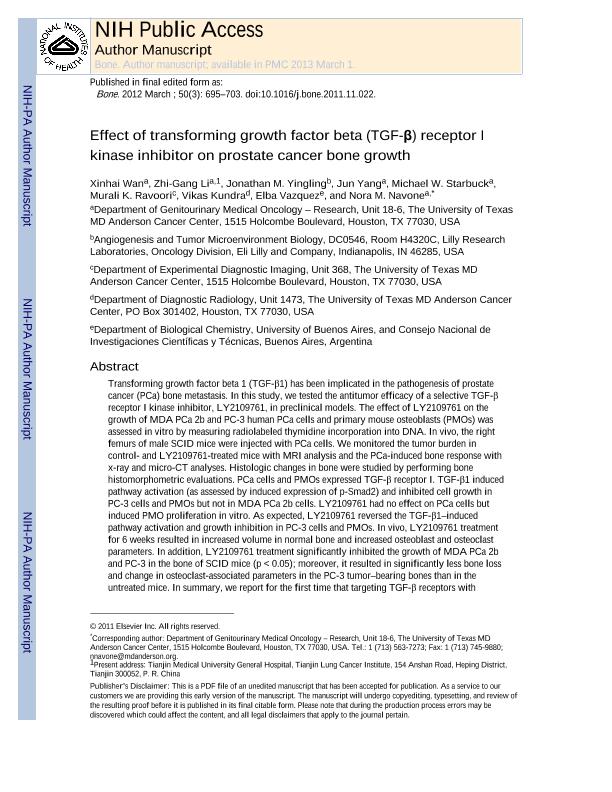
Transforming growth factor beta 1 (TGF-β1) has been implicated in the pathogenesis of prostate cancer (PCa) bone metastasis. In this study, we tested the antitumor efficacy of a selective TGF-β receptor I kinase inhibitor, LY2109761, in preclinical models. The effect of LY2109761 on the growth of MDA PCa 2b and PC-3 human PCa cells and primary mouse osteoblasts (PMOs) was assessed in vitro by measuring radiolabeled thymidine incorporation into DNA. In vivo, the right femurs of male SCID mice were injected with PCa cells. We monitored the tumor burden in control- and LY2109761-treated mice with MRI analysis and the PCa-induced bone response with X-ray and micro-CT analyses. Histologic changes in bone were studied by performing bone histomorphometric evaluations. PCa cells and PMOs expressed TGF-β receptor I. TGF-β1 induced pathway activation (as assessed by induced expression of p-Smad2) and inhibited cell growth in PC-3 cells and PMOs but not in MDA PCa 2b cells. LY2109761 had no effect on PCa cells but induced PMO proliferation in vitro. As expected, LY2109761 reversed the TGF-β1-induced pathway activation and growth inhibition in PC-3 cells and PMOs. In vivo, LY2109761 treatment for 6. weeks resulted in increased volume in normal bone and increased osteoblast and osteoclast parameters. In addition, LY2109761 treatment significantly inhibited the growth of MDA PCa 2b and PC-3 in the bone of SCID mice (p<0.05); moreover, it resulted in significantly less bone loss and change in osteoclast-associated parameters in the PC-3 tumor-bearing bones than in the untreated mice. In summary, we report for the first time that targeting TGF-β receptors with LY2109761 can control PCa bone growth while increasing the mass of normal bone. This increased bone mass in nontumorous bone may be a desirable side effect of LY2109761 treatment for men with osteopenia or osteoporosis secondary to androgen-ablation therapy, reinforcing the benefit of effectively controlling PCa growth in bone. Thus, targeting TGF-β receptor I is a valuable intervention in men with advanced PCa.
Archivos asociados

Tamaño:
2.086Mb
Formato:
PDF
Licencia
 Excepto donde se diga explícitamente, este item se publica bajo la siguiente descripción:
Creative Commons Attribution-NonCommercial-ShareAlike 2.5 Unported (CC BY-NC-SA 2.5)
Excepto donde se diga explícitamente, este item se publica bajo la siguiente descripción:
Creative Commons Attribution-NonCommercial-ShareAlike 2.5 Unported (CC BY-NC-SA 2.5)
Identificadores
Colecciones
Articulos(IQUIBICEN)
Articulos de INSTITUTO DE QUIMICA BIOLOGICA DE LA FACULTAD DE CS. EXACTAS Y NATURALES
Articulos de INSTITUTO DE QUIMICA BIOLOGICA DE LA FACULTAD DE CS. EXACTAS Y NATURALES
Citación
Wan, Xinhai; Li, Zhi-Gang; Yingling, Jonathan M.; Yang, Jun; Starbuck, Michael W.; et al.; Effect of transforming growth factor beta (TGF-β) receptor I kinase inhibitor on prostate cancer bone growth; Elsevier Science Inc; Bone; 50; 3; 3-2012; 695-703
Compartir


Altmétricas