Mostrar el registro sencillo del ítem
dc.contributor.author
Arias, Hugo Rubén
dc.date.available
2020-01-21T00:19:26Z
dc.date.issued
2006-04
dc.identifier.citation
Arias, Hugo Rubén; Marine Toxins Targeting Ion Channels; Molecular Diversity Preservation International; Marine Drugs; 4; 3; 4-2006; 37-69
dc.identifier.issn
1660-3397
dc.identifier.uri
http://hdl.handle.net/11336/95368
dc.description.abstract
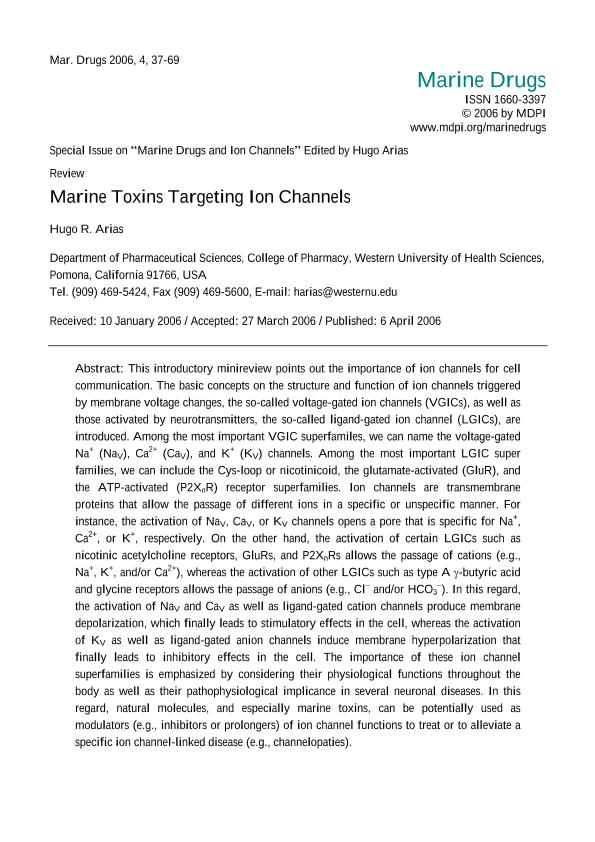
This introductory minireview points out the importance of ion channels for cell communication. The basic concepts on the structure and function of ion channels triggered by membrane voltage changes, the so-called voltage-gated ion channels (VGICs), as well as those activated by neurotransmitters, the so-called ligand-gated ion channel (LGICs), are introduced. Among the most important VGIC superfamiles, we can name the voltage-gated Na+ (NaV), Ca2+ (CaV), and K+ (KV) channels. Among the most important LGIC super families, we can include the Cys-loop or nicotinicoid, the glutamate-activated (GluR), and the ATP-activated (P2XnR) receptor superfamilies. Ion channels are transmembrane proteins that allow the passage of different ions in a specific or unspecific manner. For instance, the activation of NaV, CaV, or KV channels opens a pore that is specific for Na+, Ca2+, or K+, respectively. On the other hand, the activation of certain LGICs such as nicotinic acetylcholine receptors, GluRs, and P2XnRs allows the passage of cations (e.g., Na+, K+, and/or Ca2+), whereas the activation of other LGICs such as type A γ-butyric acid and glycine receptors allows the passage of anions (e.g., Cl− and/or HCO3−). In this regard, the activation of NaV and CaV as well as ligand-gated cation channels produce membrane depolarization, which finally leads to stimulatory effects in the cell, whereas the activation of KV as well as ligand-gated anion channels induce membrane hyperpolarization that finally leads to inhibitory effects in the cell. The importance of these ion channel superfamilies is emphasized by considering their physiological functions throughout the body as well as their pathophysiological implicance in several neuronal diseases. In this regard, natural molecules, and especially marine toxins, can be potentially used as modulators (e.g., inhibitors or prolongers) of ion channel functions to treat or to alleviate a specific ion channel-linked disease (e.g., channelopaties).
dc.format
application/pdf
dc.language.iso
eng
dc.publisher
Molecular Diversity Preservation International
dc.rights
info:eu-repo/semantics/openAccess
dc.rights.uri
https://creativecommons.org/licenses/by-nc-sa/2.5/ar/
dc.subject
voltage-gated ion channels;
dc.subject
ligand-gated ion channels;
dc.subject
natural toxins;
dc.subject
marine toxins
dc.subject.classification
Farmacología y Farmacia
dc.subject.classification
Medicina Básica
dc.subject.classification
CIENCIAS MÉDICAS Y DE LA SALUD
dc.title
Marine Toxins Targeting Ion Channels
dc.type
info:eu-repo/semantics/article
dc.type
info:ar-repo/semantics/artículo
dc.type
info:eu-repo/semantics/publishedVersion
dc.date.updated
2019-12-18T13:56:01Z
dc.journal.volume
4
dc.journal.number
3
dc.journal.pagination
37-69
dc.journal.pais
Suiza
dc.journal.ciudad
Basilea
dc.description.fil
Fil: Arias, Hugo Rubén. Western University of Health Sciences; Estados Unidos. Consejo Nacional de Investigaciones Científicas y Técnicas. Centro Científico Tecnológico Conicet - Bahía Blanca. Instituto de Matemática Bahía Blanca. Universidad Nacional del Sur. Departamento de Matemática. Instituto de Matemática Bahía Blanca; Argentina
dc.journal.title
Marine Drugs
dc.relation.alternativeid
info:eu-repo/semantics/altIdentifier/doi/https://doi.org/10.3390/md403037
dc.relation.alternativeid
info:eu-repo/semantics/altIdentifier/url/https://www.mdpi.com/1660-3397/4/3/37
dc.relation.alternativeid
info:eu-repo/semantics/altIdentifier/url/https://www.ncbi.nlm.nih.gov/pmc/articles/PMC3663413/#__ffn_sectitle
Archivos asociados

Tamaño:
360.1Kb
Formato:
PDF