Artículo
Texture discrimination and multi-unit recording in the rat vibrissal nerve

Fecha de publicación:
05/2006
Editorial:
BioMed Central
Revista:
Bmc Neuroscience
ISSN:
1471-2202
Idioma:
Inglés
Tipo de recurso:
Artículo publicado
Clasificación temática:
Resumen
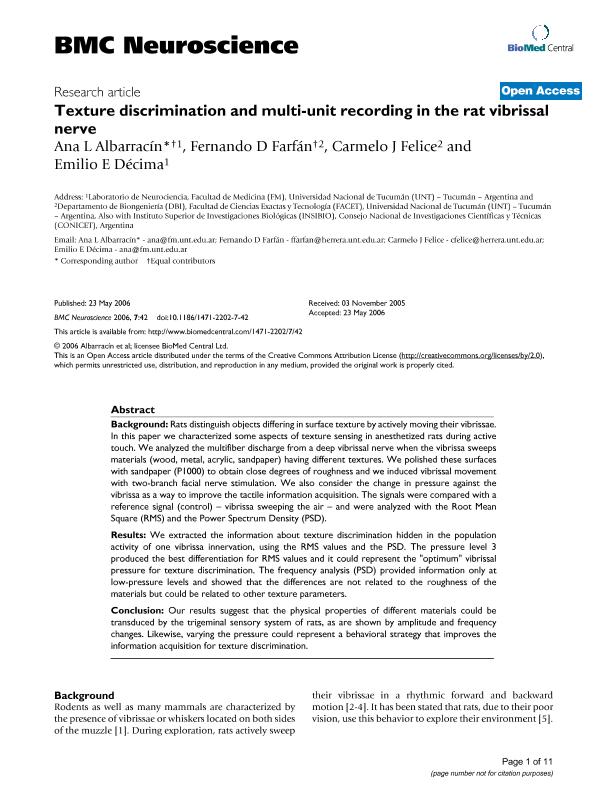
Background: Rats distinguish objects differing in surface texture by actively moving their vibrissae. In this paper we characterized some aspects of texture sensing in anesthetized rats during active touch. We analyzed the multifiber discharge from a deep vibrissal nerve when the vibrissa sweeps materials (wood, metal, acrylic, sandpaper) having different textures. We polished these surfaces with sandpaper (P1000) to obtain close degrees of roughness and we induced vibrissal movement with two-branch facial nerve stimulation. We also consider the change in pressure against the vibrissa as a way to improve the tactile information acquisition. The signals were compared with a reference signal (control) - vibrissa sweeping the air - and were analyzed with the Root Mean Square (RMS) and the Power Spectrum Density (PSD). Results: We extracted the information about texture discrimination hidden in the population activity of one vibrissa innervation, using the RMS values and the PSD. The pressure level 3 produced the best differentiation for RMS values and it could represent the "optimum" vibrissal pressure for texture discrimination. The frequency analysis (PSD) provided information only at low-pressure levels and showed that the differences are not related to the roughness of the materials but could be related to other texture parameters. Conclusion: Our results suggest that the physical properties of different materials could be transduced by the trigeminal sensory system of rats, as are shown by amplitude and frequency changes. Likewise, varying the pressure could represent a behavioral strategy that improves the information acquisition for texture discrimination.
Palabras clave:
Vibrissa
,
Surface Texture
,
Discrimination
Archivos asociados

Tamaño:
415.4Kb
Formato:
PDF
Licencia
 Excepto donde se diga explícitamente, este item se publica bajo la siguiente descripción:
Creative Commons Attribution 2.5 Unported (CC BY 2.5)
Excepto donde se diga explícitamente, este item se publica bajo la siguiente descripción:
Creative Commons Attribution 2.5 Unported (CC BY 2.5)
Identificadores
Colecciones
Articulos(INSIBIO)
Articulos de INST.SUP.DE INVEST.BIOLOGICAS
Articulos de INST.SUP.DE INVEST.BIOLOGICAS
Citación
Albarracin, Ana Lia; Farfan, Fernando Daniel; Felice, Carmelo Jose; Décima, Emilio E.; Texture discrimination and multi-unit recording in the rat vibrissal nerve; BioMed Central; Bmc Neuroscience; 7; 5-2006; 1-11
Compartir


Altmétricas