Artículo
Multiscale modelization in a small virus: Mechanism of proton channeling and its role in triggering capsid disassembly
Viso, Juan Francisco ; Belelli, Patricia Gabriela
; Machado, Matías Agustín
; Gonzalez, Humberto; Pantano, Sergio; Amundarain, María Julia
; Zamarreño, Fernando
; Branda, Maria Marta
; Guérin, Diego Marcelo Alejandro
; Costabel, Marcelo Daniel
; Belelli, Patricia Gabriela
; Machado, Matías Agustín
; Gonzalez, Humberto; Pantano, Sergio; Amundarain, María Julia
; Zamarreño, Fernando
; Branda, Maria Marta
; Guérin, Diego Marcelo Alejandro
; Costabel, Marcelo Daniel
; Belelli, Patricia Gabriela
; Machado, Matías Agustín
; Gonzalez, Humberto; Pantano, Sergio; Amundarain, María Julia
; Zamarreño, Fernando
; Branda, Maria Marta
; Guérin, Diego Marcelo Alejandro
; Costabel, Marcelo Daniel
Fecha de publicación:
16/04/2018
Editorial:
Public Library of Science
Revista:
Plos Computational Biology
ISSN:
1553-734X
Idioma:
Inglés
Tipo de recurso:
Artículo publicado
Resumen
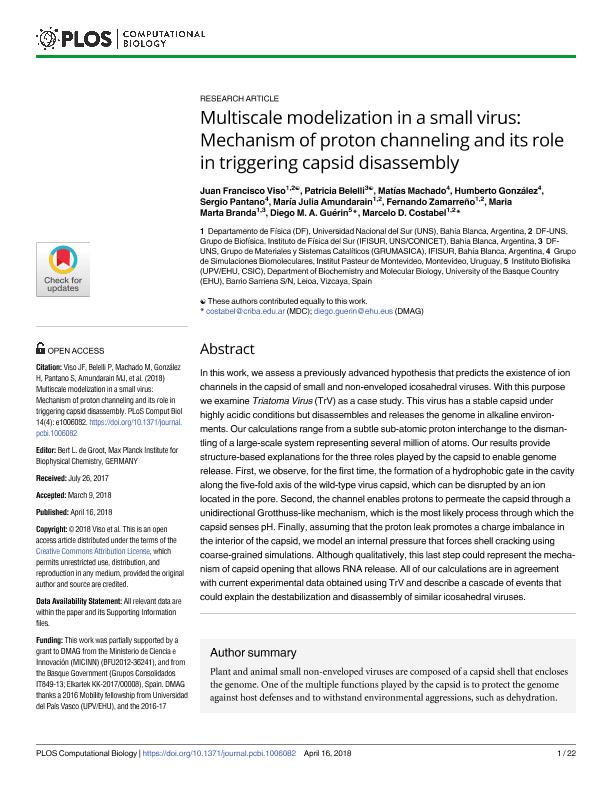
In this work, we assess a previously advanced hypothesis that predicts the existence of ion channels in the capsid of small and non-enveloped icosahedral viruses. With this purpose we examine Triatoma Virus (TrV) as a case study. This virus has a stable capsid under highly acidic conditions but disassembles and releases the genome in alkaline environments. Our calculations range from a subtle sub-atomic proton interchange to the dismantling of a large-scale system representing several million of atoms. Our results provide structure-based explanations for the three roles played by the capsid to enable genome release. First, we observe, for the first time, the formation of a hydrophobic gate in the cavity along the five-fold axis of the wild-type virus capsid, which can be disrupted by an ion located in the pore. Second, the channel enables protons to permeate the capsid through a unidirectional Grotthuss-like mechanism, which is the most likely process through which the capsid senses pH. Finally, assuming that the proton leak promotes a charge imbalance in the interior of the capsid, we model an internal pressure that forces shell cracking using coarse-grained simulations. Although qualitatively, this last step could represent the mechanism of capsid opening that allows RNA release. All of our calculations are in agreement with current experimental data obtained using TrV and describe a cascade of events that could explain the destabilization and disassembly of similar icosahedral viruses.
Palabras clave:
TrV
,
Molecular Dynamics
,
QM/MM
,
Proton channel
Archivos asociados

Tamaño:
23.14Mb
Formato:
PDF
Licencia
 Excepto donde se diga explícitamente, este item se publica bajo la siguiente descripción:
Creative Commons Attribution 2.5 Unported (CC BY 2.5)
Excepto donde se diga explícitamente, este item se publica bajo la siguiente descripción:
Creative Commons Attribution 2.5 Unported (CC BY 2.5)
Identificadores
Colecciones
Articulos(IFISUR)
Articulos de INSTITUTO DE FISICA DEL SUR
Articulos de INSTITUTO DE FISICA DEL SUR
Citación
Viso, Juan Francisco; Belelli, Patricia Gabriela; Machado, Matías Agustín; Gonzalez, Humberto; Pantano, Sergio; et al.; Multiscale modelization in a small virus: Mechanism of proton channeling and its role in triggering capsid disassembly; Public Library of Science; Plos Computational Biology; 14; 4; 16-4-2018; 1-22
Compartir


Altmétricas