Artículo
Vector analysis: A tool for preventing the introduction of invasive alien species into protected areas

Fecha de publicación:
04/01/2018
Editorial:
Pensoft Publishers
Revista:
Nature Conservation
ISSN:
1314–6947
e-ISSN:
1314–3301
Idioma:
Inglés
Tipo de recurso:
Artículo publicado
Clasificación temática:
Resumen
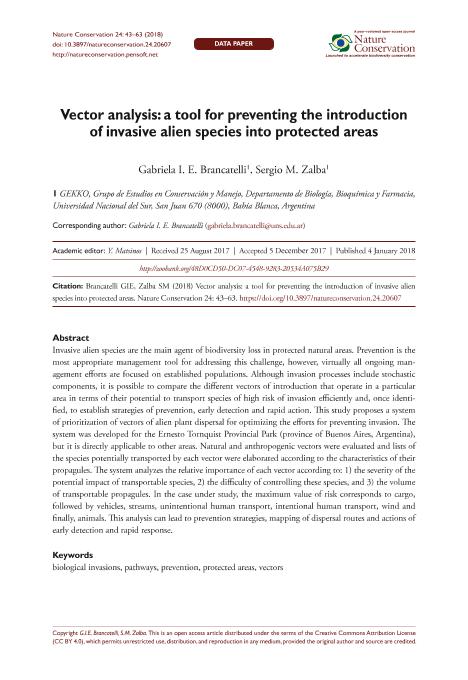
Invasive alien species are the main agent of biodiversity loss in protected natural areas. Prevention is the most appropriate management tool for addressing this challenge, however, virtually all ongoing management efforts are focused on established populations. Although invasion processes include stochastic components, it is possible to compare the different vectors of introduction that operate in a particular area in terms of their potential to transport species of high risk of invasion efficiently and, once identified, to establish strategies of prevention, early detection and rapid action. This study proposes a system of prioritization of vectors of alien plant dispersal for optimizing the efforts for preventing invasion. The system was developed for the Ernesto Tornquist Provincial Park (province of Buenos Aires, Argentina), but it is directly applicable to other areas. Natural and anthropogenic vectors were evaluated and lists of the species potentially transported by each vector were elaborated according to the characteristics of their propagules. The system analyzes the relative importance of each vector according to: 1) the severity of the potential impact of transportable species, 2) the difficulty of controlling these species, and 3) the volume of transportable propagules. In the case under study, the maximum value of risk corresponds to cargo, followed by vehicles, streams, unintentional human transport, intentional human transport, wind and finally, animals. This analysis can lead to prevention strategies, mapping of dispersal routes and actions of early detection and rapid response.
Palabras clave:
BIOLOGICAL INVASIONS
,
PATHWAYS
,
PREVENTION
,
PROTECTED AREAS
,
VECTORS
Archivos asociados

Tamaño:
573.8Kb
Formato:
PDF
Licencia
 Excepto donde se diga explícitamente, este item se publica bajo la siguiente descripción:
Creative Commons Attribution 2.5 Unported (CC BY 2.5)
Excepto donde se diga explícitamente, este item se publica bajo la siguiente descripción:
Creative Commons Attribution 2.5 Unported (CC BY 2.5)
Identificadores
Colecciones
Articulos(CCT - BAHIA BLANCA)
Articulos de CTRO.CIENTIFICO TECNOL.CONICET - BAHIA BLANCA
Articulos de CTRO.CIENTIFICO TECNOL.CONICET - BAHIA BLANCA
Citación
Brancatelli, Gabriela Ivanna Elizabeth; Zalba, Sergio Martín; Vector analysis: A tool for preventing the introduction of invasive alien species into protected areas; Pensoft Publishers; Nature Conservation; 24; 04-1-2018; 43-63
Compartir


Altmétricas