Artículo
Invasive predator control program in Austral Patagonia for endangered bird conservation

Fecha de publicación:
10/2016
Editorial:
Springer
Revista:
European Journal of Wildlife Research
ISSN:
1612-4642
Idioma:
Inglés
Tipo de recurso:
Artículo publicado
Clasificación temática:
Resumen
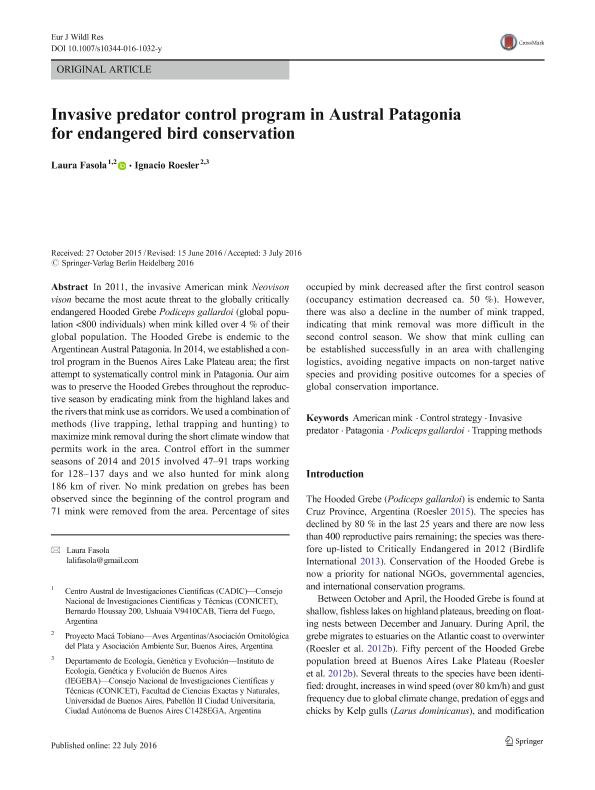
In 2011, the invasive American mink Neovison vison became the most acute threat to the globally critically endangered Hooded Grebe Podiceps gallardoi (global population <800 individuals) when mink killed over 4 % of their global population. The Hooded Grebe is endemic to the Argentinean Austral Patagonia. In 2014, we established a control program in the Buenos Aires Lake Plateau area; the first attempt to systematically control mink in Patagonia. Our aim was to preserve the Hooded Grebes throughout the reproductive season by eradicating mink from the highland lakes and the rivers that mink use as corridors. We used a combination of methods (live trapping, lethal trapping and hunting) to maximize mink removal during the short climate window that permits work in the area. Control effort in the summer seasons of 2014 and 2015 involved 47–91 traps working for 128–137 days and we also hunted for mink along 186 km of river. No mink predation on grebes has been observed since the beginning of the control program and 71 mink were removed from the area. Percentage of sites occupied by mink decreased after the first control season (occupancy estimation decreased ca. 50 %). However, there was also a decline in the number of mink trapped, indicating that mink removal was more difficult in the second control season. We show that mink culling can be established successfully in an area with challenging logistics, avoiding negative impacts on non-target native species and providing positive outcomes for a species of global conservation importance.
Archivos asociados

Tamaño:
808.5Kb
Formato:
PDF
Licencia
 Excepto donde se diga explícitamente, este item se publica bajo la siguiente descripción:
Creative Commons Attribution-NonCommercial-ShareAlike 2.5 Unported (CC BY-NC-SA 2.5)
Excepto donde se diga explícitamente, este item se publica bajo la siguiente descripción:
Creative Commons Attribution-NonCommercial-ShareAlike 2.5 Unported (CC BY-NC-SA 2.5)
Identificadores
Colecciones
Articulos(CADIC)
Articulos de CENTRO AUSTRAL DE INVESTIGACIONES CIENTIFICAS
Articulos de CENTRO AUSTRAL DE INVESTIGACIONES CIENTIFICAS
Citación
Fasola, Laura; Roesler, Carlos Ignacio; Invasive predator control program in Austral Patagonia for endangered bird conservation; Springer; European Journal of Wildlife Research; 62; 5; 10-2016; 601-608
Compartir


Altmétricas