Artículo
Trophic interactions and food web structure of a subantarctic marine food web in the Beagle Channel: Bahía Lapataia, Argentina

Fecha de publicación:
04/2017
Editorial:
Springer
Revista:
Polar Biology
ISSN:
0722-4060
Idioma:
Inglés
Tipo de recurso:
Artículo publicado
Clasificación temática:
Resumen
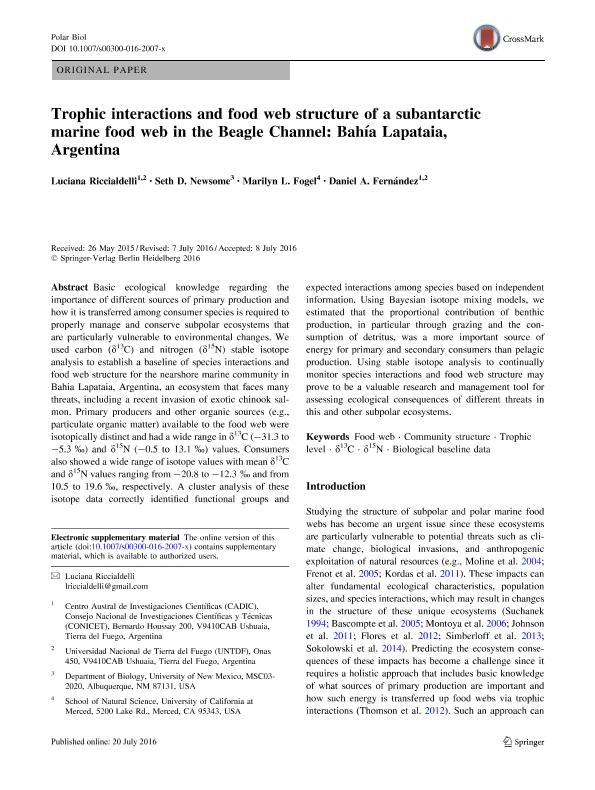
Basic ecological knowledge regarding the importance of different sources of primary production and how it is transferred among consumer species is required to properly manage and conserve subpolar ecosystems that are particularly vulnerable to environmental changes. We used carbon (δ13C) and nitrogen (δ15N) stable isotope analysis to establish a baseline of species interactions and food web structure for the nearshore marine community in Bahia Lapataia, Argentina, an ecosystem that faces many threats, including a recent invasion of exotic chinook salmon. Primary producers and other organic sources (e.g., particulate organic matter) available to the food web were isotopically distinct and had a wide range in δ13C (−31.3 to −5.3 ‰) and δ15N (−0.5 to 13.1 ‰) values. Consumers also showed a wide range of isotope values with mean δ13C and δ15N values ranging from −20.8 to −12.3 ‰ and from 10.5 to 19.6 ‰, respectively. A cluster analysis of these isotope data correctly identified functional groups and expected interactions among species based on independent information. Using Bayesian isotope mixing models, we estimated that the proportional contribution of benthic production, in particular through grazing and the consumption of detritus, was a more important source of energy for primary and secondary consumers than pelagic production. Using stable isotope analysis to continually monitor species interactions and food web structure may prove to be a valuable research and management tool for assessing ecological consequences of different threats in this and other subpolar ecosystems.
Palabras clave:
BIOLOGICAL BASELINE DATA
,
COMMUNITY STRUCTURE
,
FOOD WEB
,
TROPHIC LEVEL
,
d13C
,
d13C
Archivos asociados

Tamaño:
855.5Kb
Formato:
PDF
Licencia
 Excepto donde se diga explícitamente, este item se publica bajo la siguiente descripción:
Creative Commons Attribution-NonCommercial-ShareAlike 2.5 Unported (CC BY-NC-SA 2.5)
Excepto donde se diga explícitamente, este item se publica bajo la siguiente descripción:
Creative Commons Attribution-NonCommercial-ShareAlike 2.5 Unported (CC BY-NC-SA 2.5)
Identificadores
Colecciones
Articulos(CADIC)
Articulos de CENTRO AUSTRAL DE INVESTIGACIONES CIENTIFICAS
Articulos de CENTRO AUSTRAL DE INVESTIGACIONES CIENTIFICAS
Citación
Riccialdelli, Luciana; Newsome, Seth D.; Fogel, Marilyn L.; Fernandez, Daniel Alfredo; Trophic interactions and food web structure of a subantarctic marine food web in the Beagle Channel: Bahía Lapataia, Argentina; Springer; Polar Biology; 40; 4; 4-2017; 807-821
Compartir


Altmétricas