Artículo
Mississippian–Early Permian brachiopods from western Argentina: Tools for middle- to high-latitude correlation, paleobiogeographic and paleoclimatic reconstruction

Fecha de publicación:
12/2010
Editorial:
Elsevier Science
Revista:
Palaeogeography, Palaeoclimatology, Palaeoecology
ISSN:
0031-0182
Idioma:
Inglés
Tipo de recurso:
Artículo publicado
Clasificación temática:
Resumen
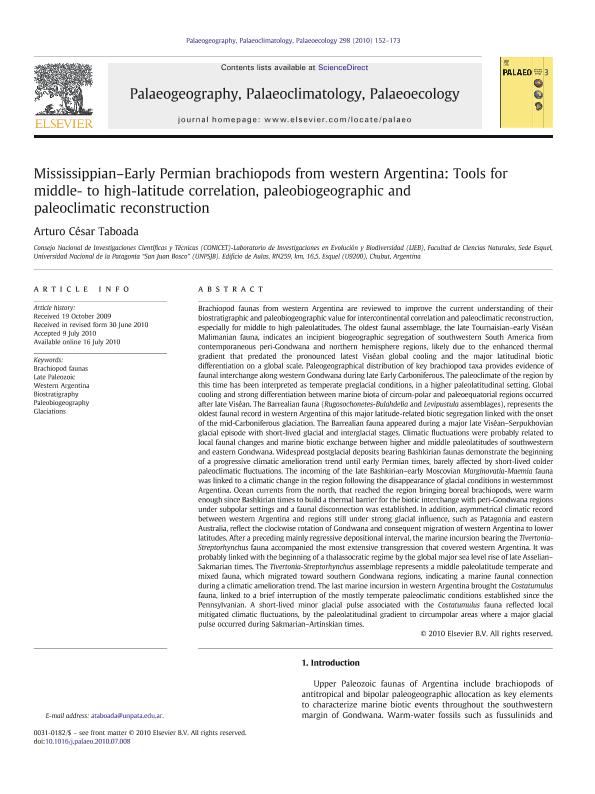
Brachiopod faunas from western Argentina are reviewed to improve the current understanding of their biostratigraphic and paleobiogeographic value for intercontinental correlation and paleoclimatic reconstruction, especially for middle to high paleolatitudes. The oldest faunal assemblage, the late Tournaisian–early Viséan Malimanian fauna, indicates an incipient biogeographic segregation of southwestern South America from contemporaneous peri-Gondwana and northern hemisphere regions, likely due to the enhanced thermal gradient that predated the pronounced latest Viséan global cooling and the major latitudinal biotic differentiation on a global scale. Paleogeographical distribution of key brachiopod taxa provides evidence of faunal interchange along western Gondwana during late Early Carboniferous. The paleoclimate of the region by this time has been interpreted as temperate preglacial conditions, in a higher paleolatitudinal setting. Global cooling and strong differentiation between marine biota of circum-polar and paleoequatorial regions occurred after late Viséan. The Barrealian fauna (Rugosochonetes-Bulahdelia and Levipustula assemblages), represents the oldest faunal record in western Argentina of this major latitude-related biotic segregation linked with the onset of the mid-Carboniferous glaciation. The Barrealian fauna appeared during a major late Viséan–Serpukhovian glacial episode with short-lived glacial and interglacial stages. Climatic fluctuations were probably related to local faunal changes and marine biotic exchange between higher and middle paleolatitudes of southwestern and eastern Gondwana. Widespread postglacial deposits bearing Bashkirian faunas demonstrate the beginning of a progressive climatic amelioration trend until early Permian times, barely affected by short-lived colder paleoclimatic fluctuations. The incoming of the late Bashkirian–early Moscovian Marginovatia-Maemia fauna was linked to a climatic change in the region following the disappearance of glacial conditions in westernmost Argentina. Ocean currents from the north, that reached the region bringing boreal brachiopods, were warm enough since Bashkirian times to build a thermal barrier for the biotic interchange with peri-Gondwana regions under subpolar settings and a faunal disconnection was established. In addition, asymmetrical climatic record between western Argentina and regions still under strong glacial influence, such as Patagonia and eastern Australia, reflect the clockwise rotation of Gondwana and consequent migration of western Argentina to lower latitudes. After a preceding mainly regressive depositional interval, the marine incursion bearing the Tivertonia-Streptorhynchus fauna accompanied the most extensive transgression that covered western Argentina. It was probably linked with the beginning of a thalassocratic regime by the global major sea level rise of late Asselian–Sakmarian times. The Tivertonia-Streptorhynchus assemblage represents a middle paleolatitude temperate and mixed fauna, which migrated toward southern Gondwana regions, indicating a marine faunal connection during a climatic amelioration trend. The last marine incursion in western Argentina brought the Costatumulus fauna, linked to a brief interruption of the mostly temperate paleoclimatic conditions established since the Pennsylvanian. A short-lived minor glacial pulse associated with the Costatumulus fauna reflected local mitigated climatic fluctuations, by the paleolatitudinal gradient to circumpolar areas where a major glacial pulse occurred during Sakmarian–Artinskian times.
Archivos asociados

Tamaño:
5.721Mb
Formato:
PDF
Licencia
 Excepto donde se diga explícitamente, este item se publica bajo la siguiente descripción:
Creative Commons Attribution-NonCommercial-ShareAlike 2.5 Unported (CC BY-NC-SA 2.5)
Excepto donde se diga explícitamente, este item se publica bajo la siguiente descripción:
Creative Commons Attribution-NonCommercial-ShareAlike 2.5 Unported (CC BY-NC-SA 2.5)
Identificadores
Colecciones
Articulos(SEDE CENTRAL)
Articulos de SEDE CENTRAL
Articulos de SEDE CENTRAL
Citación
Taboada, Arturo Cesar; Mississippian–Early Permian brachiopods from western Argentina: Tools for middle- to high-latitude correlation, paleobiogeographic and paleoclimatic reconstruction; Elsevier Science; Palaeogeography, Palaeoclimatology, Palaeoecology; 298; 1-2; 12-2010; 152-173
Compartir


Altmétricas