Artículo
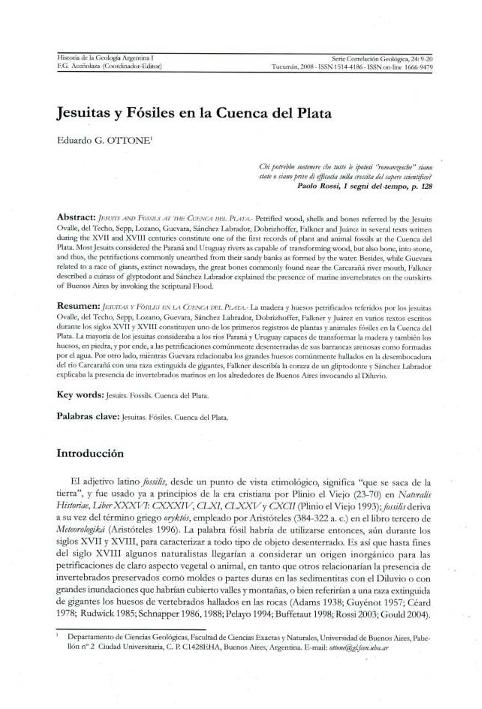
La madera y huesos petrificados referidos por los jesuitas Ovalle, del Techo, Sepp, Lozano, Guevara, Sánchez Labrador, Dobrizhoffer, Falkner y Juárez en varios textos escritos durante los siglos XVII y XVIII constituyen uno de los primeros registros de plantas y animales fósiles en la Cuenca del Plata. La mayoría de los jesuitas consideraba a los ríos Paraná y Uruguay capaces de transformar la madera y también los huesos, en piedra, y por ende, a las petrificaciones comúnmente desenterradas de sus barrancas arenosas como formadas por el agua. Por otro lado, mientras Guevara relacionaba los grandes huesos comúnmente hallados en la desembocadura del río Carcarañá con una raza extinguida de gigantes, Falkner describía la coraza de un gliptodonte y Sánchez Labrador explicaba la presencia de invertebrados marinos en los alrededores de Buenos Aires invocando al Diluvio. Petrified wood, shells and bones referred by the Jesuits Ovalle, del Techo, Sepp, Lozano, Guevara, Sánchez Labrador, Dobrizhoffer, Falkner and Juárez in several texts written during the XVII and XVIII centuries constitute one of the first records of plant and animal fossils at the Cuenca del Plata. Most Jesuits considered the Paraná and Uruguay rivers as capable of transforming wood, but also bone, into stone, and thus, the petrifactions commonly unearthed from their sandy banks as formed by the water. Besides, while Guevara related to a race of giants, extinct nowadays, the great bones commonly found near the Carcarañá river mouth, Falkner described a cuirass of glyptodont and Sánchez Labrador explained the presence of marine invertebrates on the outskirts of Buenos Aires by invoking the scriptural Flood.
Jesuitas y fósiles en la Cuenca del Plata
Título:
Jesuits and fossils at the Cuenca del Plata

Fecha de publicación:
12/2008
Editorial:
Instituto Superior de Correlación Geológica
Revista:
Serie Correlación Geológica
ISSN:
1514-4186
Idioma:
Español
Tipo de recurso:
Artículo publicado
Clasificación temática:
Resumen
Palabras clave:
HISTORIA
,
GEOLOGÍA
,
PALEONTOLOGÍA
,
JESUITAS
Archivos asociados

Tamaño:
1.175Mb
Formato:
PDF
Licencia
 Excepto donde se diga explícitamente, este item se publica bajo la siguiente descripción:
Creative Commons Attribution-NonCommercial-ShareAlike 2.5 Unported (CC BY-NC-SA 2.5)
Excepto donde se diga explícitamente, este item se publica bajo la siguiente descripción:
Creative Commons Attribution-NonCommercial-ShareAlike 2.5 Unported (CC BY-NC-SA 2.5)
Identificadores
Colecciones
Articulos(IDEAN)
Articulos de INSTITUTO DE ESTUDIOS ANDINOS "DON PABLO GROEBER"
Articulos de INSTITUTO DE ESTUDIOS ANDINOS "DON PABLO GROEBER"
Citación
Ottone, Eduardo Guillermo; Jesuitas y fósiles en la Cuenca del Plata; Instituto Superior de Correlación Geológica; Serie Correlación Geológica; 24; 12-2008; 9-20
Compartir

