Mostrar el registro sencillo del ítem
dc.contributor.author
Herrero Jáuregui, Cristina
dc.contributor.author
Oesterheld, Martin
dc.date.available
2020-01-06T15:22:46Z
dc.date.issued
2018-06
dc.identifier.citation
Herrero Jáuregui, Cristina; Oesterheld, Martin; Effects of grazing intensity on plant richness and diversity: a meta-analysis; Wiley Blackwell Publishing, Inc; Oikos; 127; 6; 6-2018; 757-766
dc.identifier.issn
0030-1299
dc.identifier.uri
http://hdl.handle.net/11336/93604
dc.description.abstract
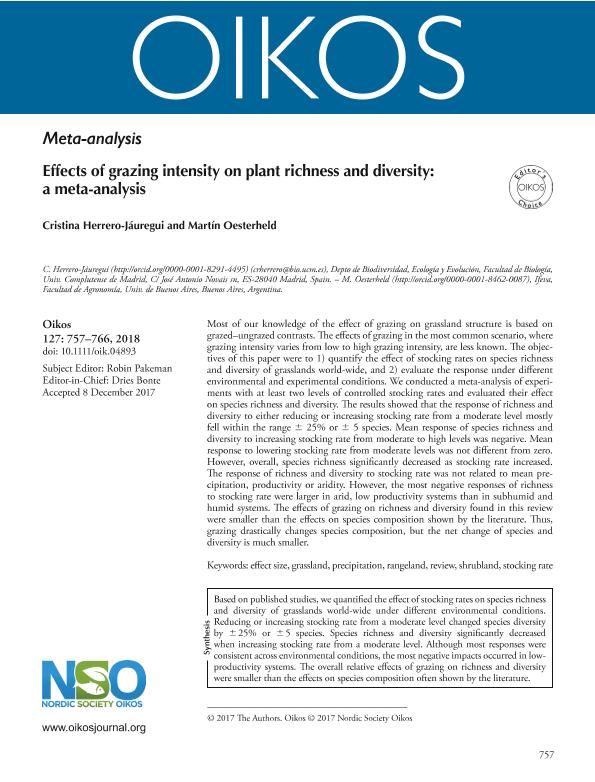
Most of our knowledge of the effect of grazing on grassland structure is based on grazed–ungrazed contrasts. The effects of grazing in the most common scenario, where grazing intensity varies from low to high grazing intensity, are less known. The objectives of this paper were to 1) quantify the effect of stocking rates on species richness and diversity of grasslands world-wide, and 2) evaluate the response under different environmental and experimental conditions. We conducted a meta-analysis of experiments with at least two levels of controlled stocking rates and evaluated their effect on species richness and diversity. The results showed that the response of richness and diversity to either reducing or increasing stocking rate from a moderate level mostly fell within the range 25% or 5 species. Mean response of species richness and diversity to increasing stocking rate from moderate to high levels was negative. Mean response to lowering stocking rate from moderate levels was not different from zero. However, overall, species richness significantly decreased as stocking rate increased. The response of richness and diversity to stocking rate was not related to mean precipitation, productivity or aridity. However, the most negative responses of richness to stocking rate were larger in arid, low productivity systems than in subhumid and humid systems. The effects of grazing on richness and diversity found in this review were smaller than the effects on species composition shown by the literature. Thus, grazing drastically changes species composition, but the net change of species and diversity is much smaller.
dc.format
application/pdf
dc.language.iso
eng
dc.publisher
Wiley Blackwell Publishing, Inc
dc.rights
info:eu-repo/semantics/openAccess
dc.rights.uri
https://creativecommons.org/licenses/by-nc-sa/2.5/ar/
dc.subject
EFFECT SIZE
dc.subject
GRASSLAND
dc.subject
PRECIPITATION
dc.subject
RANGELAND
dc.subject
REVIEW
dc.subject
SHRUBLAND
dc.subject
STOCKING RATE
dc.subject.classification
Otras Ciencias Agrícolas
dc.subject.classification
Otras Ciencias Agrícolas
dc.subject.classification
CIENCIAS AGRÍCOLAS
dc.title
Effects of grazing intensity on plant richness and diversity: a meta-analysis
dc.type
info:eu-repo/semantics/article
dc.type
info:ar-repo/semantics/artículo
dc.type
info:eu-repo/semantics/publishedVersion
dc.date.updated
2019-10-23T21:16:24Z
dc.journal.volume
127
dc.journal.number
6
dc.journal.pagination
757-766
dc.journal.pais
Reino Unido
dc.journal.ciudad
Londres
dc.description.fil
Fil: Herrero Jáuregui, Cristina. Universidad Complutense de Madrid; España
dc.description.fil
Fil: Oesterheld, Martin. Consejo Nacional de Investigaciones Científicas y Técnicas. Oficina de Coordinación Administrativa Parque Centenario. Instituto de Investigaciones Fisiológicas y Ecológicas Vinculadas a la Agricultura. Universidad de Buenos Aires. Facultad de Agronomía. Instituto de Investigaciones Fisiológicas y Ecológicas Vinculadas a la Agricultura; Argentina
dc.journal.title
Oikos
dc.relation.alternativeid
info:eu-repo/semantics/altIdentifier/url/http://doi.wiley.com/10.1111/oik.04893
dc.relation.alternativeid
info:eu-repo/semantics/altIdentifier/doi/http://dx.doi.org/10.1111/oik.04893
Archivos asociados

Tamaño:
718.6Kb
Formato:
PDF