Artículo
Liquid transfer from single cavities to rotating rolls

Fecha de publicación:
05/2014
Editorial:
Cambridge University Press
Revista:
Journal Of Fluid Mechanics
ISSN:
0022-1120
Idioma:
Inglés
Tipo de recurso:
Artículo publicado
Clasificación temática:
Resumen
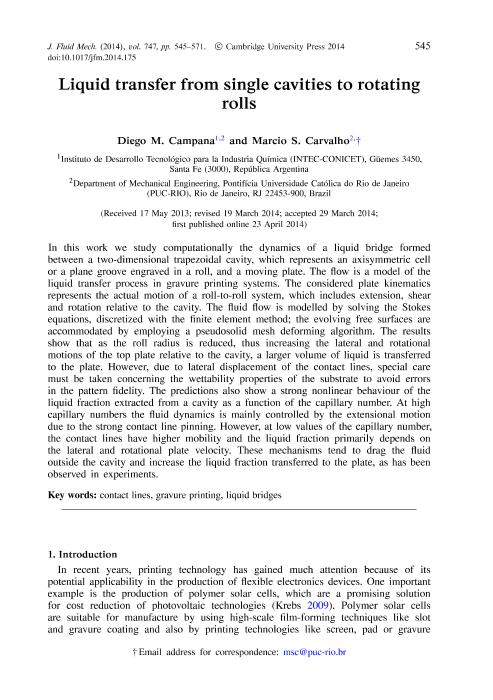
In this work we study computationally the dynamics of a liquid bridge formed between a 2D trapezoidal cavity, which represents an axisymmetric cell or a plane groove engraved in a roll, and a moving plate. The flow is a model of the liquid transfer process in gravure printing systems. The considered plate kinematics represents the actual motion of a roll-to-roll system, which includes extension, shear and rotation relative to the cavity. The fluid flow is modeled by solving the Stokes equations, discretized with the finite element method; the evolving free surfaces are accomodated by employing a pseudo-solid mesh deforming algorithm. The results show that as the roll radius is reduced, thus increasing lateral and rotational motions of the top plate relative to the cavity, a larger volume of liquid is transferred to the plate. However, due to lateral displacement of the contact lines, special care must be taken concerning the wettability properties of the substrate to avoid errors in the pattern fidelity. The predictions also show a strong non-linear behavior of the liquid fraction extracted from a cavity as a function of the capillary number. At high capillary numbers the fluid dynamics is mainly controlled by the extensional motion due to the strong contact line pinning. On the other hand, at low values of capillary number, the contact lines have higher mobility and the liquid fraction primarily depends on lateral and rotational plate velocity. These mechanisms tend to drag the fluid outside the cavity and increase the liquid fraction transferred to the plate, as been observed in experiments.
Palabras clave:
Contact Lines
,
Liquid Bridges
,
Gravure Printing
Archivos asociados

Tamaño:
1.144Mb
Formato:
PDF
Licencia
 Excepto donde se diga explícitamente, este item se publica bajo la siguiente descripción:
Creative Commons Attribution-NonCommercial-ShareAlike 2.5 Unported (CC BY-NC-SA 2.5)
Excepto donde se diga explícitamente, este item se publica bajo la siguiente descripción:
Creative Commons Attribution-NonCommercial-ShareAlike 2.5 Unported (CC BY-NC-SA 2.5)
Identificadores
Colecciones
Articulos(INTEC)
Articulos de INST.DE DES.TECNOL.PARA LA IND.QUIMICA (I)
Articulos de INST.DE DES.TECNOL.PARA LA IND.QUIMICA (I)
Citación
Campana, Diego Martin; Carvalho, Marcio; Liquid transfer from single cavities to rotating rolls; Cambridge University Press; Journal Of Fluid Mechanics; 747; 5-2014; 545-571
Compartir


Altmétricas