Mostrar el registro sencillo del ítem
dc.contributor.author
Gallol, Luis Ezequiel
dc.contributor.author
Mohamed, Fabian Heber
dc.date.available
2019-12-30T15:20:48Z
dc.date.issued
2018-05
dc.identifier.citation
Gallol, Luis Ezequiel; Mohamed, Fabian Heber; Immunomorphometric variations of sustentacular cells of the male viscacha adrenal medulla during the annual reproductive cycle. Effects of androgens and melatonin; Elsevier Gmbh, Urban & Fischer Verlag; Acta Histochemica; 120; 4; 5-2018; 363-372
dc.identifier.issn
0065-1281
dc.identifier.uri
http://hdl.handle.net/11336/93215
dc.description.abstract
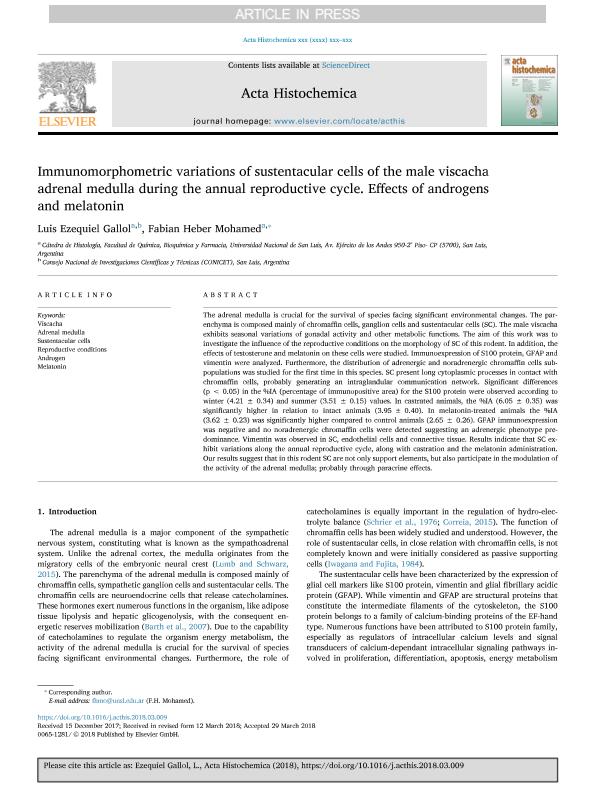
The adrenal medulla is crucial for the survival of species facing significant environmental changes. The parenchyma is composed mainly of chromaffin cells, ganglion cells and sustentacular cells (SC). The male viscacha exhibits seasonal variations of gonadal activity and other metabolic functions. The aim of this work was to investigate the influence of the reproductive conditions on the morphology of SC of this rodent. In addition, the effects of testosterone and melatonin on these cells were studied. Immunoexpression of S100 protein, GFAP and vimentin were analyzed. Furthermore, the distribution of adrenergic and noradrenergic chromaffin cells subpopulations was studied for the first time in this species. SC present long cytoplasmic processes in contact with chromaffin cells, probably generating an intraglandular communication network. Significant differences (p < 0.05) in the %IA (percentage of immunopositive area) for the S100 protein were observed according to winter (4.21 ± 0.34) and summer (3.51 ± 0.15) values. In castrated animals, the %IA (6.05 ± 0.35) was significantly higher in relation to intact animals (3.95 ± 0.40). In melatonin-treated animals the %IA (3.62 ± 0.23) was significantly higher compared to control animals (2.65 ± 0.26). GFAP immunoexpression was negative and no noradrenergic chromaffin cells were detected suggesting an adrenergic phenotype predominance. Vimentin was observed in SC, endothelial cells and connective tissue. Results indicate that SC exhibit variations along the annual reproductive cycle, along with castration and the melatonin administration. Our results suggest that in this rodent SC are not only support elements, but also participate in the modulation of the activity of the adrenal medulla; probably through paracrine effects.
dc.format
application/pdf
dc.language.iso
eng
dc.publisher
Elsevier Gmbh, Urban & Fischer Verlag
dc.rights
info:eu-repo/semantics/openAccess
dc.rights.uri
https://creativecommons.org/licenses/by-nc-nd/2.5/ar/
dc.subject
ADRENAL MEDULLA
dc.subject
ANDROGEN
dc.subject
MELATONIN
dc.subject
REPRODUCTIVE CONDITIONS
dc.subject
SUSTENTACULAR CELLS
dc.subject
VISCACHA
dc.subject.classification
Bioquímica y Biología Molecular
dc.subject.classification
Ciencias Biológicas
dc.subject.classification
CIENCIAS NATURALES Y EXACTAS
dc.title
Immunomorphometric variations of sustentacular cells of the male viscacha adrenal medulla during the annual reproductive cycle. Effects of androgens and melatonin
dc.type
info:eu-repo/semantics/article
dc.type
info:ar-repo/semantics/artículo
dc.type
info:eu-repo/semantics/publishedVersion
dc.date.updated
2019-10-23T21:41:51Z
dc.journal.volume
120
dc.journal.number
4
dc.journal.pagination
363-372
dc.journal.pais
Alemania
dc.description.fil
Fil: Gallol, Luis Ezequiel. Consejo Nacional de Investigaciones Científicas y Técnicas; Argentina. Universidad Nacional de San Luis. Facultad de Química, Bioquímica y Farmacia. Departamento de Bioquímica y Ciencias Biológicas; Argentina
dc.description.fil
Fil: Mohamed, Fabian Heber. Universidad Nacional de San Luis. Facultad de Química, Bioquímica y Farmacia. Departamento de Bioquímica y Ciencias Biológicas; Argentina
dc.journal.title
Acta Histochemica
dc.relation.alternativeid
info:eu-repo/semantics/altIdentifier/doi/http://dx.doi.org/10.1016/j.acthis.2018.03.009
dc.relation.alternativeid
info:eu-repo/semantics/altIdentifier/url/https://www.sciencedirect.com/science/article/pii/S0065128117304579
Archivos asociados

Tamaño:
4.852Mb
Formato:
PDF