Artículo
The role of seed germination in the invasion process of Honey locust (Gleditsia triacanthos L., Fabaceae): comparison with a native confamilial

Fecha de publicación:
04/2015
Editorial:
Wiley Blackwell Publishing, Inc
Revista:
Plant Species Biology
ISSN:
0913-557X
Idioma:
Inglés
Tipo de recurso:
Artículo publicado
Clasificación temática:
Resumen
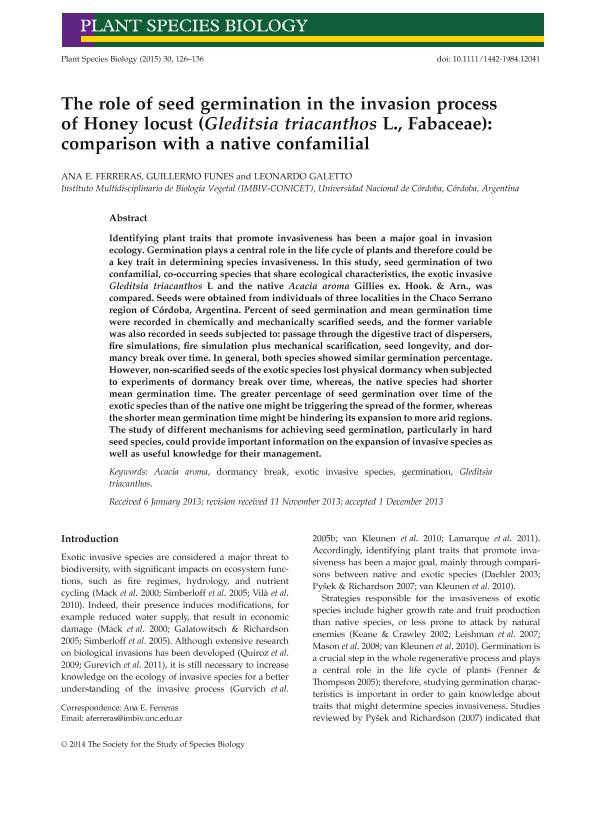
Identifying plant traits that promote invasiveness has been a major goal in invasion ecology. Germination plays a central role in plant life cycle and could therefore be a key trait in determining species invasiveness. In this study, seed germination of two confamilial, co-occurring species that share ecological characteristics, the exotic invasive Gleditsia triacanthos L. and the native Acacia aroma Gillies ex. Hook. & Arn., was compared. Seeds were obtained from individuals of three localities in the Chaco Serrano region of Córdoba, Argentina. Percentage of seed germination and mean germination time were recorded in chemically and mechanically scarified seeds, and the former variable was also recorded in seeds subjected to: passage through the digestive tract of dispersers, fire simulations, fire simulation plus mechanical scarification, seed longevity, and dormancy break over time. In general, both species showed similar germination percentage. However, non-scarified seeds of the exotic species lost physical dormancy when subjected to experiments of dormancy break over time, whereas, the native species had shorter mean germination time. The greater percentage of seed germination over time of the exotic species than of the native one might be triggering the spread of the former, whereas the shorter mean germination time might be hindering its expansion to more arid regions. The study of different mechanisms for achieving seed germination, particularly in hard seed species, could provide important information on the expansion of invasive species as well as useful knowledge for their management.
Archivos asociados

Tamaño:
385.1Kb
Formato:
PDF
Licencia
 Excepto donde se diga explícitamente, este item se publica bajo la siguiente descripción:
Creative Commons Attribution-NonCommercial-ShareAlike 2.5 Unported (CC BY-NC-SA 2.5)
Excepto donde se diga explícitamente, este item se publica bajo la siguiente descripción:
Creative Commons Attribution-NonCommercial-ShareAlike 2.5 Unported (CC BY-NC-SA 2.5)
Identificadores
Colecciones
Articulos(IMBIV)
Articulos de INST.MULTIDISCIPL.DE BIOLOGIA VEGETAL (P)
Articulos de INST.MULTIDISCIPL.DE BIOLOGIA VEGETAL (P)
Citación
Ferreras, Ana Elisa; Funes, Guillermo; Galetto, Leonardo; The role of seed germination in the invasion process of Honey locust (Gleditsia triacanthos L., Fabaceae): comparison with a native confamilial; Wiley Blackwell Publishing, Inc; Plant Species Biology; 30; 2; 4-2015; 126-136
Compartir


Altmétricas