Artículo
Climate change in the distribution of neotropical redbelly toads (Melanophryniscus, Anura, Amphibia): How to prioritize species and populations?
Zank, Caroline; Becker, Fernando Gertum; Abadie, Michelle; Baldo, Juan Diego ; Maneyro, Raúl; Borges Martins, Márcio
; Maneyro, Raúl; Borges Martins, Márcio
Fecha de publicación:
04/2014
Editorial:
Public Library Of Science
Revista:
Plos One
ISSN:
1932-6203
Idioma:
Inglés
Tipo de recurso:
Artículo publicado
Clasificación temática:
Resumen
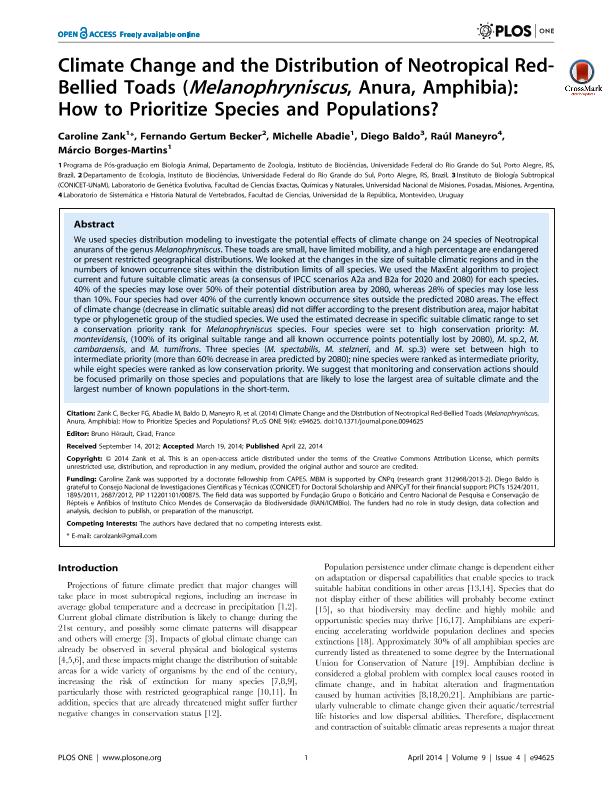
We used species distribution modeling to investigate the potential effects of climate change on 24 species of Neotropical anurans of the genus Melanophryniscus. These toads are small, have limited mobility, and a high percentage are endangered or present restricted geographical distributions. We looked at the changes in the size of suitable climatic regions and in the numbers of known occurrence sites within the distribution limits of all species. We used the MaxEnt algorithm to project current and future suitable climatic areas (a consensus of IPCC scenarios A2a and B2a for 2020 and 2080) for each species. 40% of the species may lose over 50% of their potential distribution area by 2080, whereas 28% of species may lose less than 10%. Four species had over 40% of the currently known occurrence sites outside the predicted 2080 areas. The effect of climate change (decrease in climatic suitable areas) did not differ according to the present distribution area, major habitat type or phylogenetic group of the studied species. We used the estimated decrease in specific suitable climatic range to set a conservation priority rank for Melanophryniscus species. Four species were set to high conservation priority: M. montevidensis, (100% of its original suitable range and all known occurrence points potentially lost by 2080), M. sp.2, M. cambaraensis and M. tumifrons. Three species (M. spectabilis, M. stelzneri and M. sp.3) were set between high to intermediate priority (more than 60% decrease in area predicted by 2080); nine species were ranked as intermediate priority, while eight species were ranked as low conservation priority. We suggest that monitoring and conservation actions should be focused primarily on those species and populations that are likely to lose the largest area of suitable climate and the largest number of known populations in the short-term.
Archivos asociados

Tamaño:
699.8Kb
Formato:
PDF
Licencia
 Excepto donde se diga explícitamente, este item se publica bajo la siguiente descripción:
Creative Commons Attribution 2.5 Unported (CC BY 2.5)
Excepto donde se diga explícitamente, este item se publica bajo la siguiente descripción:
Creative Commons Attribution 2.5 Unported (CC BY 2.5)
Identificadores
Colecciones
Articulos(CCT - NORDESTE)
Articulos de CTRO.CIENTIFICO TECNOL.CONICET - NORDESTE
Articulos de CTRO.CIENTIFICO TECNOL.CONICET - NORDESTE
Citación
Zank, Caroline; Becker, Fernando Gertum; Abadie, Michelle; Baldo, Juan Diego; Maneyro, Raúl; et al.; Climate change in the distribution of neotropical redbelly toads (Melanophryniscus, Anura, Amphibia): How to prioritize species and populations?; Public Library Of Science; Plos One; 9; 4; 4-2014; 1-11
Compartir

