Artículo
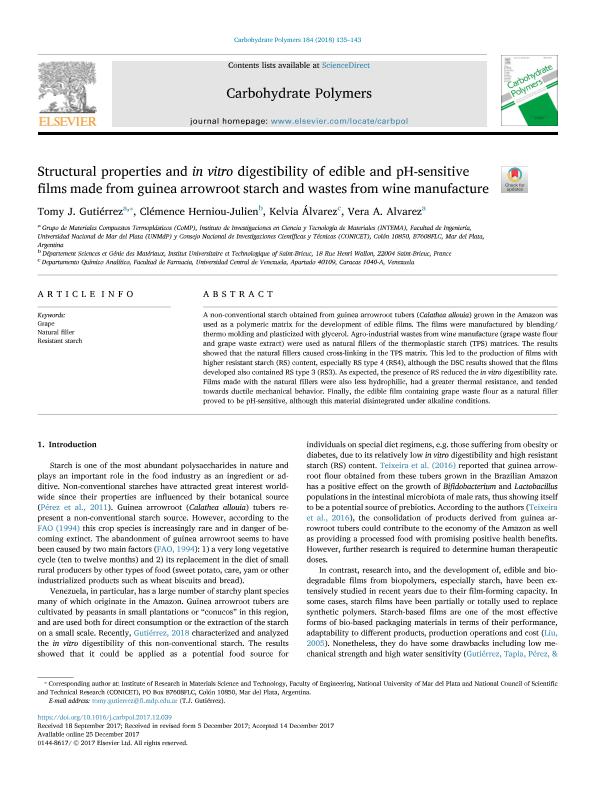
Structural properties and in vitro digestibility of edible and pH-sensitive films made from guinea arrowroot starch and wastes from wine manufacture
Gutiérrez Carmona, Tomy José ; Herniou Julien, Clémence; Alvarez Gonzalez, Kelvia Kristina; Alvarez, Vera Alejandra
; Herniou Julien, Clémence; Alvarez Gonzalez, Kelvia Kristina; Alvarez, Vera Alejandra
Fecha de publicación:
15/03/2018
Editorial:
Elsevier
Revista:
Carbohydrate Polymers
ISSN:
0144-8617
Idioma:
Inglés
Tipo de recurso:
Artículo publicado
Clasificación temática:
Resumen
A non-conventional starch obtained from guinea arrowroot tubers (Calathea allouia) grown in the Amazon was used as a polymeric matrix for the development of edible films. The films were manufactured by blending/thermo molding and plasticized with glycerol. Agro-industrial wastes from wine manufacture (grape waste flour and grape waste extract) were used as natural fillers of the thermoplastic starch (TPS) matrices. The results showed that the natural fillers caused cross-linking in the TPS matrix. This led to the production of films with higher resistant starch (RS) content, especially RS type 4 (RS4), although the DSC results showed that the films developed also contained RS type 3 (RS3). As expected, the presence of RS reduced the in vitro digestibility rate. Films made with the natural fillers were also less hydrophilic, had a greater thermal resistance, and tended towards ductile mechanical behavior. Finally, the edible film containing grape waste flour as a natural filler proved to be pH-sensitive, although this material disintegrated under alkaline conditions.
Palabras clave:
Grape
,
Natural filler
,
Resistant starch
Archivos asociados

Tamaño:
732.8Kb
Formato:
PDF
Licencia
 Excepto donde se diga explícitamente, este item se publica bajo la siguiente descripción:
Creative Commons Attribution-NonCommercial-ShareAlike 2.5 Unported (CC BY-NC-SA 2.5)
Excepto donde se diga explícitamente, este item se publica bajo la siguiente descripción:
Creative Commons Attribution-NonCommercial-ShareAlike 2.5 Unported (CC BY-NC-SA 2.5)
Identificadores
Colecciones
Articulos(INTEMA)
Articulos de INST.DE INV.EN CIENCIA Y TECNOL.MATERIALES (I)
Articulos de INST.DE INV.EN CIENCIA Y TECNOL.MATERIALES (I)
Citación
Gutiérrez Carmona, Tomy José; Herniou Julien, Clémence; Alvarez Gonzalez, Kelvia Kristina; Alvarez, Vera Alejandra; Structural properties and in vitro digestibility of edible and pH-sensitive films made from guinea arrowroot starch and wastes from wine manufacture; Elsevier; Carbohydrate Polymers; 184; 15-3-2018; 135-143
Compartir


Altmétricas