Mostrar el registro sencillo del ítem
dc.contributor.author
Rolandi, Carmen
dc.contributor.author
Lighton, John R. B.
dc.contributor.author
de la Vega, Gerardo José
dc.contributor.author
Schilman, Pablo Ernesto
dc.contributor.author
Mensch, Julian
dc.date.available
2019-12-26T18:46:56Z
dc.date.issued
2018-07
dc.identifier.citation
Rolandi, Carmen; Lighton, John R. B.; de la Vega, Gerardo José; Schilman, Pablo Ernesto; Mensch, Julian; Genetic variation for tolerance to high temperatures in a population of Drosophila melanogaster; Wiley Blackwell Publishing, Inc; Ecology and Evolution; 8; 21; 7-2018; 10374-10383
dc.identifier.issn
2045-7758
dc.identifier.uri
http://hdl.handle.net/11336/92977
dc.description.abstract
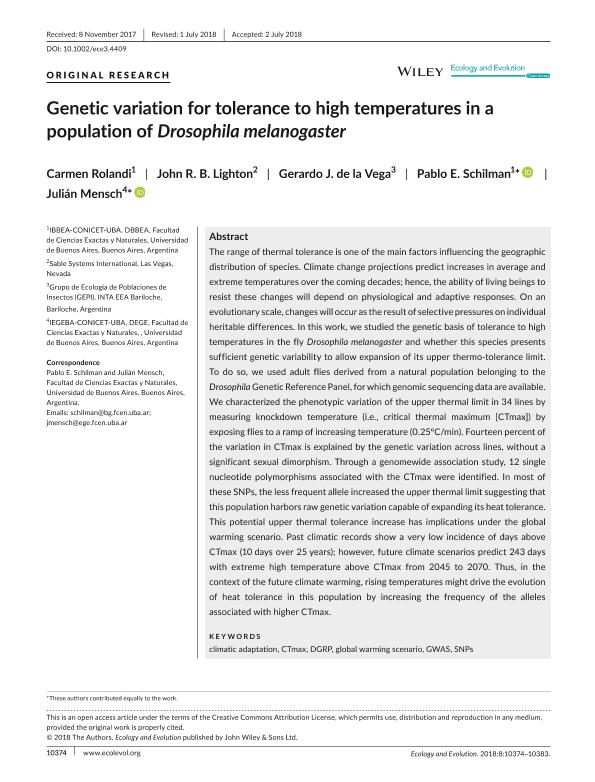
The range of thermal tolerance is one of the main factors influencing the geographic distribution of species. Climate change projections predict increases in average and extreme temperatures over the coming decades; hence, the ability of living beings to resist these changes will depend on physiological and adaptive responses. On an evolutionary scale, changes will occur as the result of selective pressures on individual heritable differences. In this work, we studied the genetic basis of tolerance to high temperatures in the fly Drosophila melanogaster and whether this species presents sufficient genetic variability to allow expansion of its upper thermo-tolerance limit. To do so, we used adult flies derived from a natural population belonging to the Drosophila Genetic Reference Panel, for which genomic sequencing data are available. We characterized the phenotypic variation of the upper thermal limit in 34 lines by measuring knockdown temperature (i.e., critical thermal maximum [CTmax]) by exposing flies to a ramp of increasing temperature (0.25°C/min). Fourteen percent of the variation in CTmax is explained by the genetic variation across lines, without a significant sexual dimorphism. Through a genomewide association study, 12 single nucleotide polymorphisms associated with the CTmax were identified. In most of these SNPs, the less frequent allele increased the upper thermal limit suggesting that this population harbors raw genetic variation capable of expanding its heat tolerance. This potential upper thermal tolerance increase has implications under the global warming scenario. Past climatic records show a very low incidence of days above CTmax (10 days over 25 years); however, future climate scenarios predict 243 days with extreme high temperature above CTmax from 2045 to 2070. Thus, in the context of the future climate warming, rising temperatures might drive the evolution of heat tolerance in this population by increasing the frequency of the alleles associated with higher CTmax.
dc.format
application/pdf
dc.language.iso
eng
dc.publisher
Wiley Blackwell Publishing, Inc
dc.rights
info:eu-repo/semantics/openAccess
dc.rights.uri
https://creativecommons.org/licenses/by-nc-sa/2.5/ar/
dc.subject
CLIMATIC ADAPTATION
dc.subject
CTMAX
dc.subject
DGRP
dc.subject
GLOBAL WARMING SCENARIO
dc.subject
GWAS
dc.subject
SNPS
dc.subject.classification
Biología
dc.subject.classification
Ciencias Biológicas
dc.subject.classification
CIENCIAS NATURALES Y EXACTAS
dc.title
Genetic variation for tolerance to high temperatures in a population of Drosophila melanogaster
dc.type
info:eu-repo/semantics/article
dc.type
info:ar-repo/semantics/artículo
dc.type
info:eu-repo/semantics/publishedVersion
dc.date.updated
2019-12-16T19:11:35Z
dc.journal.volume
8
dc.journal.number
21
dc.journal.pagination
10374-10383
dc.journal.pais
Estados Unidos
dc.description.fil
Fil: Rolandi, Carmen. Consejo Nacional de Investigaciones Científicas y Técnicas. Oficina de Coordinación Administrativa Ciudad Universitaria. Instituto de Biodiversidad y Biología Experimental y Aplicada. Universidad de Buenos Aires. Facultad de Ciencias Exactas y Naturales. Instituto de Biodiversidad y Biología Experimental y Aplicada; Argentina
dc.description.fil
Fil: Lighton, John R. B.. Sable Systems International; Estados Unidos
dc.description.fil
Fil: de la Vega, Gerardo José. Consejo Nacional de Investigaciones Científicas y Técnicas; Argentina. Instituto Nacional de Tecnología Agropecuaria. Centro Regional Patagonia Norte. Estación Experimental Agropecuaria San Carlos de Bariloche; Argentina
dc.description.fil
Fil: Schilman, Pablo Ernesto. Consejo Nacional de Investigaciones Científicas y Técnicas. Oficina de Coordinación Administrativa Ciudad Universitaria. Instituto de Biodiversidad y Biología Experimental y Aplicada. Universidad de Buenos Aires. Facultad de Ciencias Exactas y Naturales. Instituto de Biodiversidad y Biología Experimental y Aplicada; Argentina
dc.description.fil
Fil: Mensch, Julian. Consejo Nacional de Investigaciones Científicas y Técnicas. Oficina de Coordinación Administrativa Ciudad Universitaria. Instituto de Ecología, Genética y Evolución de Buenos Aires. Universidad de Buenos Aires. Facultad de Ciencias Exactas y Naturales. Instituto de Ecología, Genética y Evolución de Buenos Aires; Argentina. Universidad de Buenos Aires. Facultad de Ciencias Exactas y Naturales. Departamento de Ecología, Genética y Evolución; Argentina
dc.journal.title
Ecology and Evolution
dc.relation.alternativeid
info:eu-repo/semantics/altIdentifier/url/https://onlinelibrary.wiley.com/doi/full/10.1002/ece3.4409
dc.relation.alternativeid
info:eu-repo/semantics/altIdentifier/doi/http://dx.doi.org/10.1002/ece3.4409
Archivos asociados

Tamaño:
845.8Kb
Formato:
PDF