Mostrar el registro sencillo del ítem
dc.contributor.author
León Bianchi, Luciana María
dc.contributor.author
Galmarini, Mara Virginia
dc.contributor.author
García Burgos, D.
dc.contributor.author
Zamora, María Clara
dc.date.available
2019-12-26T15:03:50Z
dc.date.issued
2018-07
dc.identifier.citation
León Bianchi, Luciana María; Galmarini, Mara Virginia; García Burgos, D.; Zamora, María Clara; Time-intensity and reaction-time methodology applied to the dynamic perception and liking of bitterness in relation to body mass index; Elsevier Science; Food Research International; 109; 7-2018; 606-613
dc.identifier.issn
0963-9969
dc.identifier.uri
http://hdl.handle.net/11336/92916
dc.description.abstract
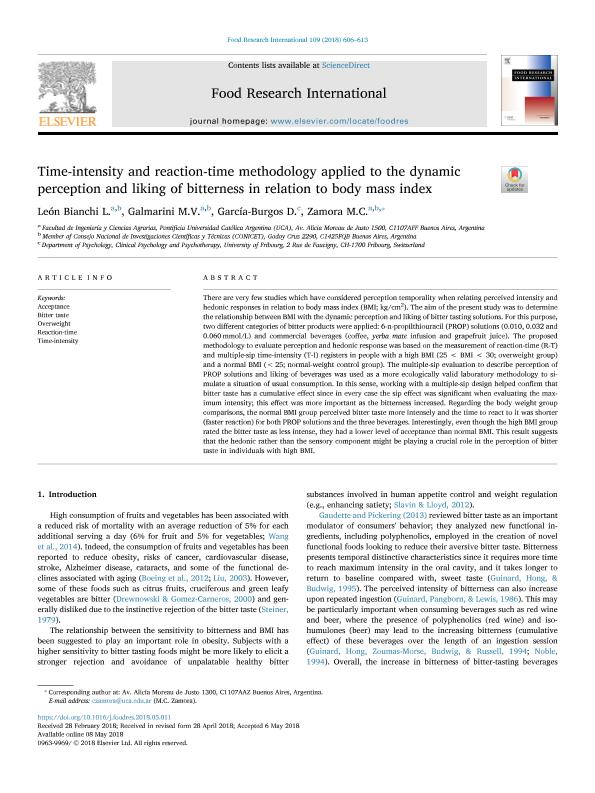
There are very few studies which have considered perception temporality when relating perceived intensity and hedonic responses in relation to body mass index (BMI; kg/cm2). The aim of the present study was to determine the relationship between BMI with the dynamic perception and liking of bitter tasting solutions. For this purpose, two different categories of bitter products were applied: 6-n-propilthiouracil (PROP) solutions (0.010, 0.032 and 0.060 mmol/L) and commercial beverages (coffee, yerba mate infusion and grapefruit juice). The proposed methodology to evaluate perception and hedonic response was based on the measurement of reaction-time (R-T) and multiple-sip time-intensity (T-I) registers in people with a high BMI (25 < BMI < 30; overweight group) and a normal BMI (<25; normal-weight control group). The multiple-sip evaluation to describe perception of PROP solutions and liking of beverages was used as a more ecologically valid laboratory methodology to simulate a situation of usual consumption. In this sense, working with a multiple-sip design helped confirm that bitter taste has a cumulative effect since in every case the sip effect was significant when evaluating the maximum intensity; this effect was more important as the bitterness increased. Regarding the body weight group comparisons, the normal BMI group perceived bitter taste more intensely and the time to react to it was shorter (faster reaction) for both PROP solutions and the three beverages. Interestingly, even though the high BMI group rated the bitter taste as less intense, they had a lower level of acceptance than normal BMI. This result suggests that the hedonic rather than the sensory component might be playing a crucial role in the perception of bitter taste in individuals with high BMI.
dc.format
application/pdf
dc.language.iso
eng
dc.publisher
Elsevier Science
dc.rights
info:eu-repo/semantics/openAccess
dc.rights.uri
https://creativecommons.org/licenses/by-nc-sa/2.5/ar/
dc.subject
ACCEPTANCE
dc.subject
BITTER TASTE
dc.subject
OVERWEIGHT
dc.subject
REACTION-TIME
dc.subject
TIME-INTENSITY
dc.subject.classification
Alimentos y Bebidas
dc.subject.classification
Otras Ingenierías y Tecnologías
dc.subject.classification
INGENIERÍAS Y TECNOLOGÍAS
dc.title
Time-intensity and reaction-time methodology applied to the dynamic perception and liking of bitterness in relation to body mass index
dc.type
info:eu-repo/semantics/article
dc.type
info:ar-repo/semantics/artículo
dc.type
info:eu-repo/semantics/publishedVersion
dc.date.updated
2019-12-20T22:56:40Z
dc.journal.volume
109
dc.journal.pagination
606-613
dc.journal.pais
Países Bajos
dc.journal.ciudad
Amsterdam
dc.description.fil
Fil: León Bianchi, Luciana María. Pontificia Universidad Católica Argentina "Santa María de los Buenos Aires". Facultad de Ciencias Agrarias; Argentina. Consejo Nacional de Investigaciones Científicas y Técnicas; Argentina
dc.description.fil
Fil: Galmarini, Mara Virginia. Consejo Nacional de Investigaciones Científicas y Técnicas; Argentina. Pontificia Universidad Católica Argentina "Santa María de los Buenos Aires". Facultad de Ciencias Agrarias; Argentina
dc.description.fil
Fil: García Burgos, D.. University of Fribourg; Suiza
dc.description.fil
Fil: Zamora, María Clara. Consejo Nacional de Investigaciones Científicas y Técnicas; Argentina. Pontificia Universidad Católica Argentina "Santa María de los Buenos Aires". Facultad de Ciencias Agrarias; Argentina
dc.journal.title
Food Research International
dc.relation.alternativeid
info:eu-repo/semantics/altIdentifier/url/http://linkinghub.elsevier.com/retrieve/pii/S0963996918303673
dc.relation.alternativeid
info:eu-repo/semantics/altIdentifier/doi/http://dx.doi.org/10.1016/j.foodres.2018.05.011
Archivos asociados

Tamaño:
779.2Kb
Formato:
PDF