Artículo
A preliminary simulation for the development of an implantable pulsatile blood pump
Di Paolo, Jose; Insfrán, Jordán Francisco ; Fries, Exequiel R.; Campana, Diego Martin
; Berli, Marcelo Eduardo
; Ubal, Sebastian
; Fries, Exequiel R.; Campana, Diego Martin
; Berli, Marcelo Eduardo
; Ubal, Sebastian
; Fries, Exequiel R.; Campana, Diego Martin
; Berli, Marcelo Eduardo
; Ubal, Sebastian
Fecha de publicación:
06/2014
Editorial:
Techno-press
Revista:
Advances in Biomechanics and Applications
ISSN:
2287-2094
Idioma:
Inglés
Tipo de recurso:
Artículo publicado
Clasificación temática:
Resumen
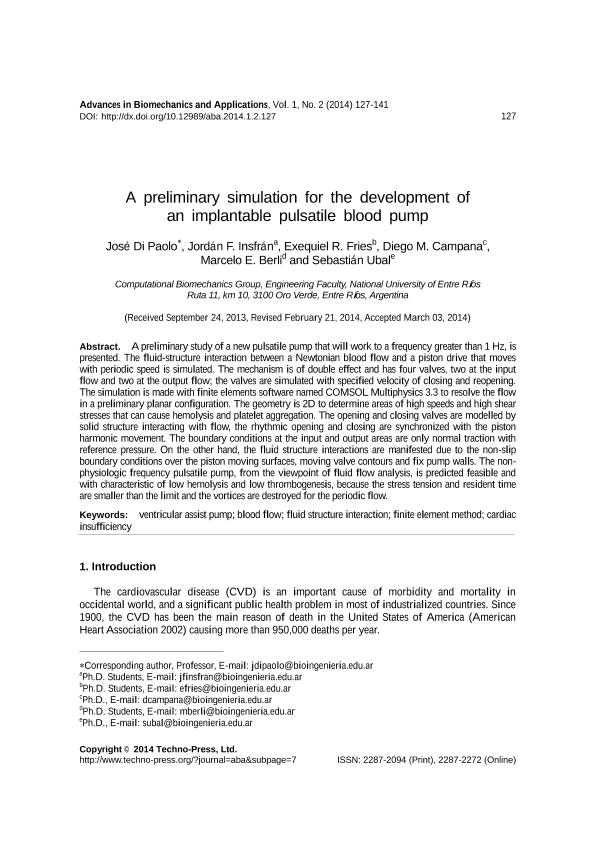
A preliminary study of a new pulsatile pump, that will work to a frequency greater than 1 Hz, is presented. The fluid-structure interaction between a Newtonian blood flow and a piston drive that moves with periodic speed is simulated. The mechanism is of double effect and has four valves, two at the input flow and two at the output flow; the valves are simulated with specified velocity of closing and reopening. The simulation is made with a finite elements software named COMSOL Multiphysics 3.3 to resolve the flow in a preliminary planar configuration. The geometry is 2D to determine areas of high speeds and high shear stresses that can cause hemolysis and platelet aggregation. The opening and closing valves are modelled by solid structure interacting with flow, the rhythmic opening and closing are synchronized with the piston harmonic movement. The boundary conditions at the input and output areas are only normal traction with reference pressure. On the other hand, the fluid structure interactions are manifested due to the non-slip boundary conditions over the piston moving surfaces, moving valve contours and fix pump walls. The non-physiologic frequency pulsatile pump, from the viewpoint of fluid flow analysis, is predicted feasible and with characteristic of low hemolysis and low thrombogenesis, because the stress tension and resident time are smaller than the limit and the vortices are destroyed for the periodic flow.
Archivos asociados

Tamaño:
1.502Mb
Formato:
PDF
Licencia
 Excepto donde se diga explícitamente, este item se publica bajo la siguiente descripción:
Creative Commons Attribution-NonCommercial-ShareAlike 2.5 Unported (CC BY-NC-SA 2.5)
Excepto donde se diga explícitamente, este item se publica bajo la siguiente descripción:
Creative Commons Attribution-NonCommercial-ShareAlike 2.5 Unported (CC BY-NC-SA 2.5)
Identificadores
Colecciones
Articulos(INTEC)
Articulos de INST.DE DES.TECNOL.PARA LA IND.QUIMICA (I)
Articulos de INST.DE DES.TECNOL.PARA LA IND.QUIMICA (I)
Articulos(SEDE CENTRAL)
Articulos de SEDE CENTRAL
Articulos de SEDE CENTRAL
Citación
Di Paolo, Jose; Insfrán, Jordán Francisco; Fries, Exequiel R.; Campana, Diego Martin; Berli, Marcelo Eduardo; et al.; A preliminary simulation for the development of an implantable pulsatile blood pump; Techno-press; Advances in Biomechanics and Applications; 1; 2; 6-2014; 127-141
Compartir


Altmétricas