Artículo
Role of hormonal circuitry upon T cell development in Chagas disease: Possible implications on T cell dysfunctions

Fecha de publicación:
06/2018
Editorial:
Frontiers Research Foundation
Revista:
Frontiers in endocrinology
ISSN:
1664-2392
Idioma:
Inglés
Tipo de recurso:
Artículo publicado
Clasificación temática:
Resumen
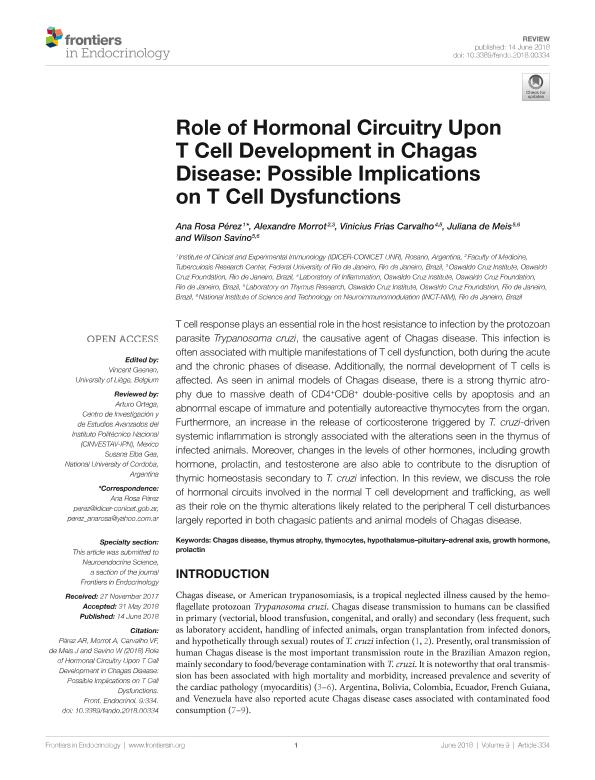
T cell response plays an essential role in the host resistance to infection by the protozoan parasite Trypanosoma cruzi, the causative agent of Chagas disease. This infection is often associated with multiple manifestations of T cell dysfunction, both during the acute and the chronic phases of disease. Additionally, the normal development of T cells is affected. As seen in animal models of Chagas disease, there is a strong thymic atrophy due to massive death of CD4+CD8+ double-positive cells by apoptosis and an abnormal escape of immature and potentially autoreactive thymocytes from the organ. Furthermore, an increase in the release of corticosterone triggered by T. cruzi-driven systemic inflammation is strongly associated with the alterations seen in the thymus of infected animals. Moreover, changes in the levels of other hormones, including growth hormone, prolactin, and testosterone are also able to contribute to the disruption of thymic homeostasis secondary to T. cruzi infection. In this review, we discuss the role of hormonal circuits involved in the normal T cell development and trafficking, as well as their role on the thymic alterations likely related to the peripheral T cell disturbances largely reported in both chagasic patients and animal models of Chagas disease.
Archivos asociados

Tamaño:
404.9Kb
Formato:
PDF
Licencia
 Excepto donde se diga explícitamente, este item se publica bajo la siguiente descripción:
Creative Commons Attribution 2.5 Unported (CC BY 2.5)
Excepto donde se diga explícitamente, este item se publica bajo la siguiente descripción:
Creative Commons Attribution 2.5 Unported (CC BY 2.5)
Identificadores
Colecciones
Articulos(IDICER)
Articulos de INSTITUTO DE INMUNOLOGIA CLINICA Y EXPERIMENTAL DE ROSARIO
Articulos de INSTITUTO DE INMUNOLOGIA CLINICA Y EXPERIMENTAL DE ROSARIO
Citación
Perez, Ana Rosa; Morrot, Alexandre; Carvalho, Vinicius Frias; de Meis, Juliana; Savino, Wilson; Role of hormonal circuitry upon T cell development in Chagas disease: Possible implications on T cell dysfunctions; Frontiers Research Foundation; Frontiers in endocrinology; 9; JUN; 6-2018; 1-8
Compartir


Altmétricas