Artículo
Distinct phenotypic traits of Staphylococcus aureus are associated with persistent, contagious bovine intramammary infections
Grunert, Tom; Stessl, Beatrix; Wolf, Franz; Sordelli, Daniel Oscar ; Buzzola, Fernanda Roxana
; Ehling-Schulz, Monika
; Buzzola, Fernanda Roxana
; Ehling-Schulz, Monika
; Buzzola, Fernanda Roxana
; Ehling-Schulz, Monika
Fecha de publicación:
12/2018
Editorial:
Nature Publishing Group
Revista:
Scientific Reports
e-ISSN:
2045-2322
Idioma:
Inglés
Tipo de recurso:
Artículo publicado
Clasificación temática:
Resumen
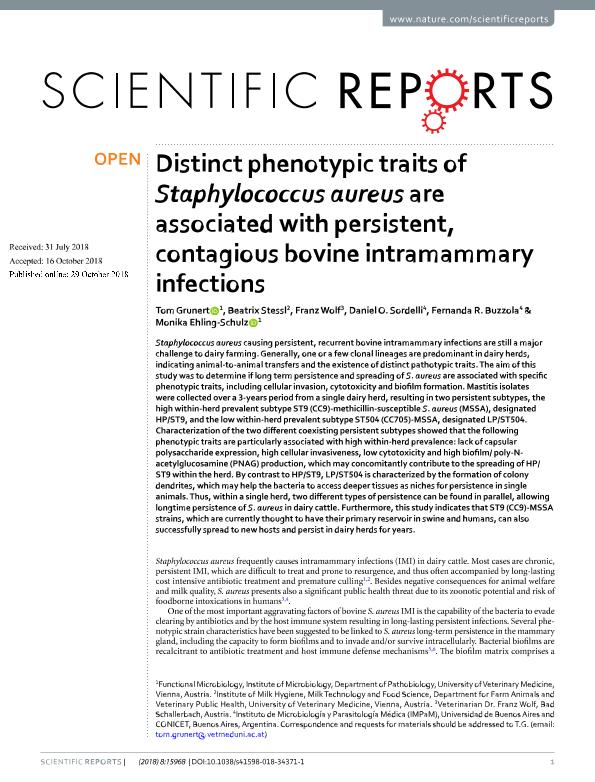
Staphylococcus aureus causing persistent, recurrent bovine intramammary infections are still a major challenge to dairy farming. Generally, one or a few clonal lineages are predominant in dairy herds, indicating animal-to-animal transfers and the existence of distinct pathotypic traits. The aim of this study was to determine if long term persistence and spreading of S. aureus are associated with specific phenotypic traits, including cellular invasion, cytotoxicity and biofilm formation. Mastitis isolates were collected over a 3-years period from a single dairy herd, resulting in two persistent subtypes, the high within-herd prevalent subtype ST9 (CC9)-methicillin-susceptible S. aureus (MSSA), designated HP/ST9, and the low within-herd prevalent subtype ST504 (CC705)-MSSA, designated LP/ST504. Characterization of the two different coexisting persistent subtypes showed that the following phenotypic traits are particularly associated with high within-herd prevalence: lack of capsular polysaccharide expression, high cellular invasiveness, low cytotoxicity and high biofilm/ poly-N-acetylglucosamine (PNAG) production, which may concomitantly contribute to the spreading of HP/ST9 within the herd. By contrast to HP/ST9, LP/ST504 is characterized by the formation of colony dendrites, which may help the bacteria to access deeper tissues as niches for persistence in single animals. Thus, within a single herd, two different types of persistence can be found in parallel, allowing longtime persistence of S. aureus in dairy cattle. Furthermore, this study indicates that ST9 (CC9)-MSSA strains, which are currently thought to have their primary reservoir in swine and humans, can also successfully spread to new hosts and persist in dairy herds for years.
Palabras clave:
Staphyolococcus aureus
,
Bovine
,
Mastitis
,
Persistence
Archivos asociados

Tamaño:
1.568Mb
Formato:
PDF
Licencia
 Excepto donde se diga explícitamente, este item se publica bajo la siguiente descripción:
Creative Commons Attribution-NonCommercial-ShareAlike 2.5 Unported (CC BY-NC-SA 2.5)
Excepto donde se diga explícitamente, este item se publica bajo la siguiente descripción:
Creative Commons Attribution-NonCommercial-ShareAlike 2.5 Unported (CC BY-NC-SA 2.5)
Identificadores
Colecciones
Articulos(IMPAM)
Articulos de INSTITUTO DE INVESTIGACIONES EN MICROBIOLOGIA Y PARASITOLOGIA MEDICA
Articulos de INSTITUTO DE INVESTIGACIONES EN MICROBIOLOGIA Y PARASITOLOGIA MEDICA
Citación
Grunert, Tom; Stessl, Beatrix; Wolf, Franz; Sordelli, Daniel Oscar; Buzzola, Fernanda Roxana; et al.; Distinct phenotypic traits of Staphylococcus aureus are associated with persistent, contagious bovine intramammary infections; Nature Publishing Group; Scientific Reports; 8; 1; 12-2018; 1 - 10
Compartir


Altmétricas