Artículo
Organic matter effects on the Cr(VI) removal efficiency and tolerance of Typha domingensis.
Mufarrege, María de Las Mercedes ; Hadad, Hernán Ricardo
; Di Luca, Gisela Alfonsina
; Sanchez, Gabriela Cristina; Maine, Maria Alejandra
; Caffaratti, Sandra Ester; Pedro, María del Carmen
; Hadad, Hernán Ricardo
; Di Luca, Gisela Alfonsina
; Sanchez, Gabriela Cristina; Maine, Maria Alejandra
; Caffaratti, Sandra Ester; Pedro, María del Carmen
; Hadad, Hernán Ricardo
; Di Luca, Gisela Alfonsina
; Sanchez, Gabriela Cristina; Maine, Maria Alejandra
; Caffaratti, Sandra Ester; Pedro, María del Carmen
Fecha de publicación:
12/2018
Editorial:
Springer
Revista:
Water, Air and Soil Pollution
ISSN:
0049-6979
Idioma:
Inglés
Tipo de recurso:
Artículo publicado
Clasificación temática:
Resumen
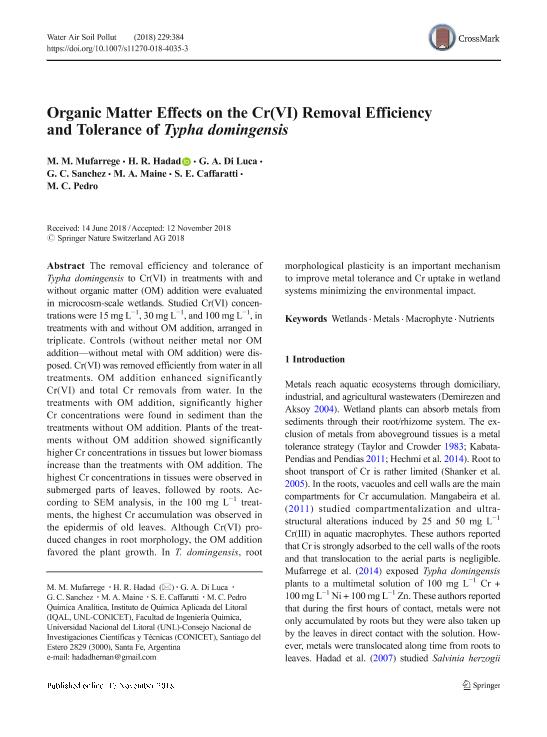
The removal efficiency and tolerance of Typha domingensis to Cr(VI) in treatments with and without organic matter (OM) addition were evaluated in microcosm-scale wetlands. Studied Cr(VI) concentrations were 15 mg L−1, 30 mg L−1, and 100 mg L−1, in treatments with and without OM addition, arranged in triplicate. Controls (without neither metal nor OM addition—without metal with OM addition) were disposed. Cr(VI) was removed efficiently from water in all treatments. OM addition enhanced significantly Cr(VI) and total Cr removals from water. In the treatments with OM addition, significantly higher Cr concentrations were found in sediment than the treatments without OM addition. Plants of the treatments without OM addition showed significantly higher Cr concentrations in tissues but lower biomass increase than the treatments with OM addition. The highest Cr concentrations in tissues were observed in submerged parts of leaves, followed by roots. According to SEM analysis, in the 100 mg L−1 treatments, the highest Cr accumulation was observed in the epidermis of old leaves. Although Cr(VI) produced changes in root morphology, the OM addition favored the plant growth. In T. domingensis, root morphological plasticity is an important mechanism to improve metal tolerance and Cr uptake in wetland systems minimizing the environmental impact.
Palabras clave:
MACROPHYTE
,
METALS
,
NUTRIENTS
,
WETLANDS
Archivos asociados

Tamaño:
1.473Mb
Formato:
PDF
Licencia
 Excepto donde se diga explícitamente, este item se publica bajo la siguiente descripción:
Creative Commons Attribution-NonCommercial-ShareAlike 2.5 Unported (CC BY-NC-SA 2.5)
Excepto donde se diga explícitamente, este item se publica bajo la siguiente descripción:
Creative Commons Attribution-NonCommercial-ShareAlike 2.5 Unported (CC BY-NC-SA 2.5)
Identificadores
Colecciones
Articulos(IQAL)
Articulos de INSTITUTO DE QUIMICA APLICADA DEL LITORAL
Articulos de INSTITUTO DE QUIMICA APLICADA DEL LITORAL
Citación
Mufarrege, María de Las Mercedes; Hadad, Hernán Ricardo; Di Luca, Gisela Alfonsina; Sanchez, Gabriela Cristina; Maine, Maria Alejandra; et al.; Organic matter effects on the Cr(VI) removal efficiency and tolerance of Typha domingensis.; Springer; Water, Air and Soil Pollution; 229; 12; 12-2018
Compartir


Altmétricas