Artículo
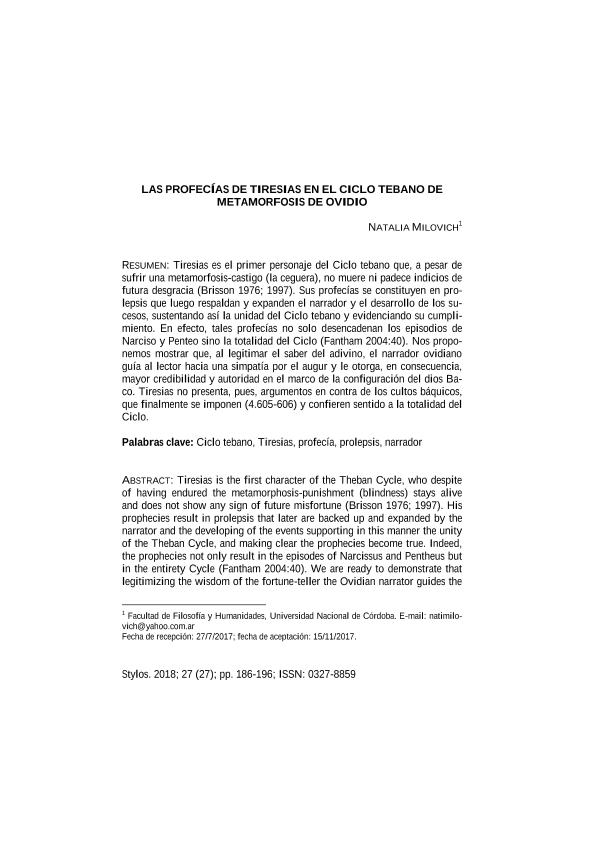
Tiresias es el primer personaje del Ciclo tebano que, a pesar de sufrir una metamorfosis-castigo (la ceguera), no muere ni padece indicios de futura desgracia (Brisson 1976; 1997). Sus profecías se constituyen en prolepsis que luego respaldan y expanden el narrador y el desarrollo de los sucesos, sustentando así la unidad del Ciclo tebano y evidenciando su cumplimiento. En efecto, tales profecías no solo desencadenan los episodios de Narciso y Penteo sino la totalidad del Ciclo (Fantham 2004:40). Nos proponemos mostrar que, al legitimar el saber del adivino, el narrador ovidiano guía al lector hacia una simpatía por el augur y le otorga, en consecuencia, mayor credibilidad y autoridad en el marco de la configuración del dios Baco. Tiresias no presenta, pues, argumentos en contra de los cultos báquicos, que finalmente se imponen (4.605-606) y confieren sentido a la totalidad del Ciclo. Tiresias is the first character of the Theban Cycle, who despite of having endured the metamorphosis-punishment (blindness) stays alive and does not show any sign of future misfortune (Brisson 1976; 1997). His prophecies result in prolepsis that later are backed up and expanded by the narrator and the developing of the events supporting in this manner the unity of the Theban Cycle, and making clear the prophecies become true. Indeed, the prophecies not only result in the episodes of Narcissus and Pentheus but in the entirety Cycle (Fantham 2004:40). We are ready to demonstrate that legitimizing the wisdom of the fortune-teller the Ovidian narrator guides the reader to feel affection for the augur, and consequently gives him more credibility and authority in the frame of configuration of the god Bacchus. Then, Tiresias does not present arguments against Bacchus worships, which are finally imposed (4.605-606) and confer sense to the entirety of the Cycle.
Las profecías de Tiresias en el Ciclo tebano de Metamorfosis de Ovidio

Fecha de publicación:
09/2018
Editorial:
Instituto de Estudios Grecolatinos
Revista:
Stylos
ISSN:
0327-8859
Idioma:
Español
Tipo de recurso:
Artículo publicado
Clasificación temática:
Resumen
Palabras clave:
CICLO TEBANO
,
TIRESIAS
,
METAMORFOSIS
,
BACO
,
PROFECÍA
,
PROLEPSIS
,
NARRADOR
Archivos asociados

Tamaño:
196.6Kb
Formato:
PDF
Licencia
 Excepto donde se diga explícitamente, este item se publica bajo la siguiente descripción:
Creative Commons Attribution-NonCommercial-ShareAlike 2.5 Unported (CC BY-NC-SA 2.5)
Excepto donde se diga explícitamente, este item se publica bajo la siguiente descripción:
Creative Commons Attribution-NonCommercial-ShareAlike 2.5 Unported (CC BY-NC-SA 2.5)
Identificadores
Colecciones
Articulos(CIECS)
Articulos de CENTRO DE INVESTIGACIONES Y ESTUDIO SOBRE CULTURA Y SOCIEDAD
Articulos de CENTRO DE INVESTIGACIONES Y ESTUDIO SOBRE CULTURA Y SOCIEDAD
Citación
Milovich, Natalia; Las profecías de Tiresias en el Ciclo tebano de Metamorfosis de Ovidio; Instituto de Estudios Grecolatinos; Stylos; 27; 27; 9-2018; 186-196
Compartir

