Mostrar el registro sencillo del ítem
dc.contributor.author
Mie, Fabian Gustavo
dc.date.available
2019-11-17T21:34:16Z
dc.date.issued
2018-06
dc.identifier.citation
Mie, Fabian Gustavo; Significado y Mente en Aristóteles; FFLCH/USP; Journal of Ancient Philosophy; 12; 1; 6-2018; 28-95
dc.identifier.issn
1981-9471
dc.identifier.uri
http://hdl.handle.net/11336/89133
dc.description.abstract
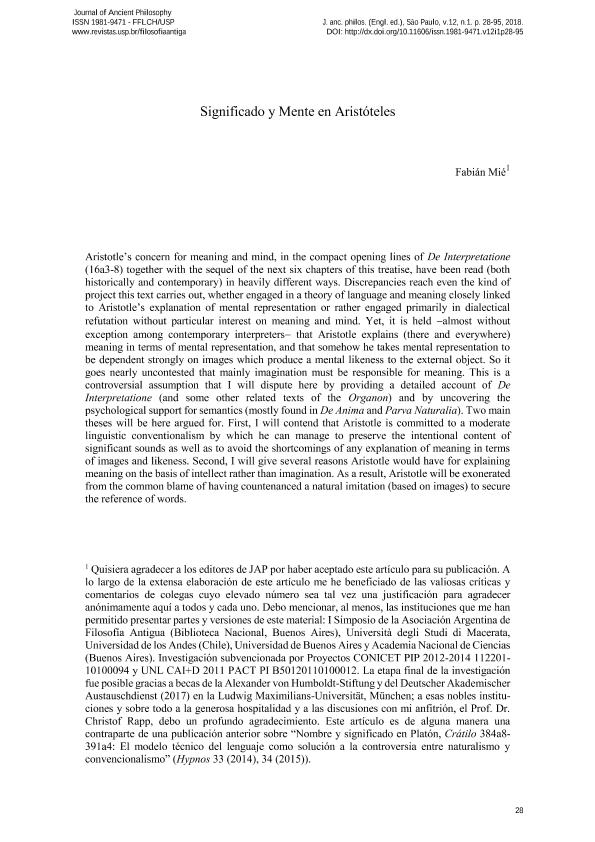
Aristotle’s concern for meaning and mind, in the compact opening lines of De Interpretatione (16a3-8) together with the sequel of the next six chapters of this treatise, have been read (both historically and contemporary) in heavily different ways. Discrepancies reach even the kind of project this text carries out, whether engaged in a theory of language and meaning closely linked to Aristotle’s explanation of mental representation or rather engaged primarily in dialectical refutation without particular interest on meaning and mind. Yet, it is held -almost without exception among contemporary interpreters- that Aristotle explains (there and everywhere) meaning in terms of mental representation, and that somehow he takes mental representation to be dependent strongly on images which produce a mental likeness to the external object. So it goes nearly uncontested that mainly imagination must be responsible for meaning. This is a controversial assumption that I will dispute here by providing a detailed account of De Interpretatione (and some other related texts of the Organon) and by uncovering the psychological support for semantics (mostly found in De Anima and Parva Naturalia). Two main theses will be here argued for. First, I will contend that Aristotle is committed to a moderate linguistic conventionalism through which he can manage to preserve the intentional content of significant sounds as well as to avoid the shortcomings of any explanation of meaning in terms of images and likeness. Second, I will give several reasons Aristotle would have for explaining meaning on the basis of intellect rather than imagination. As a result, Aristotle will be exonerated from the common blame of having countenanced a natural imitation (based on images) to secure the reference of words.
dc.format
application/pdf
dc.language.iso
spa
dc.publisher
FFLCH/USP
dc.rights
info:eu-repo/semantics/openAccess
dc.rights.uri
https://creativecommons.org/licenses/by-nc-sa/2.5/ar/
dc.subject
MEANING
dc.subject
MIND
dc.subject
INTELLECT
dc.subject
IMAGINATION
dc.subject.classification
Filosofía, Historia y Filosofía de la Ciencia y la Tecnología
dc.subject.classification
Filosofía, Ética y Religión
dc.subject.classification
HUMANIDADES
dc.title
Significado y Mente en Aristóteles
dc.type
info:eu-repo/semantics/article
dc.type
info:ar-repo/semantics/artículo
dc.type
info:eu-repo/semantics/publishedVersion
dc.date.updated
2019-10-25T18:02:10Z
dc.journal.volume
12
dc.journal.number
1
dc.journal.pagination
28-95
dc.journal.pais
Brasil
dc.journal.ciudad
Sâo Paulo
dc.description.fil
Fil: Mie, Fabian Gustavo. Universidad Nacional del Litoral. Instituto de Humanidades y Ciencias Sociales del Litoral. Consejo Nacional de Investigaciones Científicas y Técnicas. Centro Científico Tecnológico Conicet - Santa Fe. Instituto de Humanidades y Ciencias Sociales del Litoral; Argentina
dc.journal.title
Journal of Ancient Philosophy
dc.relation.alternativeid
info:eu-repo/semantics/altIdentifier/doi/https://doi.org/10.11606/issn.1981-9471.v12i1p28-95
dc.relation.alternativeid
info:eu-repo/semantics/altIdentifier/url/http://www.revistas.usp.br/filosofiaantiga/article/view/143866
Archivos asociados

Tamaño:
823.5Kb
Formato:
PDF